Technical Workshop on “Greenhouse Gas - Air Pollution Interactions and Synergies (GAINS) Indo-Gangetic Plain (IGP) Model to support IGP Regional and State Air Quality Management Planning”
The food system is one of the most significant sources of greenhouse gas emissions on the planet, making the reduction of emissions in this sector a priority for policymakers around the world. IIASA researchers explored the potential of carbon sequestration on farmland to combat climate change, offering insights into economic effects as well as its climate change mitigation potential.
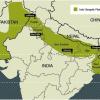
Air Quality Management in the Indo-Gangetic Plain and Himalayan Foothills (GAINS-IGP-HF)
In a new addition to the Atlas of Demography – an interactive tool by the European Commission’s Joint Research Centre (JRC) – IIASA researchers (as part of the SPARCCLE project) have released an in-depth analysis of regional variations in socioeconomic vulnerability across the EU, highlighting how demographic, health, and socioeconomic factors shape the capacity of populations to withstand climate extremes.

Macroeconomic Effects of Digitalization in Austria (W4.0)
IIASA Director General John Schellnhuber will be a guest speaker at an upcoming online event, showcasing how mid-sized African businesses are at the forefront of driving a sustainable, green future.
For over 45 years, the IIASA Young Scientists Summer Program (YSSP) has offered opportunities for PhD students to learn about systems analysis and hone their professional skills at IIASA. As this year’s summer term comes to an end, IIASA science writer Vladimir Tarakanov interviewed Amrutha G.S., 2024 YSSP participant and Kirit Parikh Fellow, to learn more about her experiences at the Institute this summer.
Our institute is happy to be part of the NASA Space Apps Challenge - the world's largest mass collaboration, inspiring creative minds of all backgrounds & skill levels to tackle real-world problems using space data, both on Earth and beyond!
The Forest Policy Modeling Forum, taking place on 18-19 September, brings together policymakers and modelers at the EU and Member State level to discuss ex-ante modeling needs and support forest policy for a better climate, improved biodiversity, and a striving bioeconomy across the EU.
The IIASA Climate Champions initiative will begin with its first workshop on 2 October covering the topic of climate change, climate resilience, and climate justice. Almost 30 students from Vienna and Lower Austria will participate.
Be part of the exciting launch of WorldCereal's advanced processing system for field-scale cropland and crop type mapping. Join our webinar on October 17, 2024, to explore the WorldCereal cloud-based processing system, the Reference Data Module, the possibilities to train and implement crop type models and future extensions.
SAbERES: Supporting climate change adaptation for small-scale producers in Mexico
IIASA researchers contributed to a new study showing that to sustain even a basic standard of living for everyone, we need to dramatically change our economic systems and technologies. The research highlights the need to fairly manage, use, and share critical resources to ensure both people and the planet can thrive.

Nicole Rohde
Research Assistant (ASA)

Adam Charette-Castonguay
Guest Research Scholar (IBF)
We are excited to introduce a new tool that exemplifies the Institute’s belief that science thrives on global cooperation: the IIASA Country Collaboration Dashboard. Whether you're an IIASA Council member, a researcher, a policymaker, or simply interested in IIASA’s work, this dashboard provides valuable insights into our collective efforts.
We are excited to announce that on Saturday, 5 October, IIASA will open its doors to the Laxenburg community as part of the Laxenburg Open Door Day with various other local institutions and associations. From 15:00-19:00, we will offer our neighbors the unique opportunity to explore Schloss Laxenburg, a place rich in history and significance. Please note that as the tours will cater to local residents, they will be conducted in German.
The IIASA Country Collaboration Dashboard provides a comprehensive view of the past five years of collaboration between IIASA and its various member countries. Whether you're an IIASA Council member, a researcher, a policymaker, or simply interested in IIASA’s work, this dashboard provides valuable insights into our collective efforts. Click on the links below to start exploring.
As an IIASA National Member Organization, the Iran National Science Foundation is hosting a series of webinars featuring distinguished experts from the Institute. The aim of the webinar series is to promote the systems analysis approach in addressing significant national and global research challenges.
IIASA Advancing Systems Analysis Program is convening a session at the Science Summit during the 79th session of the United Nations General Assembly (UNGA79) to discuss a new global security framework grounded in a science-informed understanding of both social and biophysical realities.