
The BLOOM project investigates how ecosystem conservation can help prevent the emergence of zoonotic diseases (such as Ebola) by reducing the risk of disease spillovers from wildlife to humans. This interdisciplinary initiative combines ecological, epidemiological, economic, and justice-focused modeling within a One Health framework that treats human, animal, and environmental health as interconnected.
As pressures from deforestation, habitat loss, climate change, and land-use change intensify, the risk of new outbreaks grows—especially in regions where ecological disruption brings humans into closer contact with wildlife. But these processes also create complex ripple effects: changes in land use and forest cover can alter species interactions, influence reservoir host behavior (such as bats), and increase the risk of spillover events. The BLOOM project is designed to assess these dynamics holistically, exploring the potential of spillover prevention—via conservation and land-use policy—and whether it can be a cost-effective solution in addition to reactive public health responses after outbreaks occur.
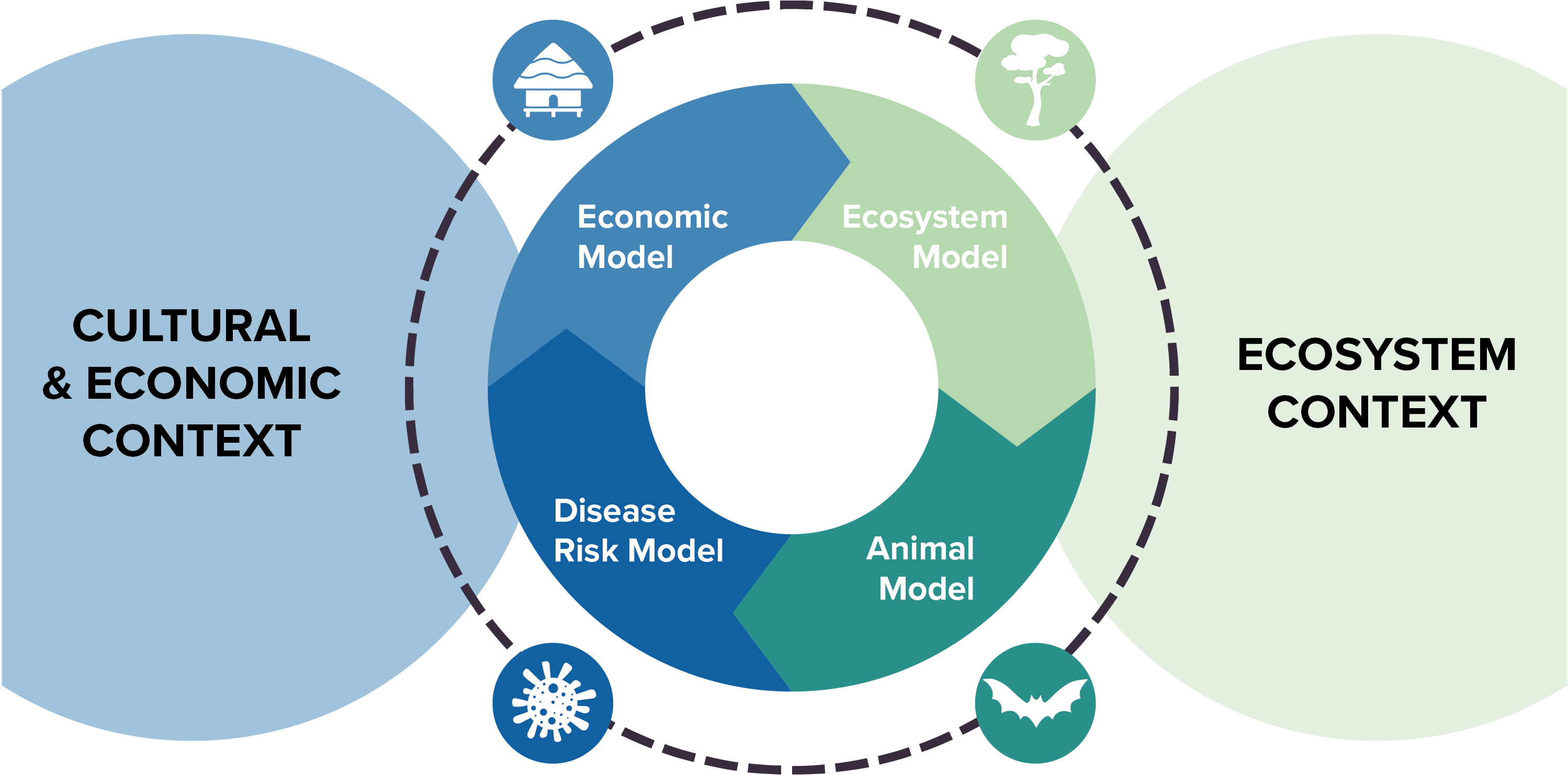
To address this challenge, BLOOM is developing an integrated modeling framework that links:
- Ecosystem dynamics (e.g., forest structure, biodiversity)
- Zoonotic disease risk (e.g., spillover from reservoir hosts like fruit bats)
- Socio-economic behavior and land-use decisions
- Governance, justice, and policy feasibility
Through advanced modeling tools (e.g., PlantFATE), BLOOM links ecosystem dynamics, bat ecology, and human land-use decisions to simulate how different conservation and development pathways affect disease risk. The project also explicitly incorporates socio-economic behavior, stakeholder values, and governance realities to ensure that its recommendations are equitable, grounded in justice, and feasible in diverse policy contexts.
By integrating these perspectives into one decision-support framework, BLOOM enables more informed and locally grounded policy options that protect public health while maintaining ecosystem services and biodiversity. Importantly, BLOOM embeds a justice and stakeholder engagement component, ensuring that solutions are not only scientifically sound but also socially acceptable, equitable, and feasible in context.
Our goal is to support data-informed, co-beneficial policies that shift from reactive crisis management to proactive, systems-based prevention—protecting both public health and ecosystem resilience.
 © Elisa Stefaniak
Case Study: Ebola Risk in West Africa
Our initial focus is on the spillover risk of Ebola Virus Disease (EVD) in Sierra Leone, a region where rich biodiversity, deforestation, and human–wildlife interactions converge in ways that elevate public health risk. Using ecological, climate, and socio-economic data, BLOOM models how habitat change affects the distribution and behavior of fruit bats, the likely reservoir hosts of EVD.
By integrating ecosystem models with a spatially explicit disease risk model, we aim to identify high-risk areas and simulate how alternative land-use strategies—from agroforestry to rewilding—might reduce spillover potential. This case study also incorporates local justice narratives and policy contexts, enabling us to test how conservation-oriented strategies align with livelihoods, governance frameworks, and climate adaptation priorities.
Ultimately, the West Africa case study serves as a prototype for scaling BLOOM’s modeling approach to other zoonotic diseases and regions facing similar biodiversity-health trade-offs.
Project Output
BLOOM will deliver both scientific insights and practical tools for decision-makers. Key outputs include:
- An integrated modeling framework that links ecosystem function, reservoir host dynamics, land-use decisions, and spillover risk under different climate and development scenarios.
- Spillover risk maps identifying ecological and socio-economic hotspots for EVD emergence, with potential applications for surveillance and planning.
- Policy scenarios and justice-informed narratives, co-developed with stakeholders, to explore the feasibility and trade-offs of conservation interventions.
- Peer-reviewed publications across ecology, epidemiology, economics, and governance fields.
- A policy brief translating scientific findings into actionable recommendations for public health and environmental policy.
- Open-access tools and datasets supporting replication, adaptation, and application in new regional contexts.
These outputs aim to empower policymakers, researchers, and local institutions with evidence-based options that reduce disease risk while promoting biodiversity, equity, and resilience.
Interactive stakeholder map
As part of Work Package 1 (Governance, Justice and Policy), team members Juliette Martin and Christopher Wong conducted a stakeholder mapping exercise. The mapping aimed to identify organisations and institutional actors relevant to land-use change, biodiversity conservation, and zoonotic disease risk in Sierra Leone, in line with the project’s objectives.
The full report of Milestone 1.1 and a link to an interactive stakeholder map in kumu.io can be found in the links below.
Collaborate with Us
We are actively seeking collaborators who share our commitment to integrated, locally grounded solutions.
We welcome contributions in:
- Policy insight and science-policy engagement
- Ecological, biodiversity, or land-use data
- Local economic, agricultural, or migration knowledge
In return, we offer:
- Co-authorship on scientific and policy outputs
- Visibility through IIASA platforms and outreach
- Support for collaboration through programs like:
Download the BLOOM Project Brief (PDF)
Download the Interaction Festival Poster (PDF)
Interested in collaborating? Contact:
- Elisa Stefaniak – [email protected]
- Michael Freiberger – [email protected]
Project Team
The bloom project combines work in the field of ecosystem function and socioeconomics with both modelling and stakeholder engagement activities. To account for this the work will be undertaken by a diverse group of researchers from four research programs and led by Elisa Stefaniak with background in environmental sciences and plant ecophysiology, and Michael Freiberger, an economist with background in health and environmental economic work.

Elisa Stefaniak
Research Scholar (BEC)

Michael Freiberger
Research Scholar (EF)

Juliette Martin
Research Scholar (BEC, EQU)

Christopher Wong
Researcher (EQU)

Stefan Wrzaczek
Senior Research Scholar (EF)

Piotr Zebrowski
Research Scholar (EM, SYRR)

Gemma Gerber
Research Scholar (BEC)
Related projects and models


News

Annual Report 2025
Annual Report 2025: Strategic Initiatives Program Highlights
Throughout 2025, the Strategic Initiatives (SI) Program continued to foster close collaboration with IIASA’s National and Regional Member Organizations, supporting targeted, solution-oriented research aligned with national and global priorities.

03 April 2025
Celebrating Research on Health at IIASA; World Health Day 2025
Researchers at IIASA are studying the direct and indirect effects of climate change on health, shedding light on healthy aging drivers and metrics and analyzing interconnections between the components of multi-dimensional national well-being.