Schoolchildren are the stakeholders that will be benefit from the city not only for today, but also for a long time in the future. As such it is crucial to include them in designing their environment. They have a fresh eye on spotting the issues and can think creatively and at the same time critically to come up with ideas to develop their environment. Hop & Mop project is aimed to work with the schoolchildren to design mini-block prototype in the streets near their schools.
IIASA Science Diplomacy Director and Head of Communications and External Relations, Susie Kitchens, will represent IIASA in New York during the UN General Assembly High-level Week 2026 and Science Summit 2026, two major international forums bringing together leaders from government, the UN system, science, and other sectors to address shared global challenges.
The University of Salzburg will welcome representatives of IIASA and the Austrian IIASA Committee for a day dedicated to scientific exchange, dialogue, and exploring future opportunities for collaboration with IIASA.
How can citizen science help us better understand and monitor the carbon stored in urban trees? This seminar will introduce Tree-Quest, a mobile app for collecting measurements of individual trees, and present results from its 2026 pilot campaign in Austria.
G/ArtenLeben
IIASA Director General Hans Joachim (John) Schellnhuber will deliver a keynote address at the Joint Preparatory Meeting of the 32nd OSCE Economic and Environmental Forum, which focuses on the role of emerging technologies and science-based diplomacy in strengthening security and stability across the OSCE region.
Join us as IIASA celebrates the Postdoc Appreciation Week (PAW) Austria – a national collaborative initiative that unites researchers, research institutions, postdoc office coordinators, and research managers to celebrate and recognize the outstanding contributions of postdoctoral researchers across Austria.
The reappearance of Budapest's “Rock of Starvation” is a visible sign of a drought months in the making. IIASA researchers have traced its progression from missing rainfall and parched soils to exceptionally low flows across the Danube basin.
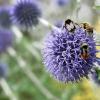
How can private gardens help support biodiversity in Austria? The new IIASA citizen science project G/ArtenLeben brings science and gardening practice together. At three G/ArtenCafés in Lower Austria, hobby gardeners are invited to contribute their knowledge and experience to research and work alongside scientists to explore how gardening can help biodiversity thrive.
IIASA Deputy Director General Karen Lips and Senior Research Scholar Elina Brutschin will participate in the European Forum Alpbach 2026, contributing IIASA expertise to discussions on decision-making under uncertainty and integrated approaches to urban climate transformation.
In an interview with Austria's ORF, IIASA researcher Daniel Huppmann explained how the country's current heat extremes align with decades of climate science and what they mean for Austria's future.
As Austria experienced record-breaking temperatures on 4 August 2026, with more than 50 weather stations reporting all-time highs, IIASA Director General Professor Hans Joachim Schellnhuber joined Austrian public radio Ö1's Mittagsjournal to discuss what these extremes mean for the future, as well as why society must prepare for a much hotter climate.
Participants in the inaugural Raiffa Academy return to universities, governments and international organizations with new tools, new collaborators and shared approaches.
Citizen science is changing how research is done, but fragmented platforms and tools continue to limit its potential. Through the Horizon Europe-funded RIECS-Concept project, IIASA is helping to lay the foundations for a pan-European research infrastructure that will connect citizen science efforts across Europe and strengthen their scientific and societal impact.
Day two at the Raiffa Academy: IIASA Journalist-in-Residence Lisa Palmer on decision-analysis tools that navigate scientific uncertainty, competing interests and the realities of negotiation under pressure.
Lisa Palmer reflects on the Raiffa Academy which opened with a premise that many global challenges suffer from failures in decision-making, negotiation and implementation, not a lack of data.
Climate change does not affect everyone equally. Vulnerability to extreme heat is shaped by a combination of conditions in which people live and work. If climate adaptation is to reduce vulnerability rather than simply manage its consequences, it must address the underlying conditions that create vulnerability. This is particularly relevant for workers, whose experiences remain a major blind spot in climate adaptation despite their essential role in providing the goods and services society depends on.
Students from Lower Austria and Vienna were recognized for their commitment to climate action and received their certificates at IIASA in Laxenburg.
Under the leadership of IIASA Director General Hans Joachim (John) Schellnhuber, the Science and Timber Construction Alliance (SITCA) was officially launched today. The initiative aims to transform the construction sector into a driver of climate protection through sustainable forest management and modern timber construction.
On 26 June 2026, the Austrian IIASA Committee gathered at the Austrian Academy of Sciences in Vienna for its 100th session – an afternoon focused on systems, science diplomacy, and the question of how to fit an entire world into a model.