
With intensifying climate-related risks deepening existing injustices across and within countries, it is paramount to center justice considerations in climate risk management research and practice. Earlier in December, around 50 participants worked intensely on this topic at a highly interactive three-day conference at IIASA to exchange expertise and develop concrete ideas and next steps.
As climate-related risks continue to intensify, their impacts are not distributed equally. Some communities face far greater threats than others while being equipped with little resources for dealing with these risks. This imbalance is deepening existing injustices and pushing regions around the world closer to the limits of adaptation on various levels.
Against this backdrop, the 2025 INQUIMUS interactive conference, hosted by the IIASA Equity and Justice (EQU) Research Group, set out to explore how justice considerations can be centered in climate risk management, and adaptation endeavors in research and practice. The conference brought together around 50 participants, ranging from early-career to senior researchers, as well as practitioners engaged in inter- and transdisciplinary work. Professional facilitators, trained in the Art of Hosting, introduced engaging interactive formats where participants could dive into the topics and discussions.
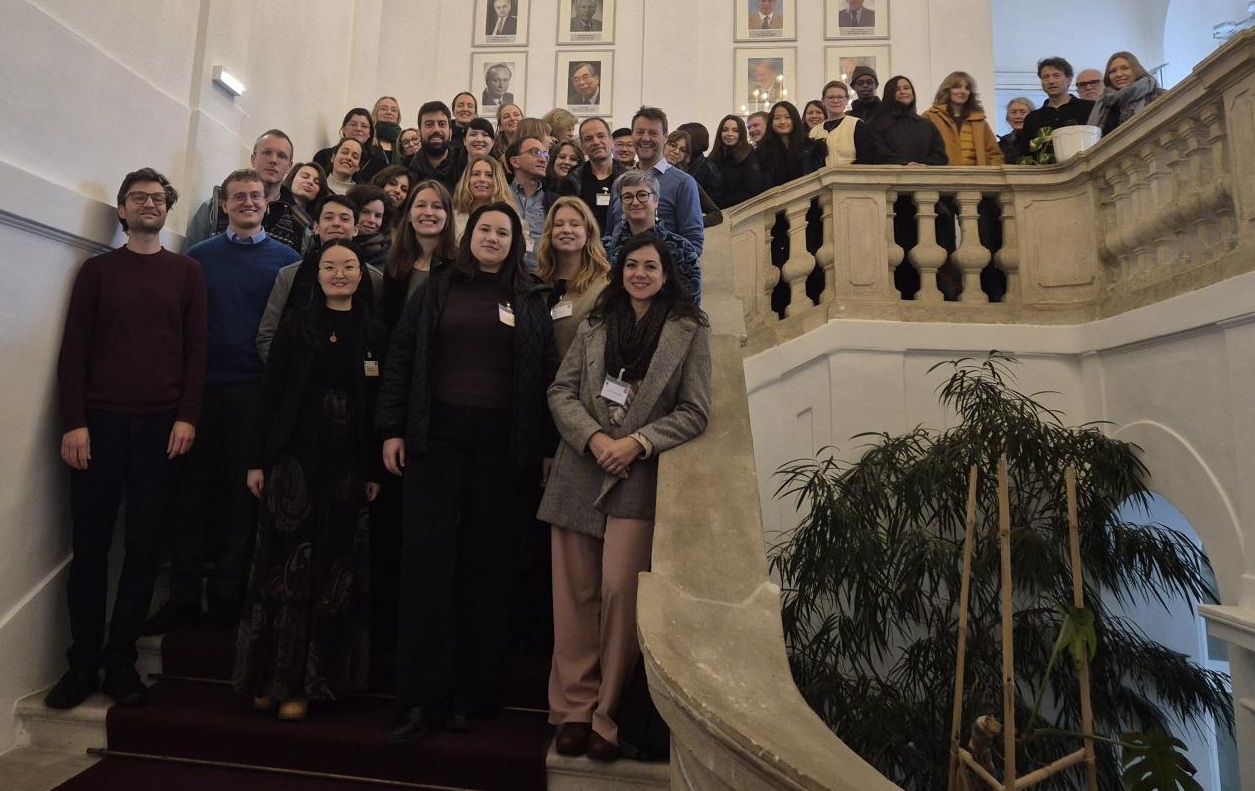 © IIASA
Group photo of the conference participants.
INQUIMUS is a workshop series initiated by the Department of Geoinformatics – Z_GIS at the University of Salzburg, Austria and EURAC Research in 2014 to integrate quantitative and qualitative assessment methodologies for complex and multidimensional phenomena like vulnerability and resilience. IIASA is one of the partner institutes, alongside the United Nations University (UNU EHS) and GeoSphere Austria. Hosted by IIASA this year, we also had the kind support and participation of our member organizations, including the Sub-Saharan Africa Regional Member Organization (SSARMO) and Egypt.
State-of-the-art talks
INQUIMUS 2025 featured three inspiring state-of-the-art (SOTA) talks from Ana Terra Amorim Maia (Basque Centre for Climate Change, Spain), Shalini Dhyani (CSIR-National National Environmental Engineering Research Institute, India), and Lisa Schipper (University of Bonn, Germany).
In the first talk, Ana explained the multiple dimensions of environmental justice (recognitional, procedural, and distributive) while also highlighting alternative conceptualizations. She emphasized the importance of intersectionality and its links to justice, illustrating her points with an ongoing project on city-level adaptation, as well as co-creating adaptation imaginaries and indicators with communities.
The second day started with Shalini’s talk, where she explored the disproportionate impacts of climate risks and biodiversity loss on those who have contributed least to these crises, highlighting systemic injustices as root causes. She further showcased approaches to integrate diverse knowledge systems, including indigenous knowledge and local capabilities, drawing on examples from her work across India.
Finally, Lisa turned the focus to global governance, examining international processes such as the Intergovernmental Panel on Climate Change (IPCC) and their limitations in addressing justice in the context of climate adaptation. She introduced the concept of maladaptation, showing how certain adaptation pathways can unintentionally produce harmful outcomes, and challenged the scientific community to reflect on its role in reinforcing maladaptive outcomes.
Together, these talks offered a comprehensive overview of state-of-the-art thinking on justice in climate risk management and the complexities of climate adaptation, which sparked thought-provoking and rich discussions among participants.
Insights from the discussions
Following the SOTA talks, participants further explored the themes in engaging interactive sessions including Deep Dives, poster discussions, and Open Space.
In the Deep Dive sessions, participants reflected on questions such as how the INQUIMUS 2025 experience changed their perspective on justice, how justice could be better integrated into their work, and what this means for scientists and practitioners more broadly. These conversations highlighted the importance of reflexivity, being explicit about the concepts of justice we use, trust-building with communities, and making justice more accessible and understandable for those we engage with.
The poster session offered a space for participants to present their work in small groups, discuss insights from the first two days, and receive peer feedback. Key takeaways included the need for clearer language around justice, the challenges of operationalizing justice aspects in risk assessments, and the recognition that quantifying adaptation does not automatically make it objective.
On the last day, an Open Space session allowed participants to co-develop ideas for mainstreaming justice in climate risk management, addressing questions and problems such as: a) Which methods exist for analyzing justice and justice preferences?, b) How can we better understand root causes and integrate justice into models and quantitative approaches?, c) How do vulnerability and intersectionality interact as concepts, d) How do we measure/integrate justice into evaluation frameworks?, or e) How can we convince interdisciplinary project teams to consider justice in our research project?
Groups were formed to continue working on these questions, sharing methods and resources and determining concrete follow-up steps. Yet, the most pressing question across all discussions remained: How can we stay connected?
Conclusion and next steps
The conference highlighted that justice aspects need to be placed at the center of managing climate-related risks, rather than treated as an add-on in climate risk management research and practice. INQUIMUS brought together people from diverse disciplines who share a commitment to incorporating justice more explicitly in their work and further strengthening the existing community. The interactive formats fostered an open and welcoming space for reflection, critical exchange, connection, as well as enabling participants to explore new ideas and concrete next steps.
What’s next? IIASA’s EQU team will invite this year’s INQUIMUS participants to a follow-up online workshop in 2026 to co-design a pathway towards a Community of Practice for Centering Justice in Climate Risk Management.
State-of-the-Art Lecture Slides
Beyond Risk Management: Centring Justice for Transformative Climate Futures
The Maladaptation of Adaptation Research, Policy and Practice
Note: This article gives the views of the authors, and not the position of the Nexus blog, nor of the International Institute for Applied Systems Analysis.