

In January, the Laxenburg Education Campus became a gathering place for curious minds, engaged citizens, and local forward-thinkers. In cooperation with IIASA, the Municipality of Laxenburg hosted the opening of the exhibition Climate & Me, welcoming visitors interested in sustainability.
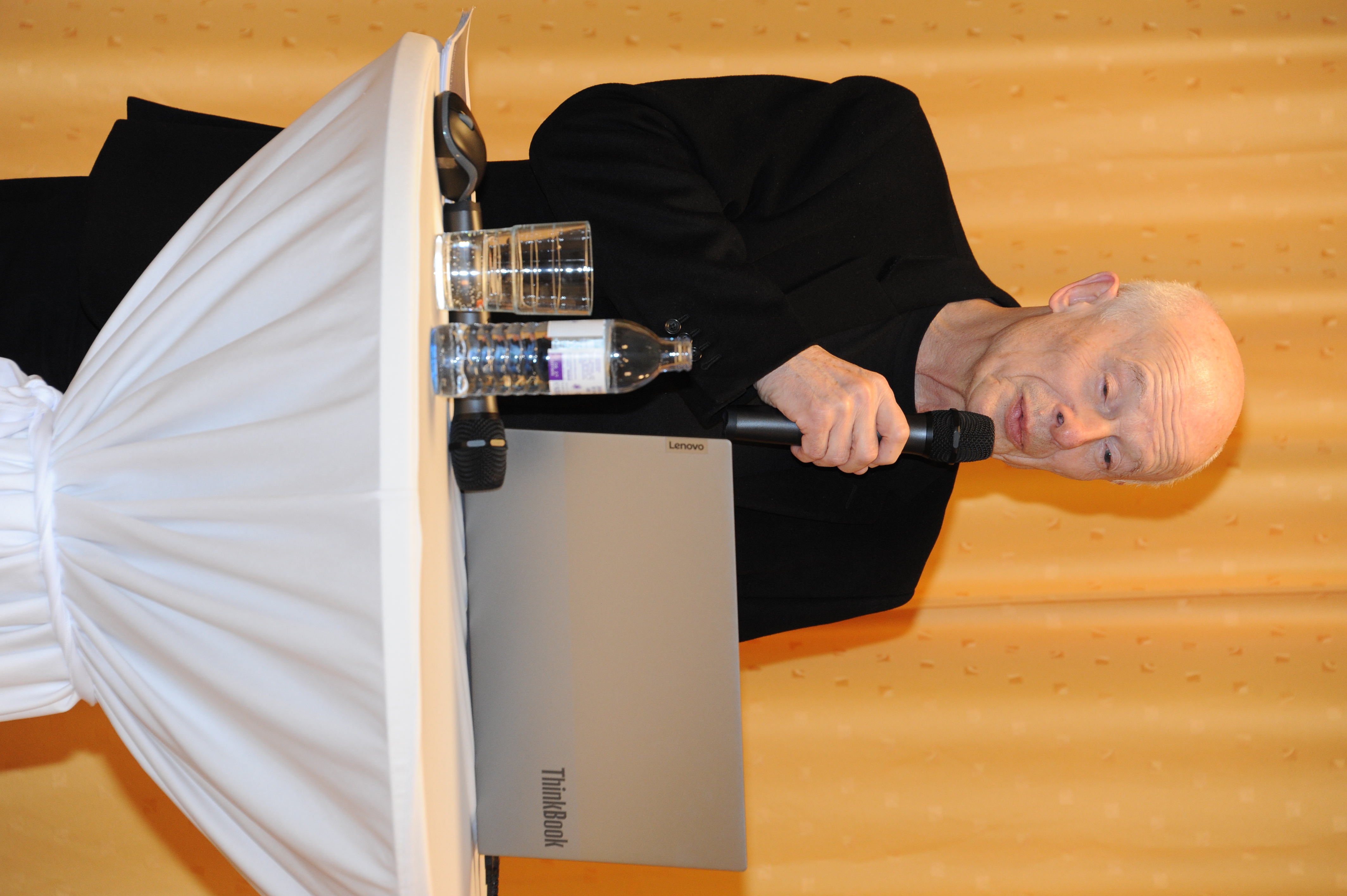
The event opened with remarks by Mayor David Berl and Environmental Councilor DI Andreas Weiß, followed by perspectives from both research and practice. A particular highlight of the evening was the keynote, The Beautiful Transformation, delivered by IIASA Director General Hans Joachim (John) Schellnhuber.
A personal opening and words of appreciation
Schellnhuber began on a personal note, thanking the organizers for the invitation and commending the education campus as a “remarkable and ambitious project.” His remarks underscored the close relationship between internationally oriented research and local initiatives, an interaction that has long been central to IIASA’s presence in Laxenburg.
Laxenburg as a space for science diplomacy
Turning to the current geopolitical context, Schellnhuber emphasized the growing importance of IIASA’s role in an increasingly fragmented world. As a pioneer of science diplomacy, IIASA provides a neutral and protected space in Laxenburg where researchers from countries including Iran and Israel, Russia and Ukraine, the United States and China collaborate on shared challenges. By enabling dialogue and cooperation across political divides, the Institute helps build trust and develop solutions grounded in scientific evidence.
This international collaboration highlights Laxenburg not only as a historic location, but also as a place actively contributing to global futures.
 © Thomas Valka
Seeing the climate crisis
Using humor and vivid imagery, Schellnhuber addressed the climate crisis in relatable terms, drawing a comparison to the film Don’t Look Up. Unlike the sudden threat portrayed in the movie, he noted, the climate crisis unfolds gradually and is therefore easier to ignore.
To illustrate this, he shared a personal experience from a flight over Greenland. As the plane passed over the landscape, Schellnhuber looked out of the window and observed open water where solid ice had once been. He noticed that he was the only passenger doing so; the others were focused on their screens. The anecdote served as a powerful reminder of how easily profound environmental change can go unseen and of the need to pay closer attention to the world around us.
The beautiful transformation: nature as a model
Despite the urgency of climate change, Schellnhuber’s message was ultimately optimistic. He argued that solutions lie not only in technological innovation, but also in learning from natural processes that have sustained life for billions of years. Photosynthesis, which removes CO₂ from the atmosphere while producing oxygen, offers a model that can be applied more systematically.
He outlined a vision of buildings designed as carbon sinks, using timber instead of concrete and renewable materials instead of finite resources. The Laxenburg Education Campus (Bildungscampus) itself served as a tangible example: constructed largely from wood, it demonstrates how climate-conscious design can be implemented at scale.
“Laxenburg has shown what’s possible – the world needs to follow,” Schellnhuber said, capturing his message in a concise phrase: Saving the world in style.
Climate action as a cultural project
In closing, Schellnhuber emphasized that climate action extends beyond technology and data. It also involves questions of lifestyle, design, and shared responsibility. Addressing climate change successfully will require coordinated efforts across policy, business, and everyday life, bringing scientific insight together with cultural change to shape a sustainable and livable future.
News
15 October 2026
IIASA strengthens science diplomacy ties at UNGA in New York
IIASA Science Diplomacy Director and Head of Communications and External Relations Susie Kitchens represented the Institute at the United Nations General Assembly (UNGA) High-level Week and Science Summit in New York in September, contributing to discussions on how science and international cooperation can help address shared global challenges.

13 October 2026
Connecting disciplines and inspiring new ideas with the Environment and Climate Research Hub
IIASA Deputy Director General Karen Lips delivered a keynote at the University of Vienna's recent Environment and Climate Research Hub (ECH) Research Frontiers Workshop in Bad Vöslau, Austria, emphasizing the importance of interdisciplinary collaboration in addressing complex environmental and climate challenges.
12 October 2026
Connecting science across borders: IIASA Committee meets University of Salzburg
How can universities and international research organisations work together to address the complex challenges of a changing world? This question shaped a full day of scientific exchange at the University of Salzburg on 6 October, when the Austrian IIASA Committee met with members of the University community to discuss research, collaboration and opportunities for researchers and students.