
ASA Program aims to discover, develop, and deploy new, more effective, and efficient ways of infusing systems science into policy and decision making for sustainable development.
Explore options to engage with ASA
The Advancing Systems Analysis (ASA) Program welcomes expressions of interest from researchers at all career stages who wish to collaborate with us in advancing data, methods, and models as well as inter- and trans-disciplinary research to tackle the complexity of pressing sustainability challenges. More information on options to engage with ASA.
Despite numerous success stories, many policies and decisions that currently aim to deal with global change are not sufficiently informed by cutting-edge science. Among the major barriers that prevent the effective input of science into policy are perceived shortfalls in agility, realism, and relevance of the current generation of methods and models from the standpoint of end users. To address these barriers, ASA strives to advance agile, realistic, and relevant systems analytical tools and methods, and facilitate a shared understanding of the capabilities and limits of these tools and methods with end users. Consequently, ASA’s efforts span the full range, from advancing research methods and tools of systems analysis to innovating at the interface between policy- and decision making, as well as with society at large.
ASA Program’s major objectives are:
- To innovate approaches and tools to analyze increasingly systemic, social-ecological risks and support decisions aimed at enhancing resilience and facilitating sustainability transitions and transformations.
- To further the capacity of agile, on-demand systems analysis underpinned by a suite of modeling frameworks of appropriate complexity.
- To mobilize multiple sources of data and the power of data science to diagnose and identify solutions to reduce vulnerabilities and risks.
- To advance feasible and effective ways of engagement with policymakers, the private sector, and citizens.
- To enhance trust and shared understanding of systems analysis methods and tools, in particular, through open science.


Projects
Open-Earth-Monitor Cyberinfrastructure (OEMC)

Transformations within Reach (TwR-II)
Staff

Piotr Zebrowski
Research Scholar (EM, SYRR)

Petr Pesov
Research Scholar (DOB-AT1) (CAT)

Linda See
Principal Research Scholar (NODES)

Kalle Parvinen
Guest Research Scholar (EM, CAT)
News

15 October 2026
MowingQuest system-test campaign 2026 concludes, data collection continues
IIASA’s MowingQuest citizen-science campaign has wrapped up its August–September 2026 system test, with 25 pioneer users submitting almost 800 observations across eight countries. The results will help improve the app and data-quality workflows ahead of the main 2027 campaign. Two participants have also won Garmin GPS watches in the campaign raffle.
06 October 2026
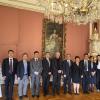
Nanjing University delegation visits IIASA to explore future collaboration
A high-level delegation from Nanjing University (NJU), led by Professor Tan Zhemin, President of NJU and Fellow of the Chinese Academy of Sciences, visited IIASA to discuss opportunities for strengthening scientific cooperation and advancing joint research on global challenges.

23 September 2026
IIASA researchers strengthen cooperation with Kyrgyzstan on AI and industrial development
IIASA Cooperation and Transformative Governance (CAT) Research Group Leader and Senior Research Scholar Nadejda Komendantova and CAT Research Scholar Dmitry Erokhin have contributed to a series of scientific and policy forums in Kyrgyzstan in 2026. Their research on artificial intelligence in the production sector builds on IIASA’s longstanding cooperation with the country on sustainable industrial development.
Events
Residence Palace, Brussels, Belgium
Final LAMASUS Conference
Barcelona, Spain
Open Earth Monitor Final Workshop 2026
Bali, Indonesia
IIASA at IDRiM 2026 in Bali
Focus
24 July 2026
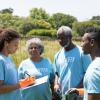
Citizen science and the politics of measuring sustainability
How we measure sustainability matters. In a new World View article published in Nature Sustainability, IIASA researcher Dilek Fraisl explores why citizen science and other participatory approaches should play a greater role in developing the indicators and methodologies that guide international action on climate, biodiversity, and sustainable development.

21 July 2026
One climate forecast, many online conversations
What happens when an El Niño forecast reaches social media? Drawing on two recent studies, IIASA researchers Dmitry Erokhin and Nadejda Komendantova explore how the same climate information is discussed differently across online platforms and why those differences matter for climate communication and resilience.