
Defining a safe operating space for water resources in a changing climate and society
 © www.sos-water.eu
Introduction
The SOS-Water Project endeavors to establish the boundaries within which the Earth’s capacity to provide life-support systems for humanity is not endangered, and humanity’s capacity to adapt to environmental changes is not exceeded.
An interdisciplinary team of researchers from eleven institutions across nine countries will develop a multidimensional SOS for water.
Overview
SOS-Water is a EU-funded project, started in October 2022, which aims to define a safe operating space (SOS) for water resources, accounting concurrently for all relevant water dimensions across multiple sectors and spatial scales under the influence of socio-economic, policy, technological, and climatic changes.
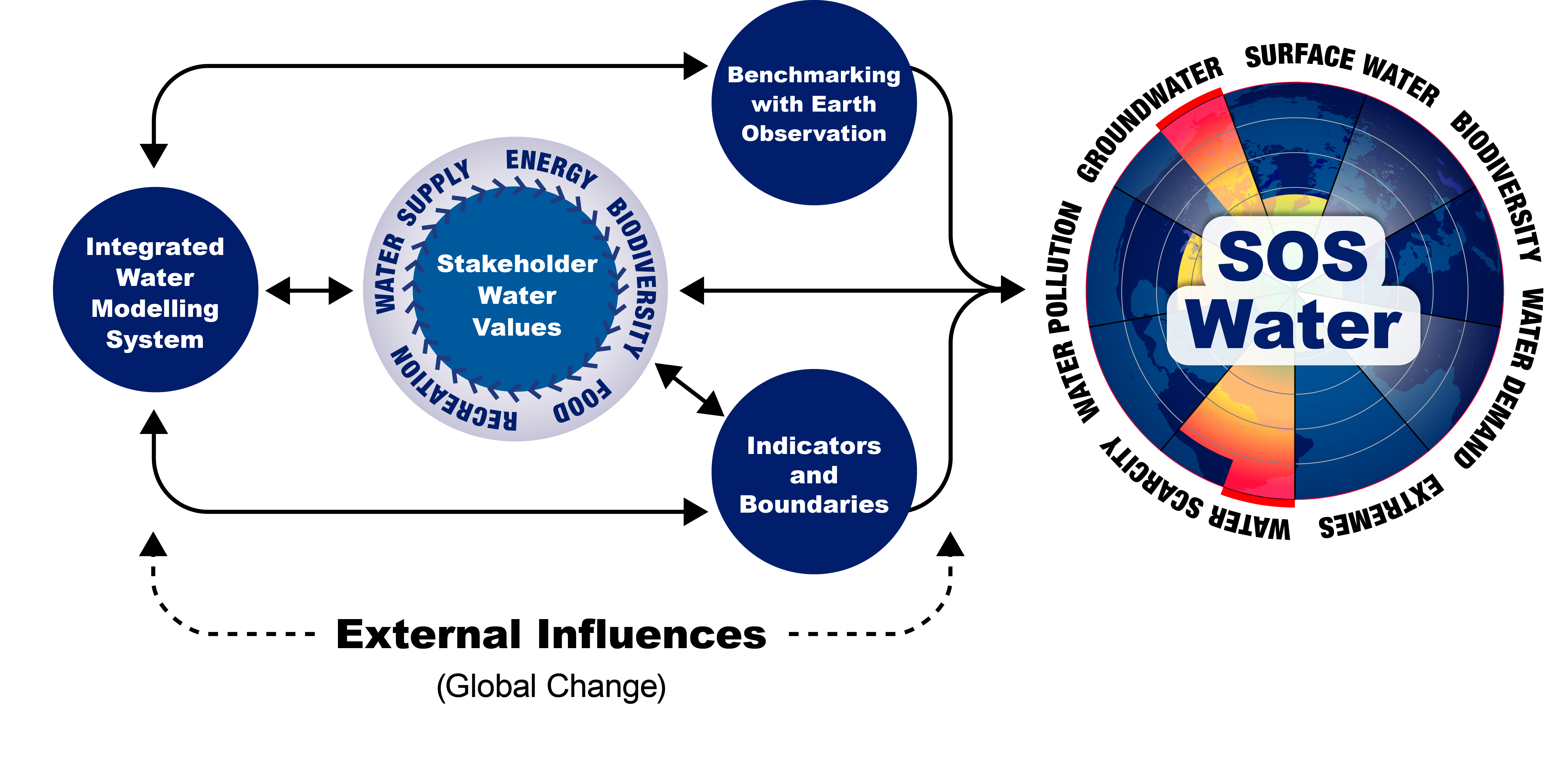
SOS Water seeks to understand the Safe Operating Space (SOS) of the entire water resources system based on integrated modelling, monitoring, advanced indicator development, and an inclusive stakeholders’ engagement based on true collaboration, including co-development of scenarios and management pathways.
 © SOS Water EU
In addition to going beyond state-of-the-art water systems modeling, the project will develop a comprehensive set of indicators to assess and monitor the environmental, social, and economic performance of water systems.
A strong emphasis will also be put on participatory research and inclusive stakeholder engagement.
The participating researchers will collaborate with regional and local authorities, water user representatives, non-governmental organizations, and citizens to co-create future scenarios and water management pathways.
By streamlining water planning at different levels, it can be ensured that water allocation among societies, economies, and ecosystems will be economically efficient, socially fair, and resilient to shocks.
 © SOS Water Consortium
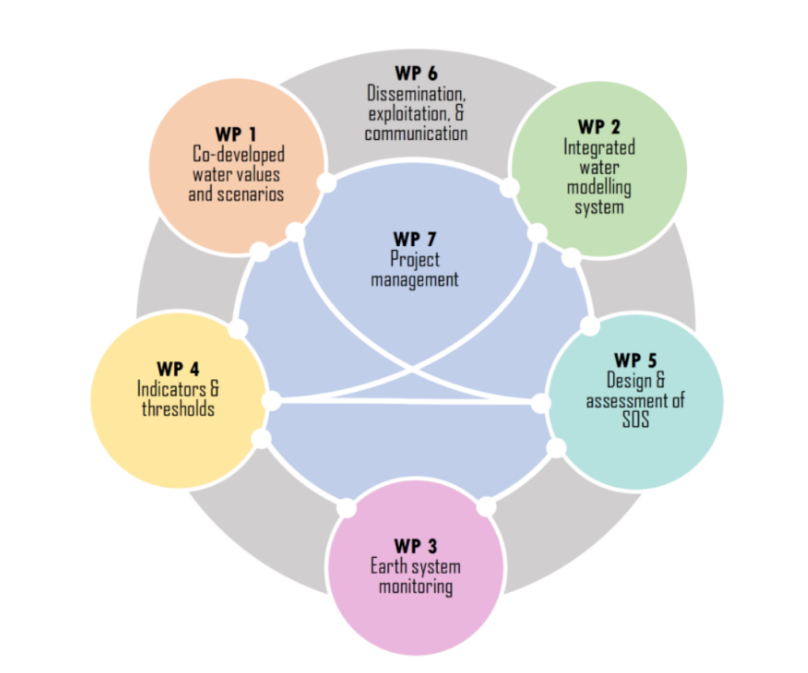
Work Packages
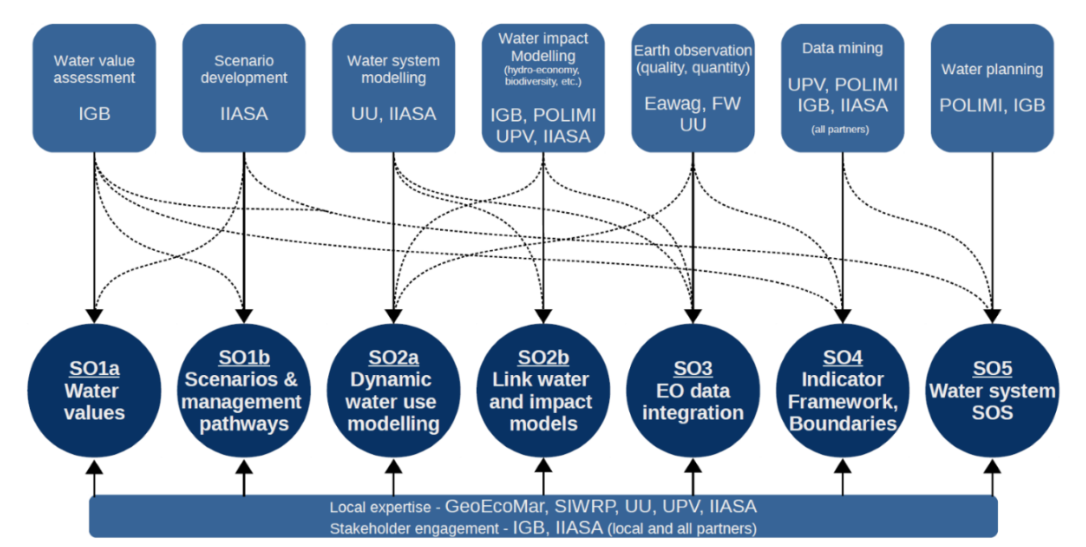
- WP1: Co-developed Water Values and Scenarios
focuses on establishing real-world applications and understanding stakeholder requirements, setting the stage for practical and impactful research. - WP2: Integrated Water Modelling System
involves developing advanced tools and models for water resource management, integrating data from various sources to create a comprehensive management framework. - WP3: Earth System Monitoring
aims to explore future scenarios impacting water systems, providing essential context for planning and decision-making. - WP4: Indicators and Thresholds
systematically assesses and develops a comprehensive range of water indicators to evaluate environmental, economic, and social dimensions of water systems. - WP5: Design and assessment of SOS
develops and applies the SOS concept, assessing water system performance across scenarios and identifying robust policies to mitigate vulnerabilities. - WP6: Dissemination, Exploitation, and Communication
ensures the project’s findings and innovations are effectively communicated to stakeholders, supporting widespread adoption and impact. - WP7: Project Management and Coordination
provides the administrative, financial, and strategic coordination necessary for the successful execution of the project, fostering collaboration and ensuring adherence to objectives.
 © SOS Water Consortium
SOS-Water Project Team
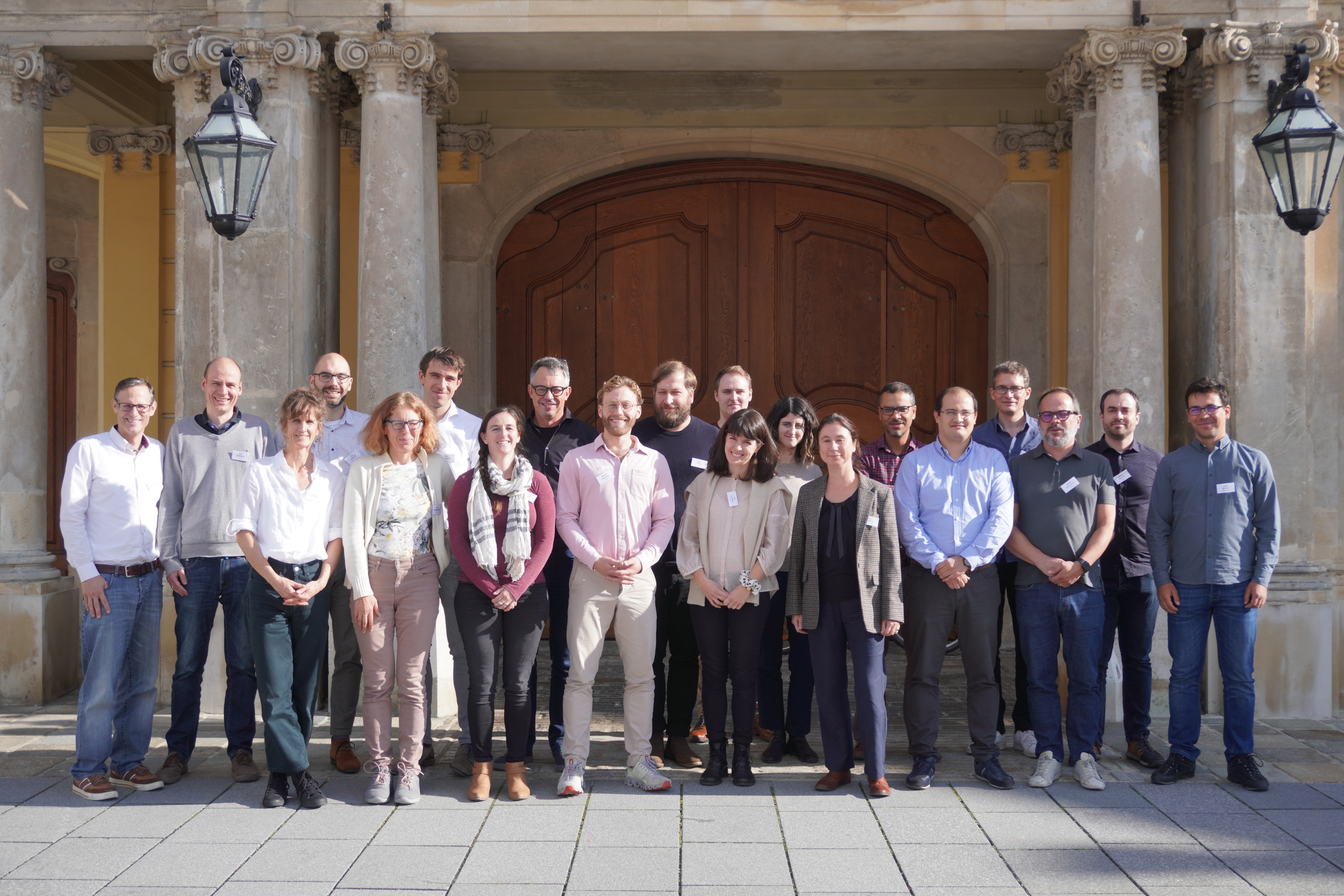
The Water Security research group at IIASA is the coordinator of the project consortium.
The consortium consists of the following partners:
- International Institute for Applied Systems Analysis (Austria)
- Universiteit Utrecht (The Netherlands)
- Universitat Politècnica de València (Spain)
- Politecnico di Milano (Italy)
- Forschungsverbund Berlin e.V. (Germany)
- FutureWater (The Nethrlands)
- Institutul National de Cercetare-Dezvoltare pentru Geologie si Geoecologie Marina (Romania)
- Southern Institute for Water Resources Planning (Vietnam)
- Eutema Research Services GmbH (Austria)
- Aalborg University (Denmark)
- Eidgenoessische Anstalt Fuer Wasserversorgung, Abwasserreinigung und Gewaesserchutz EAWAG (Swizerland)
 © SOS Water Consortium
IIASA Project Team

Taher Kahil
Research Group Leader and Senior Research Scholar (WAT)

Mikhail Smilovic
Research Scholar (WAT)
Peter Burek
Senior Research Scholar (WAT)

Sylvia Tramberend
Senior Research Scholar (WAT)
 © IIASA
IIASA models being used in this project
 © European Union
Further Information
 © SOS Water Consortium
News
01 October 2026
Where the waters meet: Connecting global limits and local water management
Human activity and climate change are putting growing pressure on water resources, disrupting the predictability of the water cycle, and changing the availability and quality of freshwater. IIASA researchers and partners have developed a new framework for guiding water management and planning at the river-basin level, derived from the existing Global Water Planetary Boundary.

31 January 2023
SOS Water Project featured in Die Presse
IIASA's Water Security Group Leader Dr Taher Kahil interviewed for Die Press
03 October 2022
Towards a safe operating space for water resources in a changing climate and society
The SOS-Water Project, funded under the Horizon Europe scheme and coordinated by IIASA, will create a holistic and participatory assessment framework of a Safe Operating Space (SOS) for the entire water resources system to inform global and regional water management policies and pathways.
Events
IIASA, Laxenburg, Austria and online
SOS-Water final conference: Defining safe operating spaces for water-resilient futures
IIASA, Laxenburg, Austria