


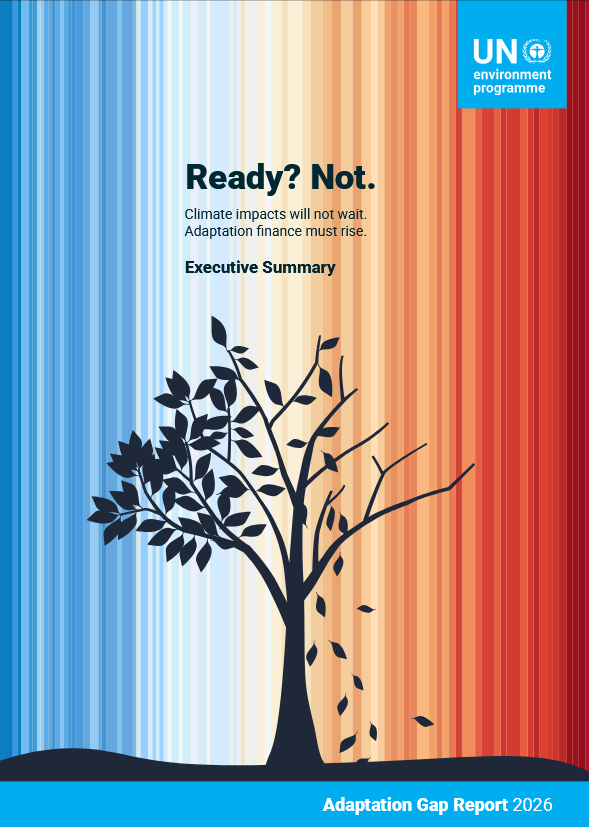
IIASA researchers contributed to the UNEP Adaptation Gap Report 2026, which warns that climate adaptation efforts and financing are failing to keep pace with accelerating climate impacts, leaving vulnerable countries increasingly exposed to losses and damages.
 © UNEP
The 13th edition of the United Nations Environment Programme (UNEP) Adaptation Gap Report, titled Ready? Not., finds that developing countries continue to face substantial shortfalls in adaptation finance, while institutional barriers hinder implementation. With global warming expected to exceed 1.5°C, adequately financed action is critical to strengthening resilience and reducing climate-related risks.
IIASA Systemic Risk and Resilience Research Group Leader Reinhard Mechler, and Dipesh Chapagain, a Guest Research Scholar in the same group, served as lead authors of chapters examining climate-related loss and damage and adaptation finance, respectively.
Chapagain, who is also affiliated with the United Nations University in Bonn, coauthored Chapter 2 on progress in adaptation finance. The report estimates that 155 developing countries will require approximately US$305 billion annually for adaptation over the coming decade, with estimates ranging from US$255 billion to US$328 billion per year. These figures largely exclude private sector adaptation needs, which could substantially increase the total. Needs are particularly high in least developed countries (LDCs) and small island developing states (SIDS), where combined annual requirements of around US$50 billion represent 3–4% of their gross domestic product (GDP), roughly twice the relative burden faced by upper-middle-income developing countries.
Meanwhile, international public adaptation finance flows from developed to developing countries have grown only marginally, raising concerns about progress towards the Glasgow Climate Pact goal of doubling adaptation finance relative to 2019 levels by 2025. The target could still be met, depending on financing developments in 2025. In contrast, South-South financial support channeled through multilateral development banks and bilateral and multilateral cooperation has increased substantially, from US$3.8 billion in 2019 to US$9.6 billion in 2024.
"The findings highlight a persistent mismatch between adaptation needs and available finance, particularly in the most vulnerable countries. Closing this gap will require greater international support and more accessible, predictable funding that enables countries to implement effective adaptation measures," says Chapagain.
Mechler co-wrote Chapter 4, which examines climate-related loss and damage and potential responses. As adaptation becomes more constrained, losses and damages are becoming increasingly systemic, unequal, and, in some cases, existential, particularly for vulnerable countries and communities.
He helped develop a practical assessment framework combining evidence on observed and projected losses and damages with considerations of climate justice and access to support. The framework links these findings to financing needs and helps guide policy responses.
The report also highlights the considerable shortfall in funding to address loss and damage. In the first funding round of the Fund for responding to Loss and Damage, requests totaling US$2.8 billion far exceeded the initial funding envelope of US$342 million. Estimates of annual loss and damage financing needs, including those developed by IIASA, run into the hundreds of billions of US dollars.
"Climate-related losses and damages are increasingly going beyond what adaptation can prevent. Our work provides a more systematic approach to assessing these impacts while accounting for questions of justice and access to support. This is essential for translating scientific evidence into effective policy responses and financing decisions. We hope the approach can be used by countries to this effect," Mechler concludes.
Further information
Read the full report
News
09 November 2026
From Barbados to London: Advancing science diplomacy and international cooperation
IIASA Science Diplomacy Director and Head of Communications and External Relations Susie Kitchens led a delegation to Barbados to explore opportunities for scientific collaboration in support of the country's economic transformation ambitions. The visit was followed by high-level engagements in London aimed at strengthening international research partnerships and IIASA's ties with UK institutions.

03 November 2026
IIASA hosts EARMA discussion on research management and professional development
On 21 October 2026, IIASA welcomed Harald Hasler-Sheetal, Board Member of the European Association of Research Managers and Administrators (EARMA), to its campus at Schloss Laxenburg to discuss professional development and exchange experiences with colleagues working in research management and administration.
28 October 2026
Vietnamese Provincial Delegation Visits IIASA to Explore Pathways for Sustainable Development
Representatives from two Vietnamese provincial governments visited IIASA in October to discuss opportunities for cooperation on sustainable development, climate resilience, and evidence-based policymaking.