
In 2025, IIASA reinforced its role as a trusted actor in science diplomacy by deepening engagement with international institutions and supporting research‑informed policy dialogue across global platforms.
The Institute maintained an active presence as an observer in major intergovernmental organizations, contributing to international policy dialogues and multilateral cooperation. It also expanded its global network through new cooperation agreements with partner institutions across countries including Australia, Burkina Faso, the Czech Republic, Egypt, Germany, Italy, Japan, Mexico, Vietnam, and Yemen, as well as with organizations such as the World Health Organization, the Pan American Health Organization, the European Commission, the Royal Society, and the Intergovernmental Science‑Policy Platform on Biodiversity and Ecosystem Services (IPBES), strengthening collaboration between the Global North and Global South and reinforcing joint research, policy engagement, and science diplomacy worldwide.

Advancing science diplomacy at international fora
At COP30 in Belém, IIASA reinforced its role in global climate discussions by contributing scientific insights. Researchers participated alongside a diverse international community of policymakers, scientists, and civil society actors, including strong representation from Indigenous groups highlighting their role in protecting biodiversity.
Beyond the climate arena, IIASA also strengthened its role in global biodiversity diplomacy by hosting the first author meeting of the IPBES Spatial Planning and Connectivity Assessment in Laxenburg. The meeting brought together experts from around the world to launch work on a major international assessment exploring how spatial planning can better integrate biodiversity conservation and human wellbeing into decision-making.
IIASA researchers involved in the Building resilience to floods and heat in the maternal and child health system in Brazil and Zambia (REACH) project, were invited to develop a background document for the Belém Health Action Plan, providing evidence on how to sustain maternal and child health services during climate-related shocks, such as floods and heatwaves, based on research in Brazil and Zambia.
The team presented these findings at the pre‑COP Global Conference on Climate and Health in Brasília, hosted by the World Health Organization, the Pan American Health Organization, and the Brazilian government, enhancing the science–policy interface. These engagements helped position the REACH project as a contributor to the implementation of the Belém Health Action Plan, which includes ongoing monitoring, reporting, and capacity‑building activities for climate-resilient health systems.
IIASA Engagement at the European Science Diplomacy Conference and in North Africa
At the 2nd European Science Diplomacy Conference in Denmark in December, IIASA Director General Hans Joachim (John) Schellnhuber delivered a plenary keynote highlighting IIASA’s legacy as a bridge across geopolitical divides. He underscored the growing importance of scientific cooperation in addressing global challenges and supporting international collaboration in an increasingly fragmented world. The conference, convened by the European Commission and partners, brought together policymakers, scientists, and diplomats to advance Europe’s global engagement. The discussions highlighted opportunities for continued engagement with European science diplomacy initiatives and strengthened IIASA’s visibility as a trusted partner for evidence-based international cooperation.
In parallel, IIASA deepened regional cooperation through a visit to Egypt led by Deputy Director General Karen Lips. Engagements with the Institute of National Planning and participation in the Innovation Research Commercialization Expo reinforced collaboration on systems analysis, water security, and sustainable development, further developing the North Africa Applied Systems Analysis Centre as a hub for regional scientific cooperation. The visit also supported follow-up discussions on future joint research activities, regional capacity building, and stronger links between North African institutions and the wider IIASA research network.
Together for water: Science diplomacy in the MENA Region
IIASA brought together around 50 representatives from international organizations, research institutions, civil society, and diplomatic missions from across the Middle East and North Africa (MENA) for a high-level workshop titled, Together for water, to address water challenges in one of the world’s most water-stressed regions. Building on its role as a neutral scientific platform, IIASA facilitated dialogue across political divides, including participants from countries in conflict, to explore cooperative solutions for transboundary river basins such as the Nile, Tigris‑Euphrates, and Jordan.
The event, supported by partners including the Austrian government, also contributed to preparations for upcoming global forums.
UK–IIASA collaboration on global challenges
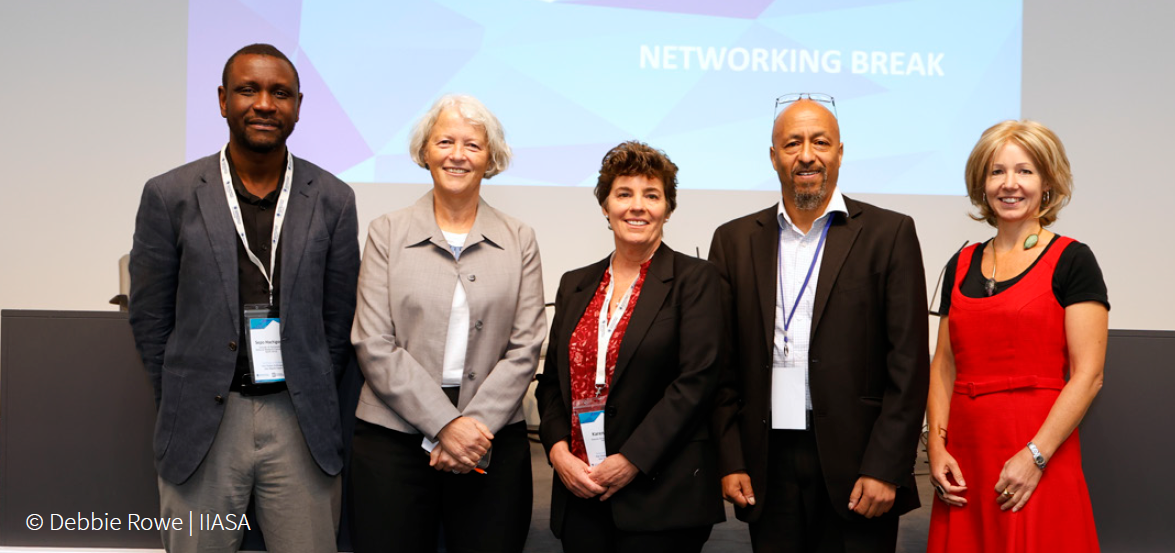
In 2025, IIASA, alongside UK Research and Innovation and the Royal Society, convened a high-level event bringing together scientific leaders to strengthen the United Kingdom’s strategic engagement with IIASA across science, policy, and diplomacy.
The event showcased IIASA’s integrative systems analysis approach in addressing global challenges, from climate change and health inequalities to energy innovation and artificial intelligence. A dedicated session highlighted IIASA’s role as a neutral platform for fostering international cooperation in a fragmented geopolitical landscape, with particular emphasis on inclusive engagement with the Global South.
Across thematic sessions, IIASA contributed expertise on interconnected risks in the Anthropocene, climate overshoot, and sustainable energy transitions, demonstrating how systems-based approaches can inform policy and governance.
 © Dreamstime
Bridging regions through science diplomacy
Engagements with partners in China and Austria formed an important part of IIASA’s science diplomacy efforts in 2025, alongside collaboration with countries including Australia, Burkina Faso, the Czech Republic, Germany, Italy, Japan, Mexico, Vietnam, and Yemen. High-level meetings with national institutions and government representatives helped reinforce long-term cooperation, strengthen diplomatic ties, and identify new areas for joint research.
Across these interactions, IIASA welcomed several prominent diplomats, including ambassadors and senior representatives, creating space for dialogue between partners from both the Global North and Global South. Discussions focused on shared challenges and sustainable development, while emphasizing the importance of inclusive, science-based cooperation that reflects diverse regional priorities.
Among these was a visit from representatives of the US Mission to International Organizations in Vienna in July 2025, which explored planned activities in science diplomacy, including the Raiffa Center and Scientia Forum, alongside opportunities to strengthen IIASA‑US collaboration across multiple fields. In September 2025, IIASA Deputy Director General Karen Lips also visited the US National Science Foundation (NSF), which will become IIASA’s new National Member Organization (NMO) for the US, further strengthening institutional ties and opportunities for collaboration.
By engaging actors across regions and levels of development, IIASA continues to strengthen its role as a neutral platform for collaboration, supporting knowledge exchange and fostering partnerships that bridge divides and advance science-based solutions to global challenges.