


LAMASUS builds on i) decades of experience in direct policy support, ii) unique modeling tools, such as GLOBIOM, the only model that integrates agricultural and land use sectors, and CAPRI, MAGNET and CLUE, which underlie JRC’s land use policy assessments, and iii) novel approaches mobilizing machine learning and citizen science.
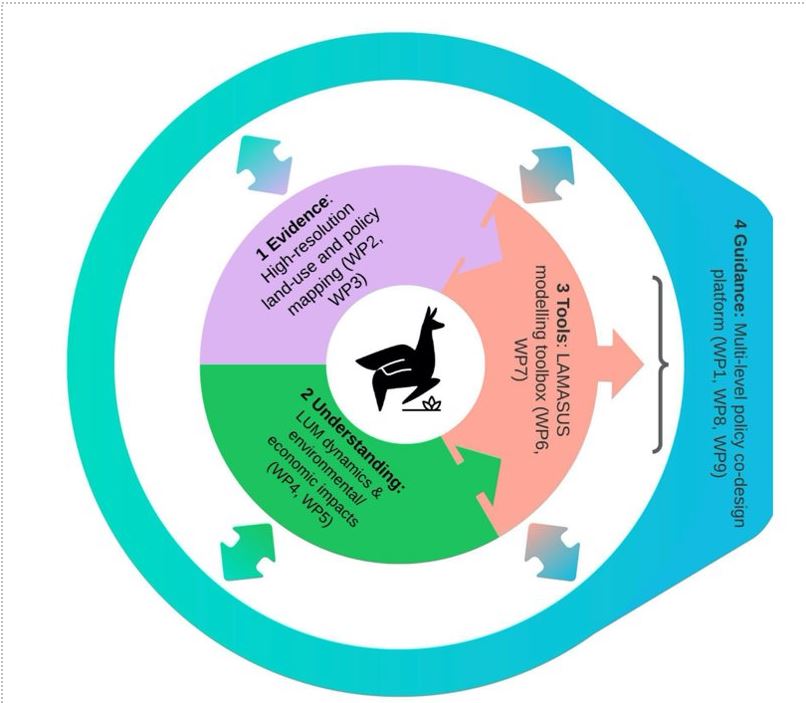
The project is driven by four key elements:
- EVIDENCE – dynamic monitoring of land use, management and related policies for evaluation and model calibration;
- UNDERSTANDING – state-of-the-art econometric and biophysical models to assess the role of past policies on changes in land use and management, and their economic and environmental impacts;
- TOOLS – a highly-integrated policy modeling framework with full sectorial coverage from agriculture and forestry to the whole economy, accounting for carbon, biodiversity and all relevant sustainability dimensions, at multiple scales (land use actors, country, EU level, global);
- GUIDANCE – a multi-level stakeholder dialogue for co-design of agriculture, forestry and climate policies by the EC, national and local governments and citizens, made accessible to stakeholders across multiple spatial scales through the novel webbased LAMASUS Portal.
- In this way, LAMUSUS will create a new level of societal engagement in which local actors contribute to the design of effective and efficient EU policies for climate neutrality and will serve as an exemplar for other policy processes within the European Green Deal.
 © Lamasus
PARTNERS
The LAMASUS consortium is built to deliver its overall ambition, and features world-leading interdisciplinary expertise in all domains necessary for the successful delivery of the project’s objectives, including expertise in integrating knowledge across disciplines. The consortium harnesses the decades of experience in policy maker support on the science policy interface and has key expertise in econometrics, social sciences, and modelling of land-use, earth and climate systems, biodiversity, sectorial economics, and land management.
The consortium of LAMASUS consists of 17 partners from 8 countries in Europe (Austria, Germany, the Netherlands, France, Poland, Spain, Norway and Switzerland).
- International Institute for Applied Systems Analysis (IIASA)
- University of Bonn (Rheinische Friedrich-Wilhelms-Universität Bonn)
- European Centre for Agricultural, Regional and Environmental Policy Research - EUROCARE GmbH
- Stichting Wageningen Research
- National Research Institute for Agriculture, Food and Environment (INRAE)
- Ruralis - Institute for Rural and Regional Research
- Johann Heinrich von Thünen Institute
- University of Natural Resources and Life Sciences (Universität für Bodenkultur Wien)
- PBL Netherlands Environmental Assessment Agency
- Vrije Universiteit Amsterdam
- University of Valencia
- University of Warsaw
- ARTTIC Innovation GmbH
- Joint Research Centre
- Zurich University of Applied Sciences/ZHAW
- University of Paris-Saclay
- Austrian Institute of Economic Research (WIFO)
 © ec.europe.eu
Lamasus receives funding under the European Union’s Horizon Europe research and innovation programme under grant agreement number 101060423. Views and opinions expressed are however those of the author(s) only and do not necessarily reflect those of the European Union. Neither the European Union nor the granting authority can be held responsible for them.
News

Annual Report 2025
Annual Report 2025: Advancing Global Partnerships Highlights
Throughout 2025, IIASA expanded its international cooperation through new agreements, research initiatives, and high-level exchanges focused on sustainability, climate action, and systems science.

Annual Report 2025
Annual Report 2025: Policy Impact Highlights
As part of its mission, IIASA provides scientific guidance to policymakers by applying systems analysis to global challenges.
10 October 2025
German Ambassador Vito Cecere visits IIASA to strengthen scientific collaboration
IIASA recently welcomed His Excellency Vito Cecere, Ambassador of the Federal Republic of Germany to Austria, for an official visit aimed at reinforcing the strong and enduring partnership between Germany and IIASA.
Events
Residence Palace, Brussels, Belgium
Final LAMASUS Conference
IIASA, Laxenburg
2025 LAMASUS Annual Consortium Meeting
ESA-ESRIN FRASCATI, ITALY