



CircEUlar was a four-year European Research and Innovation Action that advanced the understanding of how circular economy strategies can support the transition towards a net-zero emissions future
The CircEUlar project investigated the dynamics and levers of societal transformation towards a low-carbon circular economy by developing new modelling approaches and integrating insights from across disciplines. It examined how circularity can be strengthened through three key pathways:
- Dematerialization and the transition towards a service-based economy, reducing the growth of material stocks;
- Extending the lifetime of material stocks through repair, maintenance and reuse;
- Improving waste treatment and recycling systems to enable more circular material flows.
Through new data and modelling approaches, CircEUlar analyzed economy-wide material stocks and flows, greenhouse gas (GHG) emissions, and industrial value chains across interconnected sectors. Particular attention was given to mobility and buildings, two highly material-intensive sectors with significant potential for circular transformation. The project also explored the role of digitalization as an enabler of dematerialization and more circular supply chains.
A comprehensive approach to circular economy transformation
CircEUlar brought together diverse sources of data, knowledge and expertise to assess circular economy opportunities and impacts. This included insights on the roles of firms and consumers for the adoption of circular economy practices, industry perspectives on innovations and circular business models, and modelling of economy-wide material stocks and flows to identify pathways and policy levers supporting societal transformation.
The project findings were integrated into EU and global modelling frameworks, enabling the analysis of:
- alternative pathways to net-zero GHG emissions and increased circularity;
- effective policy levers for both circular production and consumption;
- impacts on climate, environment, economy and society, in line with European Green Deal objectives.
Partners
- The International Institute for Applied Systems Analysis (IIASA) (Austria) - Coordinator
- University of Natural Resources and Life Sciences (BOKU) (Austria)
- Centro Euro-Mediterraneo sui Cambiamenti Climatici (CMCC) (Italy)
- Ludwig-Maximilians Universität München (LMU) (Germany)
- Norwegian University of Science and Technology (NTNU) (Norway)
- University of Groningen (RUG) (Netherlands)
- T6 Ecosystems (T6) (Italy)
- Technische Universität Berlin (TUB) (Germany)
- Mercator Research Institute on Global Commons and Climate Change (MCC) (Germany)
Associated Partners
Explore and Learn
Policy Briefs
The briefs translate evidence generated through the project’s modelling, pathway development, empirical and social research, and stakeholder engagement into concise policy-oriented outputs.
-
Circular economy modelling for EU decision-making
Linking models and data to support evidence-based circular economy and climate policy
This brief explores how circular economy strategies can be better represented in models used to inform EU policymaking. Representing CircEUlar’s integrated modelling framework, which combines models and data with empirical research and stakeholder-informed scenarios, it provides evidence to strengthen the assessment of circular economy pathways and their policy implications. -
Pathways to climate neutrality
Prioritizing circular economy strategies for net-zero greenhouse gas emissions
This brief examines how different circular economy strategies can contribute to climate neutrality. Based on stakeholder co-developed pathways, integrated assessment and sectoral modelling, it provides evidence to help policymakers assess and prioritize circular strategies according to their climate mitigation contribution. -
Circular consumption
Enablers and barriers to demand-side circularity
This brief explores what enables or constrains the uptake of circular consumption practices across housing, mobility and digitalization. Drawing on qualitative interviews and a survey across five European countries, it provides evidence on consumer behaviors and barriers to circular practices. -
Circular without rebounds
Mitigating rebound effects in corporate circular practices through EU policy
This brief examines how rebound effects can reduce the expected environmental benefits of corporate circular practices. Combining economic analysis, employee and consumer surveys, and quantitative analysis, it provides insights to better understand and mitigate unintended impacts on consumption and resource use. -
Urban planning and data-driven approaches enable low-carbon cities
Evidence from Berlin and Porto integrated spatial studies
This brief explores how urban form and spatial planning influence emissions and resource demand. Drawing on travel and neighborhood data in Berlin and high-resolution urban data in Porto, it shows how data-driven approaches can support more effective planning for low-carbon cities.
Explore the research
Access CircEUlar’s scientific evidence across mobility, buildings, consumption and digitalization.
Access the CircEUlar Scenario Explorer
This explorer hosts scenario data developed by the CircEUlar consortium.
Browse the resources
Access the project’s public deliverables and other public reports.
Discover the key findings
Access the Zenodo Community to explore the open-source resources developed by CircEUlar.
 © CircEUlar
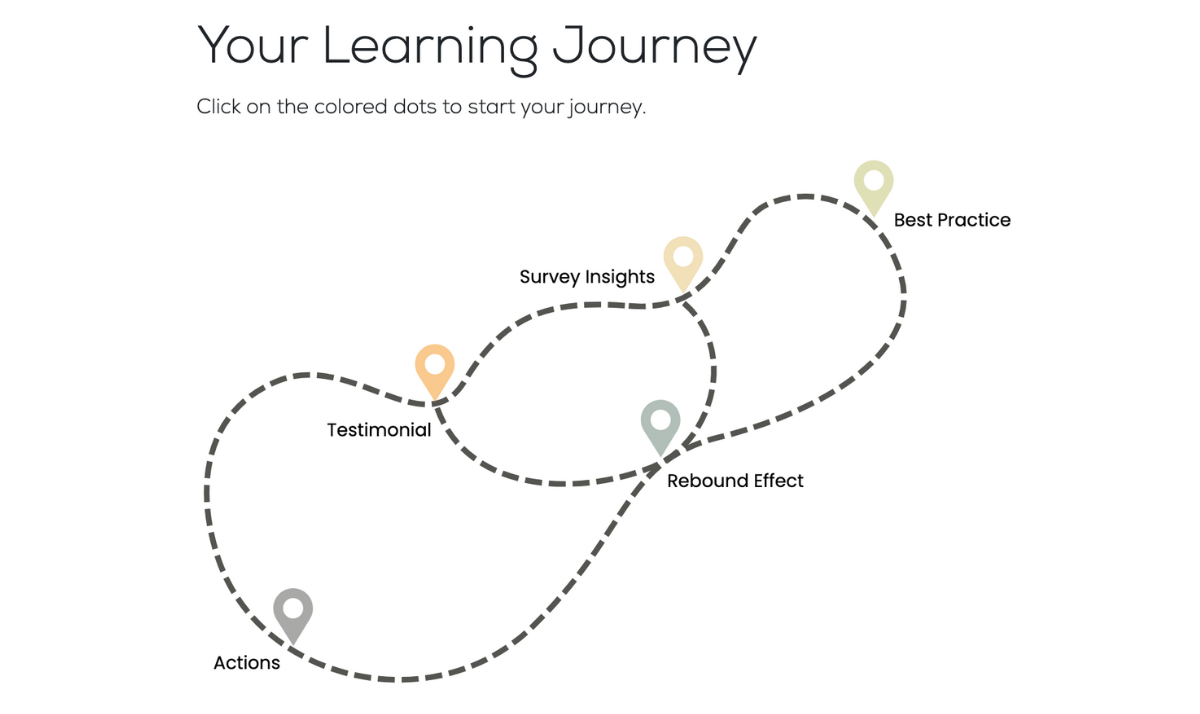
Circular ReBoundary
An Online Resource for Circular Economy Professionals
The Circular ReBoundary is an innovative online resource designed to support professionals and organizations engaged in the transition toward a circular economy.
This resource offers an insightful learning journey for anyone interested in circular practices, whether new to the field or already experienced. While it focuses on the buildings, mobility, and manufacturing sectors, its findings and tools are relevant to a wide range of industries.
Exploring Circularity Through Science and Art
Within the framework of the Klima Biennale Wien, a unique collaboration between science and art highlighted CircEUlar’s research findings through the lens of artists. Over a four-month period, a distinguished curator, Nora Mayr, facilitated dynamic exchanges between four groups of researchers from CircEUlar with the artists Barbara Kapusta, Borjana Ventzislavova, Julian Palacz, and Imayna Caceres.
Under the title “Sensing Resonance“, these collaborative efforts between science and art resulted in a series of artworks for communicating climate and scientific knowledge.
Bringing together the public and stakeholders from culture, science, education, and schools, the event sparked cross-disciplinary dialogue through a combination of good practice examples, workshops, and scientific, practical, and artistic impulses.
We have collected some inspiring intersections in a video series featuring interviews with artists, curators, and project partners.
Funding acknowledgements
Funded by the European Union under grant agreement No. 101056810. Views and opinions expressed are however those of the author(s) only and do not necessarily reflect those of the European Union or HORIZON-RIA - HORIZON Research and Innovation Actions. Neither the European Union nor the granting authority can be held responsible for them.
 © Funding Acknowledgements
Published papers:
News
25 July 2024
Exploring circularity through science and art: CircEUlar project at the Vienna Climate Summit
The first Vienna Climate Biennale took place from April to July. CircEUlar was one of the scientific partners of the Biennale, contributing insights on the potential of circular economy strategies to combat climate change. Project coordinators Marina Jovanovic and Volker Krey reflect on the 100-day festival and the unique collaboration between science and art.
14 June 2024
Expert workshop on digitalization narratives and climate change mitigation
Charlie Wilson and Elena Verdolini share insights and experiences from an expert workshop on the impacts of digitalization on energy, materials, the economy, markets, lifestyles, and society, and how these impacts directly or indirectly affect greenhouse gas emissions.
04 June 2024
Innovative demand strategies for clean energy
A perspective piece published in Nature Climate Change describes innovative strategies that significantly reduce both resource consumption and fossil fuel emissions.
Events
Groningen, The Netherlands
‘Towards Net-Zero through a Circular Economy: the consumer and business perspectives’ Stakeholder Workshop
Leuven, Belgium