

IIASA recently welcomed His Excellency Vito Cecere, Ambassador of the Federal Republic of Germany to Austria, for an official visit aimed at reinforcing the strong and enduring partnership between Germany and IIASA.
Germany has been a founding and active member of IIASA since 1972, originally represented by both the Max Planck Society and the Academy of Sciences of the German Democratic Republic. Since 1984, its membership has been maintained through the German Association for the Advancement of IIASA, supported by the German Federal Ministry of Education and Research (BMBF). Today, Germany continues to play a leading role in shaping the Institute’s governance and strategic direction through its representation on the IIASA Council. This longstanding partnership reflects Germany’s strong commitment to international scientific cooperation and to systems analysis as a foundation for addressing global challenges.
Ambassador Cecere was accompanied by Steen Marten Hoins, Embassy Representative, and Bettina Bundszus-Cecere, guest of the Embassy. The IIASA delegation was led by IIASA Director General, Hans Joachim (John) Schellnhuber, who hosted the discussions at the Institute’s historic Schloss Laxenburg premises.
Following words of welcome, Schellnhuber provided an overview of IIASA’s research mission and its decades of cooperation with German institutions. The meeting centered on opportunities to strengthen scientific collaboration between IIASA and Germany, with discussions highlighting shared priorities such as addressing climate change, advancing sustainable energy transitions, and promoting science diplomacy as a tool for peace and progress.
Germany is one of IIASA’s most engaged partners, with over 70 German institutions, including the Potsdam Institute for Climate Impact Research, various Max Planck Institutes, and the Karlsruhe Institute of Technology collaborating with IIASA on numerous projects. Joint initiatives such as RESTORE+, LAMASUS, CircEUlar, and GENIE are advancing research in areas ranging from land-use governance and circular economy pathways, to greenhouse gas removal and climate neutrality.
Ambassador Cecere emphasized Germany’s dedication to multilateral science and the importance of IIASA’s integrative systems approach in supporting evidence-based policymaking.
“Germany has been a cornerstone of IIASA since its founding over half a century ago. Today’s meeting with Ambassador Cecere reaffirmed our shared vision of science as a bridge between nations and as a driver of solutions to the planetary crises of our time. Together, we are shaping the next chapter of international science diplomacy,” said Schellnhuber reflecting on the visit.
The visit concluded with the signing of the IIASA Guest Book and a tour of Schloss Laxenburg, symbolizing the enduring partnership between IIASA and Germany in advancing global sustainability through cooperative science.

News

24 September 2026
IIASA researcher joins Austrian Academy of Sciences working group on integrated carbon neutrality
On 15 September, Principal Research Scholar Thomas Schinko represented IIASA at a high-level event of the Commission on the De-Fossilization and Carbon Neutrality of the European Energy Systems (DEE) of the Austrian Academy of Sciences (OEAW). The meeting denoted the kick-off workshop of the newly established DEE Working Group "Transsectoral and Transcontinental Integration”.
30 July 2026
The trillion-dollar question behind corporate net-zero pledges
Corporate climate spending now steers trillions of dollars in transition finance worldwide. Does it drive genuine climate action? Research shows that accounting flexibility alone can make a company's reported emissions vary by roughly a factor of two – enough to appear either as a climate leader or a laggard. A new Perspective in Nature Sustainability proposes developing industry-specific net-zero blueprints to close that gap.
28 July 2026
New citizen science campaign on mowing events launching in 2026
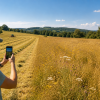
Starting this Friday, 31st of July, the Mowing Quest citizen science campaign invites people across Europe to help improve grassland monitoring. By using the free Geo-Quest app, participants can report mowing events directly from the field and support scientific research with their own observations. The campaign will be open during August and September to test the system capabilities in preparation for a larger 2027 campaign.