The following statistics are from the last 5 full calendar years: 2021-2025
Publications
5
Publications about Chile
| Title | Type | Publisher | Date Sort ascending | Journal |
|---|---|---|---|---|
| Robust Assessments of Lithium Mining Impacts Embodied in Global Supply Chain Require Spatially Explicit Analyses | article | American Chemical Society (ACS) | Environmental Science & Technology | |
| Towards durable legal protections for rivers in Chile | article | Taylor and Francis | Water International | |
| Reduced mobility? Urban exodus? Medium-term impacts of the COVID-19 pandemic on internal population movements in Latin American countries | article | arXiv | ||
| Greenhouse gas emission scenarios in nine key non-G20 countries: An assessment of progress toward 2030 climate targets | article | Elsevier | Environmental Science & Policy | |
| Uncertainty of simulated groundwater recharge at different global warming levels: a global-scale multi-model ensemble study | article | Hydrology and Earth System Sciences |
14
Publications co-authored with institutions in Chile
Pagination
12
Publications by IIASA researchers from Chile
| Title | Type | Publisher | Date Sort ascending | Journal |
|---|---|---|---|---|
| Global scenarios of household access to modern energy services under climate mitigation policy | article | Nature Energy | ||
| A model of energy poverty and access: Estimating household electricity demand and appliance ownership | article | Elsevier | Energy Economics |
Pagination
Projects
250
Projects related to Chile
| Name | Start | End Sort ascending | Abbreviation | Classification |
|---|---|---|---|---|
| State of CDR 3 | 2025 | 2026 | SoCDR 3 | Global |
| Advanced ensemble projections for indirect impacts of nuclear winter in global food systems | 2023 | 2026 | ANFOS | Global |
| Inventive forecasting tools for adapting water quality management to a new climate | 2021 | 2026 | inventWater | Global |
| Nature for insurance, and insurance for nature | 2022 | 2026 | NATURANCE | Global |
| Open-Earth-Monitor Cyberinfrastructure | 2022 | 2026 | OEMC | Global |
| Global Carbon Neutrality Pathways | 2024 | 2026 | GEIDCO VI | Global |
| Copernicus Global Land Cover and Tropical Forest Mapping and Monitoring (LCFM) - (under Framework Contract for Services Number 945329-IPR-2023 and a S | 2024 | 2026 | LCFM-D2 | Global |
| A Gathering place to cO-design and co-cReate Adaptation | 2023 | 2025 | AGORA | Global |
| Global Pasture and Livestock Monitoring | 2022 | 2025 | GPLM | Global |
| Earth System Models 2025 | 2021 | 2025 | ESM2025 | Global |
Pagination
0
Projects sponsored by funders from Chile
Engagement
1
Number of times participants from Chile joined IIASA events
1
Number of times visitors from Chile came to IIASA
People
1
- Women
- Men
Staff members from Chile
1
- Women
- Men
Postdoctoral researchers from Chile
1
- Women
- Men
YSSPers from Chile
5
- Women
- Men
- Unknown
Total number of alumni from Chile
News
11 June 2025
Supporting the development of greenhouse gas emissions and removals projections in Latin America and beyond
IIASA researchers collaborated with the United Nations Environment Programme (UNEP) to develop a new practical guide focused on enhancing the technical robustness and transparency of climate reporting through the development of greenhouse gas (GHG) emissions and removals projections. The guide will strengthen national capacities for estimating projections necessary to achieve the goals of the Paris Agreement in Latin America and other regions of the world.
02 October 2024
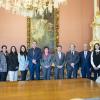
IIASA and Latin American Ambassadors explore new collaborative opportunities
On 23 September 2024, a distinguished delegation of Heads of Missions from the Latin American region, led by its Dean, Ambassador Juan Francisco Facetti Fernandez, Permanent Representative of Paraguay to the International Organizations in Vienna, visited IIASA to explore avenues for meaningful research collaborations.
Focus
23 September 2020
Crafting mines from satellite images
The mining of coal, metals, and other minerals causes loss of natural habitats across the entire globe. However, available data is insufficient to measure the extent of these impacts. IIASA alumnus Victor Maus and his colleagues mapped more than 57,000 km² of mining areas over the whole world using satellite images.