

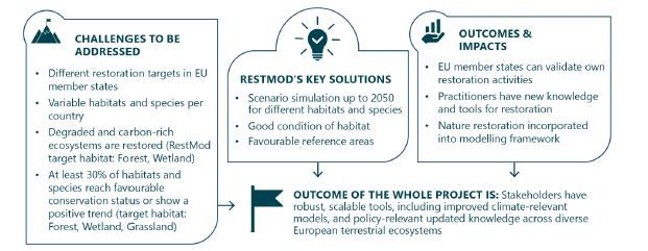
Under the EU Biodiversity Strategy, the European Climate Law, and the EU Nature Restoration Law, special emphasis is placed on degraded, carbon-rich ecosystems. At least 30 % of these habitats and species must achieve a favourable conservation status—or at minimum exhibit a positive trend. This project refines modelling approaches to address ecosystem-restoration needs and to help meet EU targets.
Ecosystem restoration is a key pillar of the EU Biodiversity Strategy for 2030 and the Nature Restoration Regulation (NRR). Yet, its implementation is constrained by fragmented actions, limited monitoring capacity, and the lack of integrated modelling tools to evaluate restoration outcomes across scales. Harmonised approaches are needed to assess biodiversity and ecosystem service gains from restoration activities, and to predict their long-term effects under changing climate and land-use conditions. These gaps limit Europe’s ability to align restoration planning with biodiversity targets, climate mitigation and adaptation goals, and land degradation neutrality.
 © RestMod
RestMod will deliver an integrated framework to support the monitoring, modelling, and assessment of ecosystem restoration in forests, wetlands, and grasslands across Europe. To achieve this, we will:
1) co-create restoration pathways,
2) couple leading ecosystem process and biodiversity models (e.g., LPJ-GUESS, G4M, HMSC),
3) simulate restoration scenarios and trajectories towards 2030 and 2050 targets, and
4) generate actionable outputs for practitioners, landowners, and policymakers. RestMod combines empirical restoration data, remote sensing, and eDNA with scalable models and participatory co-creation approaches at Open Labs across major European biogeographic zones. In doing so, we will generate high-resolution restoration pathways, spatial prioritisation maps, and open-access decision-support tools, tailored to stakeholder needs and aligned with EU and global frameworks such as the Kunming-Montreal Global Biodiversity Framework. By closing critical gaps between data, models, and decision-making, RestMod will equip the EU and its Member States with the knowledge and tools needed to implement effective, equitable, and climate-resilient restoration strategies.
 © Parvez Rana | RestMod
IIASA's ROLE
Agriculture, Forestry, and Ecosystem Services (AFE) Group:
- leads restoration-scenario development;
-
refines the following models:
The Environmental Policy Integrated Climate-based global gridded crop model (EPIC-IIASA)
Wildfire climate impacts and adaptation model (FLAM)
BeWhere Model: A Spatially Explicit System Optimization Tool
- performs Europe-wide simulations and validation;
-
and conducts spatial land-use optimisation.
Novel Data Ecosystems for Sustainability (NODES) develops an interactive online tool for exploring model outputs across management and climate scenarios.
PARTNERS
Natural Resources Institute Finland / Luonnonvarakeskus
Swedish University of Agricultural Sciences (SLU)
Aarhus University
Lund University
University of Jyväskylä
INBO (Research Institute for Nature and Forest - Instituut voor Natuur- en Bosonderzoek)
Technical University of Munich
University of Évora
Universidad Politécnica de Madrid
LifeWatch ERIC
CzechGlobe
FUNDING
RESTMOD is funded by the under the Horizon Europe call HORIZON-CL6-2025-01-BIODIV-05 on biodiversity restoration.