
Understanding the impact of drought in East Africa and identifying adaptation pathways to improve resilience.
 © INTERVENE Project
Overview
INTERVENE is a 3-year research for development project, funded by the Austrian Development Cooperation.
INTERVENE will investigate the impacts of droughts on water resources and related socioeconomic activities (drinking water supply, agriculture, irrigation, hydropower, etc.) in East Africa.
It will then identify possible adaptation pathways to improve the resilience of the human-natural water system to droughts.
The project is jointly implemented by IIASA's Water Security Research Group and the Lake Victoria Basin Comission (LVBC), an intergovernmental organisztion of the East African Community
Project team
 © Lake Victoria Basin Commission
Lake Victoria Basin Commission (LVBC)
The LVBC, a legal entity of the East African Community (EAC), is to promote, facilitate and coordinate activities of different actors towards sustainable development and poverty eradication of the Lake Victoria Basin.
 © IIASA
IIASA - Water Security Group
The Water Security group at IIASA is to provide the scientific foundation needed for addressing water security across scales and to help bridge science-policy-practices gaps in water management by leading integrated assessments of water resources towards a water secure future.

Sylvia Tramberend
Senior Research Scholar (WAT)

Taher Kahil
Research Group Leader and Senior Research Scholar (WAT)

Julian Joseph
Research Scholar (WAT)

Samantha Knights
Capacity Development Coordinator (CDAT)
INTERVENE Operational Framework
 © INTERVENE Project
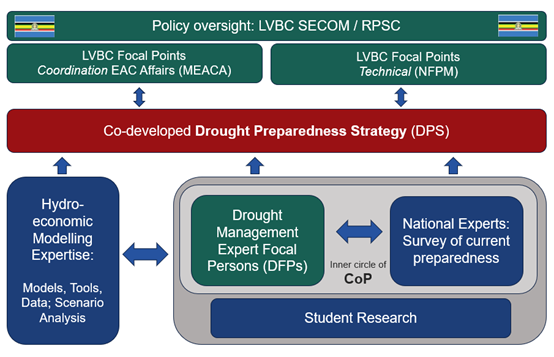
LVBC and IIASA developed an Operational Framework that would best support the co-creation of the:
- Drought preparedness and response Strategy
- Drought preparedness and response Action plans
The Drought preparedness and response Strategy is developed through the activities presented under the DPS box (red box) and is overseen by the actors and mechanisms in the green boxes above.
The development applies a research for policy approach, which connects scientific modelling (left blue box) with local know-how organized in a Community of Practice (CoP) (right grey box).
Impact and Outcome
IMPACT: sustainable socio-economic development in East Africa that is resilient and prepared for future droughts including extreme droughts.
OUTCOME: improved understanding of the necessary measures and actions needed to advance local preparedness to droughts (including response strategies and action plans)
Outputs
- OP1: Raising awareness of gender aspects of drought resilience
- OP2: Drought preparedness and response strategy & action plans (DPRSP)
- OP3: Improving drought resilience capacity to inform policy and practice
Approach
Building resilience to drought hazards requires targeted, people-centered approaches that consider the diversity of people’s social backgrounds. Diversity analysis, especially the intersectional nature of gender, is a key project objective.
Drought response strategies must consider the impacts of intersectional inequalities of social groups, especially women, on food and water resulting from social disparities such as age, education, disability, or income.
Key activities
- Stock-taking of the current drought preparedness in the countries of the East African Community (EAC). This will be achieved by an identifying analysis of drought policies, planning and management and identification of existing experience and knowledge in coping with drought. In addition to a general analysis, a focus is on the gender relevance in current drought related policies and historic response strategies to drought. Local experts will be assigned to conduct a desktop study and selected interviews.
- The LVBC will coordinate a Community of Practice (CoP) focused on development needs for developing drought resilience in East Africa.
- Development of a coupled hydro-economic modelling framework including aspects of human heterogeneity, adapted and developed for local needs. This research is led by IIASA in close collaboration and mutual interaction with the LVBC and the CoP.
- East African student support scholarship for integration of local research into international South-North research program.
- A Stakeholder Workshop (SWS) in East Africa, circa in February 2026.
- Co-development of ‘Drought Preparedness and Response Strategy & Action Plans (DPRSPs)’ for East Africa and selected countries.
- Close liaison of INTERVENE with East African policy making through the LVBC.
- A Drought Resilience Symposium (DRS) in East Africa, circa in Mai 2027.
- Capacity enhancement activities including virtual seminars and capacity building connected to the SWS and DRS
IIASA models being used in this project


Related Publications
Joseph, J., Tramberend, S. , Kabi, F., Fischer, G., & Kahil, T. (2025). Sustainable intensification of fodder crop production can mitigate feed shortage and seasonality in East Africa. Environmental Development 54 e101158. 10.1016/j.envdev.2025.101158.
Tramberend, S. , Burtscher, R. , Burek, P. , Kahil, T. , Fischer, G., Mochizuki, J. , Greve, P., Kimwaga, R., Nyenje, P., Ondiek, R., Nakawuka, P., Hyandye, C., Sibomana, C., Luoga, H.P., Matano, A.S., Langan, S. , & Wada, Y. (2021). Co-development of East African regional water scenarios for 2050. One Earth 4 (3) 434-447. 10.1016/j.oneear.2021.02.012.
Yokomatsu, M., Mochizuki, J. , Joseph, J., Burek, P. , & Kahil, T. (2023). Macroeconomic co-benefits of DRR investment: assessment using the Dynamic Model of Multi-hazard Mitigation CoBenefits (DYNAMMICs) model. Disaster Prevention and Management: An International Journal 32 (1) 139-162. 10.1108/DPM-07-2022-0154.
Kahil, T. , Parkinson, S. , Satoh, Y., Greve, P., Burek, P. , Veldkamp, T., Burtscher, R. , Byers, E. , Djilali, N., Fischer, G., Krey, V. , Langan, S. , Riahi, K. , Tramberend, S. , & Wada, Y. (2018). A continental-scale hydro-economic model for integrating water-energy-land nexus solutions. Water Resources Research 10.1029/2017WR022478.
News


26 February 2026
Congratulations to the students selected for the INTERVENE Fellowship Program
14 Student Fellowships awarded to students studying at East African Universities.