
Representatives from China’s Ministry of Human Resources and Social Security visited Schloss Laxenburg in May 2026 for discussions on international research collaboration, scientific career development, and talent exchange.
The visit brought together IIASA representatives from human resources, science diplomacy, capacity development, and research programs to exchange perspectives on attracting and supporting international scientific talent in an increasingly interconnected research landscape. The Chinese delegation was led by Qingfeng He, Deputy Director General of the Department of Personnel, Ministry of Human Resources and Social Security, and Tao Wang, Deputy Director General of the Department of International Cooperation, Ministry of Human Resources and Social Security. In addition, the delegation included Guoqiang Zhang, Counselor from the Permanent Mission of the People’s Republic of China to the United Nations and other International Organizations in Vienna, as well as representatives from several Chinese government ministries and agencies, reflecting a broad interest in international scientific cooperation, talent development, and research careers.
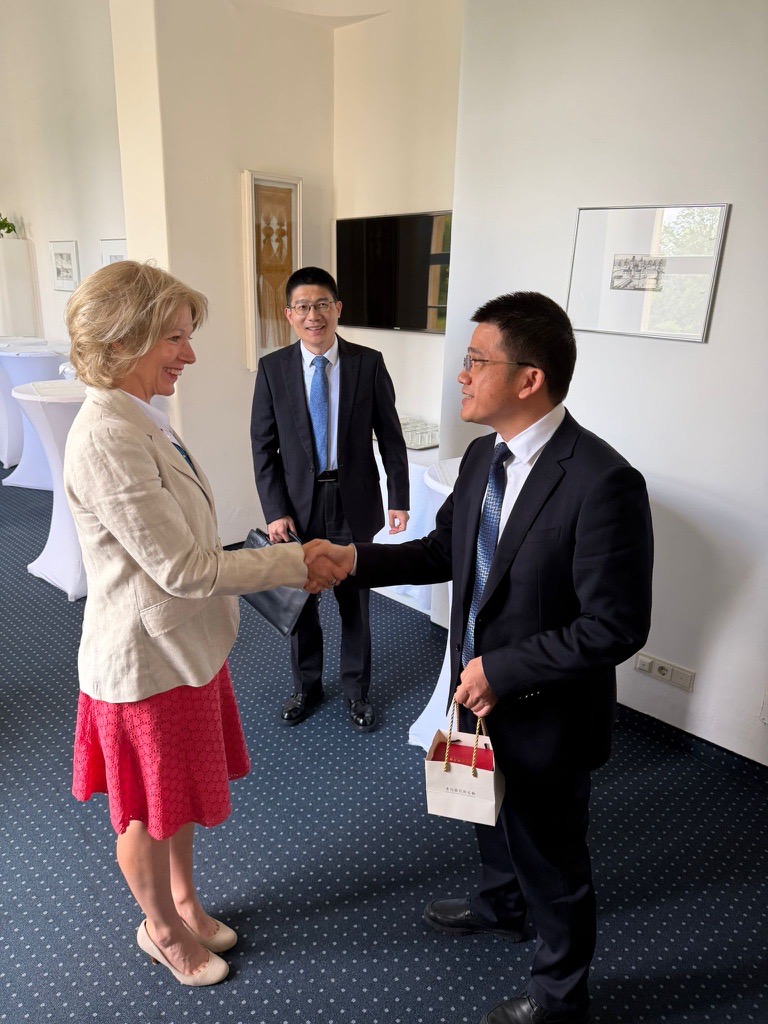 © IIASA
IIASA Science Diplomacy Director and Head of Communications and External Relations Susie Kitchens with members of the Chinese delegation.
The delegation met with IIASA Science Diplomacy Director and Head of Communications and External Relations Susie Kitchens, Head of Human Resources Lion Huijers, IIASA Guest Senior Research Scholar Gui-Ying Cao, and a number of other Chinese researchers currently working at IIASA. Discussions focused on scientific mobility, career development pathways, international recruitment practices, and opportunities to strengthen long-term cooperation between IIASA and Chinese institutions.
Susie Kitchens introduced the delegation to IIASA’s international research environment, which brings together scientists from more than 60 countries to address interconnected global challenges including climate change, sustainable development, energy systems, environmental management, and demographic change.
“The challenges facing humanity today require scientific cooperation that crosses borders, disciplines, and cultures,” she said. “Visits like this are important because they help strengthen the personal and institutional relationships that underpin international collaboration and create opportunities for the next generation of researchers to work together on solutions with global impact.”
The exchange also highlighted IIASA’s role in education, training, and scientific capacity development through initiatives such as the Young Scientists Summer Program (YSSP), postdoctoral fellowships, and regional systems analysis centers. Particular attention was given to the career trajectories of former YSSP participants, with Gui-Ying Cao sharing insights on long-term academic and professional development through international scientific collaboration.
The agenda further featured scientific highlights from Peking University and Tsinghua University alumni at IIASA, including presentations by Research Scholars Chen Huang and Biqing Zhu on collaborative research in climate, energy, health, and sustainability science. Discussions throughout the visit emphasized the value of interdisciplinary and international partnerships in advancing both scientific innovation and evidence-informed policymaking.
The visit reaffirmed the strong and growing relationship between IIASA and Chinese scientific institutions and reinforced a shared commitment to fostering international scientific exchange, talent development, and long-term collaboration.
News
06 October 2026
Nanjing University delegation visits IIASA to explore future collaboration
A high-level delegation from Nanjing University (NJU), led by Professor Tan Zhemin, President of NJU and Fellow of the Chinese Academy of Sciences, visited IIASA to discuss opportunities for strengthening scientific cooperation and advancing joint research on global challenges.

22 September 2026
IIASA at UNCCD COP17: Advancing land restoration and resilience
Building on its engagement at the 16th session of the Conference of the Parties to the United Nations Convention to Combat Desertification (UNCCD COP16) in Riyadh, IIASA contributed to a series of events and bilateral discussions at UNCCD COP17, held in Ulaanbaatar, Mongolia, towards the end of August. Under the theme, Restoring Land, Restoring Hope, COP17 advanced action on land degradation, drought resilience, and sustainable land management, with particular emphasis on rangelands and pastoral livelihoods.

21 August 2026
Overshoot Conference 2026 in Beijing: Abstract Deadline Extended
Taking place 24–25 November 2026 at Tsinghua University in Beijing, the conference is co-hosted by the International Institute for Applied Systems Analysis (IIASA) and Tsinghua University, and will bring together leading researchers, policymakers, innovators, and communicators to advance the global dialogue on overshoot pathways and responses.