

A high-level delegation from the Ministry of Science and Technology of China (MoST) and representatives of the Embassy of the People’s Republic of China in Austria visited IIASA at Schloss Laxenburg on 13 May 2026 for discussions on scientific cooperation, science diplomacy, and future collaboration.
The delegation was led by Zhuang Jia, Deputy Director General of the Department of International Cooperation at MoST, and included senior officials responsible for European scientific engagement and international partnerships. They were received by IIASA Director General Hans Joachim (John) Schellnhuber, Deputy Director General Karen Lips, IIASA Sherpa for Asia Wolfgang Lutz, Science Diplomacy Director Susie Kitchens, and other Institute representatives.
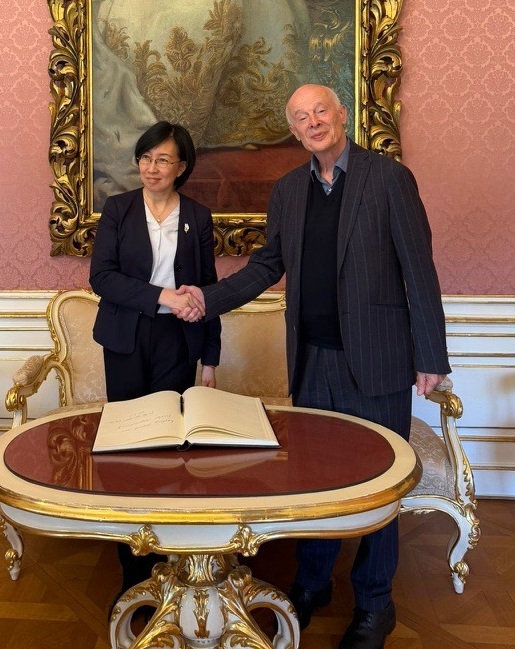 © IIASA
Zhuang Jia, Deputy Director General of the Department of International Cooperation at MoST and IIASA Director General Hans Joachim (John) Schellnhuber
Discussions focused on strengthening collaboration between IIASA and Chinese research institutions in areas including climate change, sustainable energy transitions, food and water security, demographic change, and systems analysis. Participants also explored opportunities to deepen cooperation in science diplomacy and international research exchange at a time of growing global uncertainty.
“IIASA was founded on the conviction that scientific collaboration can help bridge geopolitical divides and support peaceful international cooperation,” said IIASA Director General Hans Joachim (John) Schellnhuber. “Our long-standing partnership with China demonstrates the importance of maintaining open scientific dialogue and working together to address shared global challenges that no country can solve alone.”
The visit highlighted the strong and expanding relationship between IIASA and China. China has been a member of IIASA since 2002 through the National Natural Science Foundation of China (NSFC), and more than 50 Chinese institutions have collaborated with IIASA over the years across a broad range of scientific fields. Current areas of collaboration include sustainable agriculture, climate mitigation, air pollution, disaster preparedness, population dynamics, and global energy transitions.
Participants also discussed IIASA’s growing role in science diplomacy and international dialogue. The exchange reflected the Institute’s commitment to fostering cooperation across regions and political systems through science-based engagement and evidence-informed policymaking.
As part of the discussions, IIASA representatives highlighted several ongoing and planned initiatives, including international collaborations on sustainability and preparations for future high-level science diplomacy activities involving global research and policy leaders.
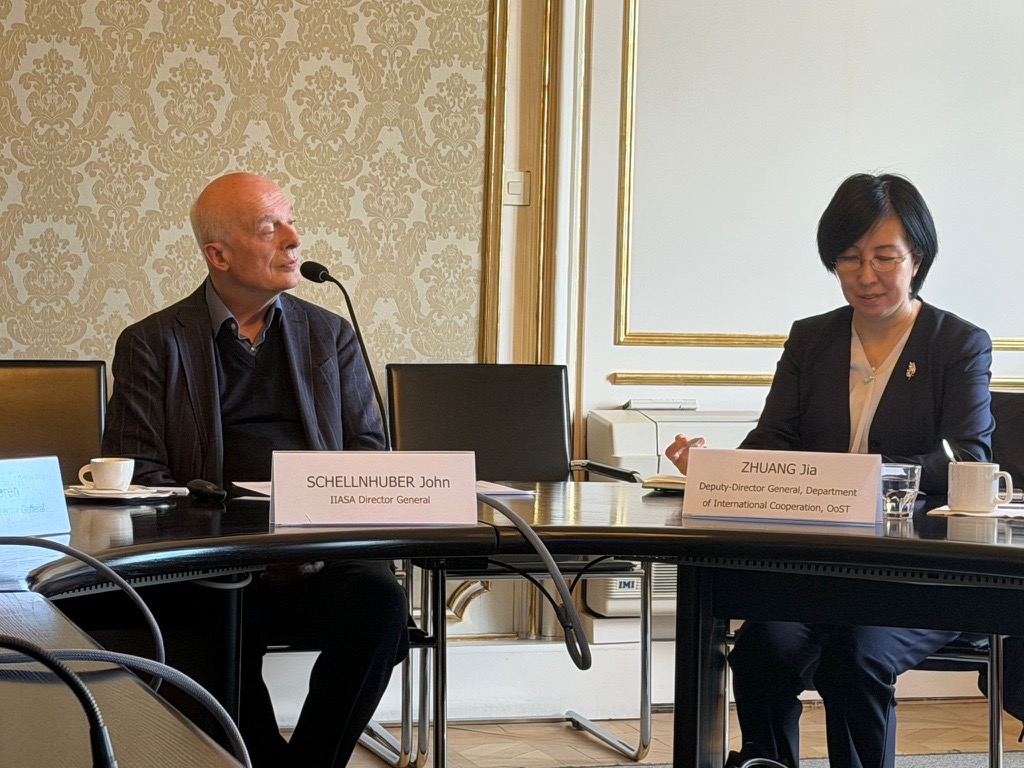 © IIASA
Zhuang Jia, Deputy Director General of the Department of International Cooperation at MoST and IIASA Director General Hans Joachim (John) Schellnhuber during the discussion.
News
06 October 2026
Nanjing University delegation visits IIASA to explore future collaboration
A high-level delegation from Nanjing University (NJU), led by Professor Tan Zhemin, President of NJU and Fellow of the Chinese Academy of Sciences, visited IIASA to discuss opportunities for strengthening scientific cooperation and advancing joint research on global challenges.
22 September 2026
IIASA at UNCCD COP17: Advancing land restoration and resilience
Building on its engagement at the 16th session of the Conference of the Parties to the United Nations Convention to Combat Desertification (UNCCD COP16) in Riyadh, IIASA contributed to a series of events and bilateral discussions at UNCCD COP17, held in Ulaanbaatar, Mongolia, towards the end of August. Under the theme, Restoring Land, Restoring Hope, COP17 advanced action on land degradation, drought resilience, and sustainable land management, with particular emphasis on rangelands and pastoral livelihoods.

21 August 2026
Overshoot Conference 2026 in Beijing: Abstract Deadline Extended
Taking place 24–25 November 2026 at Tsinghua University in Beijing, the conference is co-hosted by the International Institute for Applied Systems Analysis (IIASA) and Tsinghua University, and will bring together leading researchers, policymakers, innovators, and communicators to advance the global dialogue on overshoot pathways and responses.