

On 28 May, Peking University (PKU) and IIASA held a joint online seminar to discuss health research under global change and to review the progress, priorities, and coordination arrangements for a proposed Centre on Global Change and Health.
The seminar was co-chaired by Professor Tong Zhu from PKU and Fabian Wagner, IIASA Capacity Development and Academic Training (CDAT) Director. Josephine Borghi, who leads IIASA’s Health, Ageing, and Health Systems Research Group, supported the hosting. Participants included faculty and researchers from Peking University, including Shiqiu Zhang, Jicheng Gong, and Yue Qin (School of Environmental Science and Engineering), Tao Xue (School of Public Health), Jin Xu (China Development Research Foundation), and Chi Zhang (Institute of Population Studies), as well as representatives from IIASA, including Shonali Pachauri and Gregor Kiesewetter (Energy, Climate, and Environment Program), Marta Kozicka and Gemma Gerber (Biodiversity and Natural Resources Program), Josephine Borghi (Population and Just Societies Program), and Michael Kuhn (Economic Frontiers Research Group).
A key focus of the discussion was how to move the collaboration forward in a practical and well-coordinated way. Participants agreed that the Centre should establish a framework for collaboration and management including agreement on priority research topics of joint interest. Professor Zhu emphasized that setting up the platform promptly and clarifying the Centre’s main focus will help the partnership develop smoothly and avoid unnecessary delays.
Researchers from both institutions presented ongoing research and identified areas where collaboration could produce strong scientific synergy. The exchanges covered topics including the health impacts of air pollution, links between climate action, nutrition and health, the effects of extreme weather on health and health services, and the use of systems modeling approaches to support evidence-based assessment. Participants also discussed how digital tools and AI could strengthen climate risk reduction and improve decision-making in public health.
The seminar further contributed to preparations for an upcoming Global Change and Health Satellite Conference in Beijing, which is intended to bring together expertise from both institutions and beyond, to refine collaboration themes and formats, and further identify ways to translate research into real-world outcomes.
Overall, the seminar marked an important step in PKU–IIASA cooperation, reaffirming both institutions’ commitment to sustained engagement and coordinated progress toward establishing the proposed Centre.
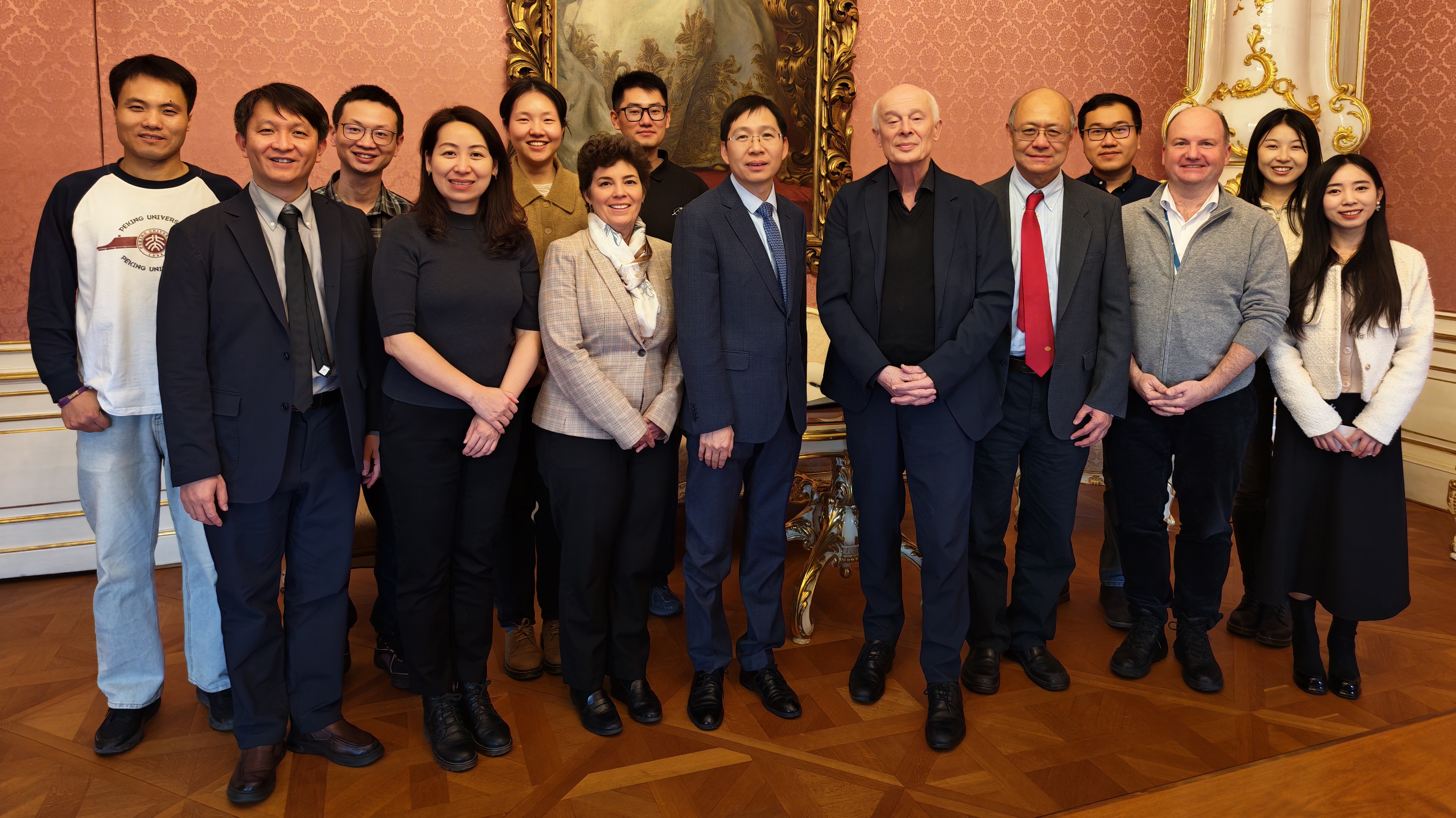 © IIASA
Peking University delegation visit to IIASA in November 2025.
News
06 October 2026
Nanjing University delegation visits IIASA to explore future collaboration
A high-level delegation from Nanjing University (NJU), led by Professor Tan Zhemin, President of NJU and Fellow of the Chinese Academy of Sciences, visited IIASA to discuss opportunities for strengthening scientific cooperation and advancing joint research on global challenges.
22 September 2026
IIASA at UNCCD COP17: Advancing land restoration and resilience
Building on its engagement at the 16th session of the Conference of the Parties to the United Nations Convention to Combat Desertification (UNCCD COP16) in Riyadh, IIASA contributed to a series of events and bilateral discussions at UNCCD COP17, held in Ulaanbaatar, Mongolia, towards the end of August. Under the theme, Restoring Land, Restoring Hope, COP17 advanced action on land degradation, drought resilience, and sustainable land management, with particular emphasis on rangelands and pastoral livelihoods.

21 August 2026
Overshoot Conference 2026 in Beijing: Abstract Deadline Extended
Taking place 24–25 November 2026 at Tsinghua University in Beijing, the conference is co-hosted by the International Institute for Applied Systems Analysis (IIASA) and Tsinghua University, and will bring together leading researchers, policymakers, innovators, and communicators to advance the global dialogue on overshoot pathways and responses.