

On 26 June 2026, the Austrian IIASA Committee gathered at the Austrian Academy of Sciences in Vienna for its 100th session – an afternoon focused on systems, science diplomacy, and the question of how to fit an entire world into a model.
In his welcome, Committee Chair Christian Köberl was quick to point out that the 100th meeting was not merely a matter of counting sessions, but an opportunity to show what the International Institute for Applied Systems Analysis (IIASA) means for Austria – looking back over the past 50 years while, at the same time, looking ahead into a landscape shifting both scientifically and geopolitically.
Alongside Academy Vice-President Ulrike Diebold, who emphasized the Academy’s enduring commitment to the Institute, he traced the line from the founding idea to the Committee’s tasks today: connecting Austrian research, policy, and the public with IIASA, representing Austria’s interests on the IIASA Council, and supporting early-career researchers.
IIASA was established in 1972 as a scientific bridge across the Iron Curtain, a place where researchers from rival and at times hostile nations could work together on global challenges. Austria was involved from the outset. As early as 1973 the Austrian Academy of Sciences (ÖAW) became the national member organization, and it has remained a generous partner ever since.
The Academy links Austrian science and public administration with IIASA, hosts high-profile events, and invests considerable effort in young researchers, funding their places at summer schools and in the popular IIASA Young Scientists Summer Program (YSSP), for instance. On 23 June 1975, the “Austrian IIASA Commission” convened for the first time under Professor Leopold Schmetterer. Fifty-one years, a renaming to “IIASA Committee” (2016), and precisely one hundred meetings later, the moment had come to look back.
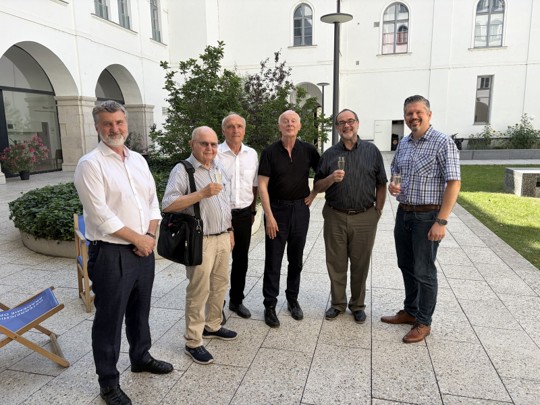 © IIASA
L–R: Heribert Buchbauer (BMFWF), Gerhard Glatzel (former Chair, Austrian IIASA Committee), Günther Fischer (Distinguished Emeritus Research Scholar, IIASA), Hans Joachim (John) Schellnhuber (Director General, IIASA), Christian Köberl (Chair, Austrian IIASA Committee) and Viktor Bruckman (NMO Secretary, Austrian IIASA Committee)
Looking back, with anecdotes
The living history fell to former chair Gerhard Glatzel, who shaped the Committee over many years. Speaking from the Academy’s perspective, he recalled people and episodes recorded in no official minutes and showed just how much the bond between the Academy and IIASA has rested (and still rests) on personal commitment. Several of these connections outlasted political upheavals and changes of government, and they go some way to explaining why Austria has remained so closely tied to the Institute for five decades.
From the oil crisis to the world climate panel
Günther Fischer, Distinguished Emeritus Scholar at IIASA, set out how an entire field of research grew from the energy questions that followed the 1973 oil shock and the Club of Rome’s Limits to Growth report. The MESSAGE energy model and the landmark report Energy in a Finite World (1981) produced the first global energy scenarios, and IIASA went on to become a dependable source of analysis for the Intergovernmental Panel on Climate Change (IPCC), as well as SRES (Special Report on Emissions Scenarios), RCPs (Representative Concentration Pathways), and SSPs (Shared Socioeconomic Pathways) – all acronyms underpinned by decades of modeling.
Systems analysis and an elephant in the seminar room
The afternoon’s finest cameo came (on a slide) from an elephant. Around the animal stand blindfolded men, each touching a different part and arriving at an entirely different conclusion. One could scarcely ask for a better illustration of applied systems analysis: whoever knows only the trunk takes the climate for a snake, the energy question for a wall, the economy for a rope. IIASA, by contrast, sets out to see the whole elephant. And because a single pair of hands is never enough, a good number of Nobel laureates helped feel out the bigger picture over the years: from Kantorovich and Koopmans to Crutzen, Schelling, and Nordhaus.
Science diplomacy: from stage to actor
Casting an eye forward was Heribert Buchbauer, head of the department for International Research Cooperation and Science Diplomacy at the Science Ministry (BMFWF). His theme was IIASA’s strategic positioning in a shifting geopolitical environment, and his verdict was unambiguous: science diplomacy is no longer a welcome extra, but a core competence. As a physical place of cooperation across ideological divides, IIASA is “science diplomacy by design”. His appeal: the Institute should move from being a mere stage to an active player, one that establishes its room for maneuver and conveys a clear, concise message to the wider world.
Science diplomacy remains a fine idea, but it must also be funded. The “next steps” list accordingly set out some very concrete intentions: raising the Institute’s profile in Austria, drawing more Austrian researchers into the Young Scientists Summer Program, and deepening ties with universities.
A new vision
The pace for the future is being set by the Institute’s leadership itself. Director General Hans Joachim (John) Schellnhuber, who has led IIASA since 2023, is pursuing a new vision that unites scientific excellence with global visibility. The Institute is working on precisely these questions as part of a sharpened research strategy with a strong science-diplomacy dimension – one that knows its room for impact and makes use of it. Schellnhuber thus embodies the ambition with which IIASA enters its second half-century: looking back not to rest, but to take a running start.
The afternoon’s proceedings were guided by NMO Secretary Viktor Bruckman, who as moderator wove together the threads of historical retrospect, energy modeling, and geopolitics, tracing a path from anecdote to strategy and, in doing so, drawing a single thread through five decades of IIASA history.
Looking ahead, there is no shortage of work for science to do: in a world forever redrawing its borders, institutions that work to bridge those divides and sketch out scenarios for a shared tomorrow are needed more than ever.
News

13 October 2026
Connecting disciplines and inspiring new ideas with the Environment and Climate Research Hub
IIASA Deputy Director General Karen Lips delivered a keynote at the University of Vienna's recent Environment and Climate Research Hub (ECH) Research Frontiers Workshop in Bad Vöslau, Austria, emphasizing the importance of interdisciplinary collaboration in addressing complex environmental and climate challenges.
12 October 2026
Connecting science across borders: IIASA Committee meets University of Salzburg
How can universities and international research organisations work together to address the complex challenges of a changing world? This question shaped a full day of scientific exchange at the University of Salzburg on 6 October, when the Austrian IIASA Committee met with members of the University community to discuss research, collaboration and opportunities for researchers and students.

24 September 2026
IIASA researcher joins Austrian Academy of Sciences working group on integrated carbon neutrality
On 15 September, Principal Research Scholar Thomas Schinko represented IIASA at a high-level event of the Commission on the De-Fossilization and Carbon Neutrality of the European Energy Systems (DEE) of the Austrian Academy of Sciences (OEAW). The meeting denoted the kick-off workshop of the newly established DEE Working Group "Transsectoral and Transcontinental Integration”.