
IIASA has emerged as one of Austria’s standout research institutions in a new Elsevier report titled, Austria as a Science and Technology Nation, which benchmarks the country’s scientific performance in an international context.
The report identifies IIASA as Austria’s most internationally collaborative research institution, with 90.3% of its publications produced through international co-authorship. This significantly exceeds Austria’s already high national average of 66.5%, which itself is well above the EU benchmark of 43% and the global average of 21%.
Elsevier describes IIASA as a research institute designed to operate as an international platform, noting that its organizational model and scientific mission are inherently geared toward cross-border collaboration and global knowledge exchange.
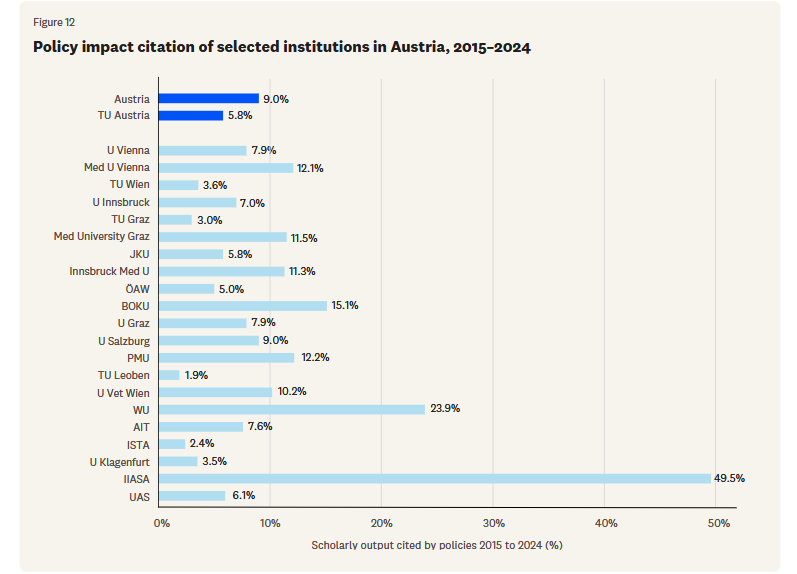
The report also identifies IIASA as Austria’s leading institution for policy-relevant scientific impact. According to the analysis, 49.5% of IIASA’s scholarly output is cited in policy documents – the highest share among Austria’s major research institutions and more than four times the Austrian national average of 12.1%.
 © Elsevier
Elsevier notes that institutions such as IIASA play a critical role in linking scientific evidence with governance and decision-making processes, and highlights policy citations as a measure of societal and political relevance.
In addition to its policy impact and international connectivity, IIASA is also recognized among Austria’s highest-performing institutions in terms of scientific influence, based on Field-Weighted Citation Impact (FWCI), which measures citation performance relative to the world average.
The report characterizes Austria as a “small but excellent” science and technology nation whose scientific influence exceeds its size, and identifies internationally connected institutions as central to that success. Within this landscape, IIASA stands out for its exceptional performance in both global scientific collaboration and policy engagement.
“The findings of this report reflect IIASA’s founding mission: bringing together the best science from across borders to support decision-making on the world’s most pressing challenges,” notes IIASA Director General Hans Joachim (John) Schellnhuber. “At a time of growing global complexity, international scientific cooperation and evidence-based policy are more important than ever.”
Austria is IIASA’s host country and one of the Institute’s founding members, with IIASA headquartered in Laxenburg near Vienna since 1973. The Austrian Academy of Sciences (OeAW) serves as Austria’s National Member Organization to IIASA, representing the country within the Institute’s international governance framework.
About the report
The report, Austria as a Science and Technology Nation, was produced by Elsevier and analyzes publication output, citation impact, international collaboration, academic-industry cooperation, patent relevance, and policy influence across Austria’s leading research institutions.
News
15 October 2026
IIASA strengthens science diplomacy ties at UNGA in New York
IIASA Science Diplomacy Director and Head of Communications and External Relations Susie Kitchens represented the Institute at the United Nations General Assembly (UNGA) High-level Week and Science Summit in New York in September, contributing to discussions on how science and international cooperation can help address shared global challenges.

13 October 2026
Connecting disciplines and inspiring new ideas with the Environment and Climate Research Hub
IIASA Deputy Director General Karen Lips delivered a keynote at the University of Vienna's recent Environment and Climate Research Hub (ECH) Research Frontiers Workshop in Bad Vöslau, Austria, emphasizing the importance of interdisciplinary collaboration in addressing complex environmental and climate challenges.
12 October 2026
Connecting science across borders: IIASA Committee meets University of Salzburg
How can universities and international research organisations work together to address the complex challenges of a changing world? This question shaped a full day of scientific exchange at the University of Salzburg on 6 October, when the Austrian IIASA Committee met with members of the University community to discuss research, collaboration and opportunities for researchers and students.