
A new article emphasizes the need for “safe zones” for researchers amid escalating geopolitical tensions. It uses the history of IIASA – established as a neutral ground during the Cold War – as a prime example.
In the article, published in Nature, researchers from the US and China discuss the fraying political relationship between the two countries, which is causing their scientific ties to weaken and become increasingly fragile. The authors call this a “dangerous trend”.
They highlight IIASA as a showcase of a "safe zone," noting that during the Cold War, while political leaders were clashing, IIASA's foundation facilitated scientific cooperation between divided nations.
“IIASA's mission of fostering cross-border scientific cooperation for the greater good is more crucial than ever. Amid the pressing challenges of our time – climate change, environmental degradation, pandemics, migration, and regional conflicts – we must not retreat from 'soft' diplomacy, but instead strengthen and expand it,” says IIASA Director General Hans Joachim (John) Schellnhuber.
The article argues that scientific communities in both nations have the potential to develop groundbreaking technologies and ideas that could benefit the world, such as clean energy innovations and advanced medicines. However, if these communities are further divided, the pace of discovery will slow, and scientists will be less equipped to respond collectively to global challenges.
To navigate this divide, scientists must become more politically aware and take a proactive role in defining the terms of engagement. The authors call on US and Chinese researchers to collaborate in identifying and advocating for so-called “safe zones” – areas of research that offer significant collaborative value while being less impacted by geopolitical tensions.
The article also takes a closer look at the history of collaboration between the US and China, highlighting the low number of student exchanges of scientists and engineers, due to recent political tensions.
Click here to read the Nature article.
Both the US and China are members of IIASA.
China, through the National Natural Science Foundation of China (NSFC), has been a member of IIASA since 2002. In 2023, a joint event between IIASA and the NSFC, highlighted the continued collaboration between the Institute and the Chinese scientific community and the ongoing research exchange through the Young Scientists Summer Program (YSSP). Key areas of scientific collaboration range from air pollution control to demographic impacts and rural energy transition.
In November and December 2024, an IIASA delegation consisting of IIASA Director General Hans Joachim (John) Schellnhuber and IIASA Sherpa for Asia, Wolfgang Lutz, visited the NSFC, Peking University, and Tsinghua University (THU), where a Memorandum of Understanding (MoU) between IIASA and the university was signed to advance global research and education.
Last month, a high-level delegation from Beihang University visited IIASA to sign an MoU officially extending their collaboration. The renewed partnership will focus on the GAINS-Beihang model, along with other joint projects.
The US, through the National Academy of Sciences, is one of the founding members of IIASA. Last year, IIASA leadership traveled to Washington DC for a series of meetings with members of the US IIASA Committee and other key stakeholders.
Meetings with the White House Office of Science and Technology Policy, the National Science Foundation, the World Bank, and the IMF aimed to establish new partnerships and enhance existing ones, integrating IIASA models into broader initiatives. Discussions with senior NASA scientists, including Chief Scientist Kate Calvin, an alumna of IIASA’s Young Scientists Summer Program, explored positioning IIASA as a hub for NASA and identifying areas for deeper collaboration.
News
06 October 2026
Nanjing University delegation visits IIASA to explore future collaboration
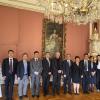
A high-level delegation from Nanjing University (NJU), led by Professor Tan Zhemin, President of NJU and Fellow of the Chinese Academy of Sciences, visited IIASA to discuss opportunities for strengthening scientific cooperation and advancing joint research on global challenges.

22 September 2026
IIASA at UNCCD COP17: Advancing land restoration and resilience
Building on its engagement at the 16th session of the Conference of the Parties to the United Nations Convention to Combat Desertification (UNCCD COP16) in Riyadh, IIASA contributed to a series of events and bilateral discussions at UNCCD COP17, held in Ulaanbaatar, Mongolia, towards the end of August. Under the theme, Restoring Land, Restoring Hope, COP17 advanced action on land degradation, drought resilience, and sustainable land management, with particular emphasis on rangelands and pastoral livelihoods.

21 August 2026
Overshoot Conference 2026 in Beijing: Abstract Deadline Extended
Taking place 24–25 November 2026 at Tsinghua University in Beijing, the conference is co-hosted by the International Institute for Applied Systems Analysis (IIASA) and Tsinghua University, and will bring together leading researchers, policymakers, innovators, and communicators to advance the global dialogue on overshoot pathways and responses.