
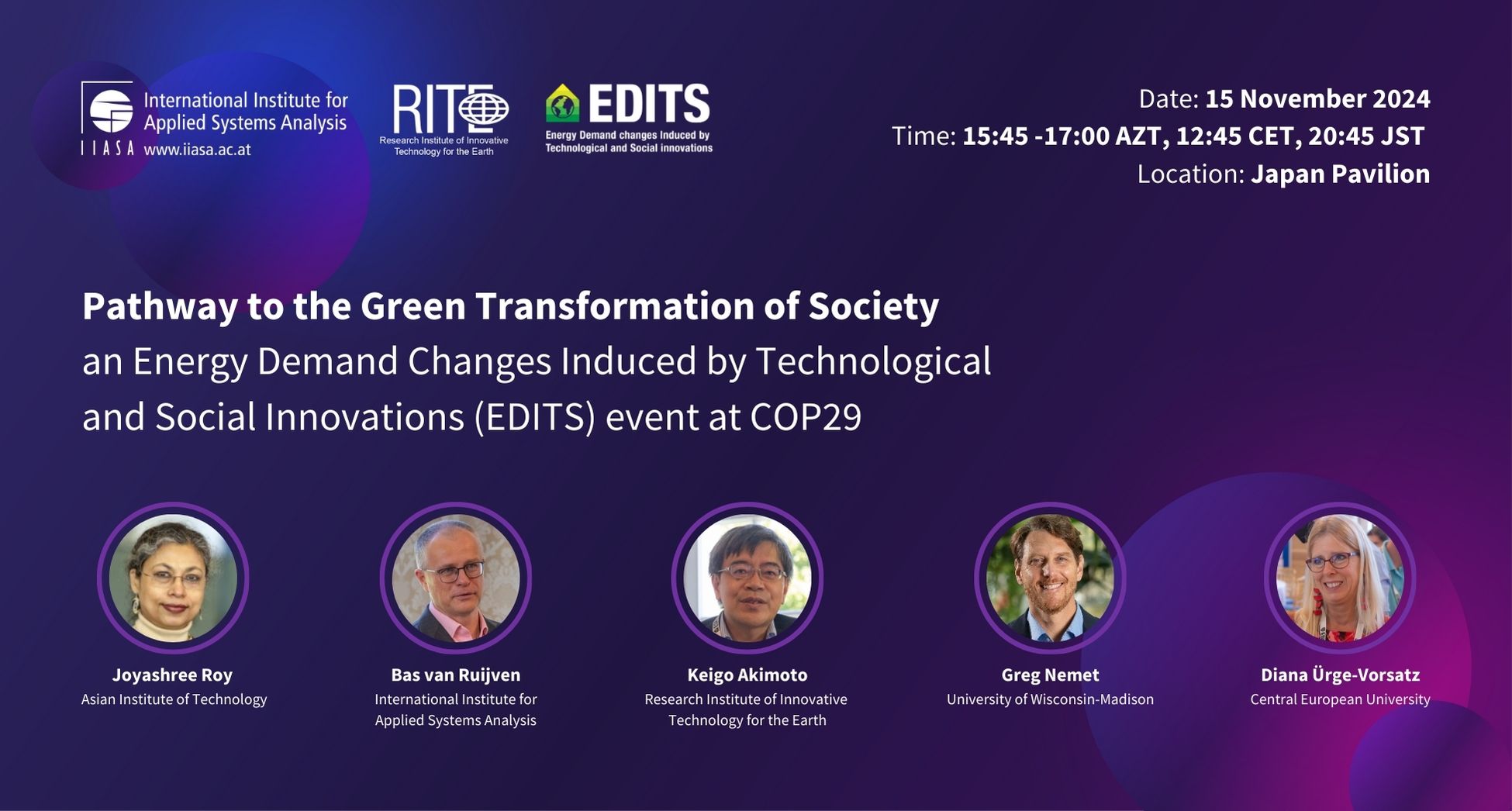
Diffusion of novel digital technologies and major social innovation trends are expected to bring about changes on the demand-side that roll-out GX in the entire socio-economy. A comprehensive evaluation of these initiatives is important in presenting the pathway to the Green Transformation of society.
 © IIASA
The speakers presented the frontiers in low energy and material demand knowledge and practices based on recent work from the Energy Demand changes Induced by Technological and Social innovations (EDITS) network, and explore how a demand-side transition can contribute to rapid and successful climate change mitigation.
Program
Moderator: Joyashree Roy, Asian Institute of Technology, Thailand
15:45-15:50 Welcome and GX policies in Japan - Hiroshi Maeda, Director, Global Environmental Affairs Office, GX Policy Group, Ministry of Economy, Trade and Industry (METI), Japan
15:50-15:55 Opening remarks on social and technological transformation with low demand [link to presentation] - Bas van Ruijven, International Institute for Applied Systems Analysis (IIASA), Austria
15:55-16:05 Importance of demand-side solutions for the net-zero society transformation [link to presentation] - Keigo Akimoto, Research Institute of Innovative Technology for the Earth (RITE), Japan
16:05-16:15 Innovation for socio-technological-economic transformation [link to presentation] - Greg Nemet, University of Wisconsin-Madison, La Follette School of Public Affairs, Wisconsin Energy Institute, USA
16:15-16:25 Urban space and society: the role of demand-side innovations [link to presentation] - Diana Ürge-Vorsatz, Professor, Central European University (CEU), Austria / Vice-Chair, IPCC
16:25-16:35 Policy as a catalyst in the green transition for developing countries [link to presentation] - Joyashree Roy, Professor, Asian Institute of Technology (AIT), Thailand
16:35-17:00 Panel comments: innovation and mitigation – Joyashree Roy, Asian Institute of Technology, Thailand
 © IIASA
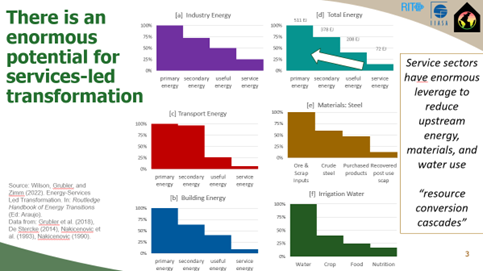
The energy cascade. Source: Wilson et al. 2022. in the presentation by Bas van Ruijven
The event was started with a welcome by Mr. Hiroshi Maeda from METI and a kick-off and welcome speech by Dr. Keigo Akimoto, RITE. Dr. Bas van Ruijven argued how demand-side solutions deliver system-wide changes and leverage up-stream savings through the energy cascade (Figure 1). Social and technological transformations are equally important in enabling low energy demand futures.
 © IIASA
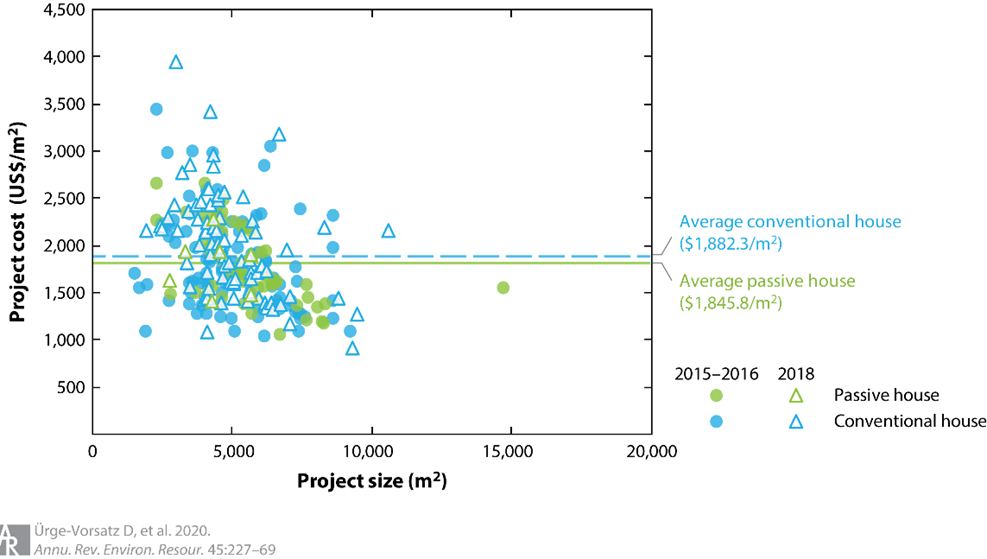
Project costs of standard and advanced constructions. Source: Urge-Vorsatz et al. 2020 in Presentation by Diana Urge-Vorsatz
Social innovations follow similar patterns as technological innovations distribution. Early adopters are critical, because they enable the testing of social change. These individuals are typically more risk-taking, environmentally more savvy, and often have social concerns. Mainstream adopters avoid risk, nevertheless they willingly follow through and adopt proven social practices, either because of the benefits or policy backing. Dr Nemet said that his research shows that the formative phase of social innovation patterns is critical, it can serve as a turning point, as well as define the speed of the spread. Social innovations could still enable fast decarbonization, which is the hope to still achieve climate goals. Dr Roy's policy example on mobility fuel-mix transformation in Pakistan demonstrated the emphasis on relevant and effective policies at turning points of the pattern formation, but especially in the roll-out phase mentioned. The policy sequence for fuel shift was very fast compared to other countries building on the local fuels, interest and collaboration, as well as policy. The Sufficiency Economy Principle in Thailand is an astounding policy example in the developing world that lays the intersection of energy savings and efficiency. It has been a cornerstone of the Thai policy system since 1973, way before the international support (e.g. IPCC 2022, GEA 2012, UNDP 2007). From 2007 SEP is integrated into Thai constitution.
Participants raised the issue of financing, especially in comparison to other finance needs, such as renewables, SDGs, carbon removal, etc. Dr. Urge-Vorsatz had previously shown that the costs of standard construction and advanced construction are in the same range (Figure 2). The panel agreed that financing is a key issue, and while energy-demand solutions are known to be very cheap relative to other interventions, there seem to be a combination of barriers that together limit full fledged upscaling.
Dr van Ruijven pointed out that the benefits that other than financial and climate, can be really emphasized (social, wellbeing, environmental, etc) impacts. According to Dr Urge-Vorsatz, financing of various targets could be cross-used, e.g. demand-side measures bring many other social benefits, water quality and quality improvements, have SDG relevance, thus climate finance and SDG finance largely overlap. We can achieve more targets with single investments, at the end of the day.
Finally, a very interesting proposal was raised by a colleague from the Danish government. Other climate areas, such as renewables, fossil fuels, etc. have clearcut pledges, and it would be interesting what kind of energy-demand targets or pledges would make sense. Dr. Nemet pointed out that there are many and successful energy saving yearly or overall targets in many US states, and in the EU and also other countries. These are generally successful and effective. Dr Roy reminded that the IPCC identified 40-70% mitigation effort could be covered by demand-side solutions. Dr Urge-Vorsatz emphasized the leveraging effects of more efficient and sufficient housing, with impacts on materials, and urban environments, leading to reduced impacts multiplying, while leveraging multiple benefits.
Dr van Ruijven informed the participants that there is a Transport Pledge at the COP29, which is in fact mostly built on demand-side measures, and encourages all to sign. Dr Keigo Akimoto indicated that the research and expert community working together within the EDITS network, Energy Demand changes Induced by Technological and Social innovations furthers the knowledge and evidence base in these discussed areas and welcomes further discussion on energy-demand measures and solutions.
Download the agenda and link for the streaming.
Upcoming Events
Yerevan, Armenia
IIASA at the United Nations Biodiversity Conference
Shanghai University
Workshop: Rethinking Urbanization in Asia
Hangzhou, China
A shared agenda for population ageing
Chulalongkorn University, Thailand
Training workshop: Demographic analysis with applications to aging, health, and education
Antalya, Türkiye
IIASA at the UN Climate Change Conference
Vienna, Austria
On sense and nonsense of end-of-the-world predictions
Austrian Academy of Sciences, Festive Hall, Dr. Ignaz Seipel-Platz 2, 1010 Vienna
On a Collision Course in Orbit: Who Bears Responsibility for Space Debris?
Beijing, China
Overshoot Conference 2026
Austrian Academy of Sciences (ÖAW), Seminar Room 1, Bäckerstraße 13, 1010 Vienna, Austria
Citizen Science and Remote Sensing for Forest Monitoring
IIASA, Laxenburg, Austria