
Strengthening Extreme Events Detection for Floods and Droughts (SEED-FD)
Introduction
Floods and droughts can severely impact communities, particularly in regions with unreliable early warning systems, such as parts of the Global South. SEED-FD is a Horizon Europe research project that aims to enhance the global prediction of extreme hydrological events. By integrating satellite data and local micro-sensors, SEED-FD improves the accuracy of flood and drought forecasts.
Building on the Copernicus Emergency Management Service (CEMS), SEED-FD develops enhanced prediction systems for global application. More precise forecasts save lives, protect essential resources, and help communities become more resilient in a rapidly changing climate.
 © SEED-FD Consortium
Project Aims
- Enhance the CEMS hydrological model
- Enhancing CEMS hydrological simulations and forecasts globally
- Expanding the CEMS early warning system forecast product portfolio for floods and droughts
Phases
The project is composed of two distinct phases:
- a scientific development phase
- a scale-up validation phase
The phases are linked together by a prototyping stage.
Different case studies are used for different phases.
Case Studies
Case studies are essential in SEED-FD, providing real-world scenarios to test and refine our hydrological models and forecasting tools. By focusing on specific regions, the project ensures its solutions are effective, adaptable, and reliable, ultimately enhancing disaster preparedness and resilience across diverse environments.
Development Phase: Danube and Bhima
In the development phase, SEED-FD focuses on the Danube and Bhima River Basins. These data-rich regions serve as testbeds to implement and evaluate evolutions before they reach maturity, benchmarking against the existing CEMS EWS capability for forecasting floods and droughts. The Danube flows through diverse climates in Central and Eastern Europe, while the Bhima in India experiences monsoon-driven weather, enhancing model accuracy and adaptability.
Validation Phase: Juba-Shebelle, Niger and Paraná
During the validation phase, SEED-FD expands efforts to the Juba-Shebelle, Niger and Paraná River Basins. The Juba-Shebelle Basin in the Horn of Africa faces semi-arid conditions and frequent droughts. The Niger River in West Africa experiences seasonal floods, while the Paraná River in South America has significant hydrological variability. These areas represent diverse hydrological challenges, allowing to fine-tune the forecasting models and enhance prediction accuracy.
Validation Phase: World
In the final step of the validation phase, SEED-FD demonstrates the global applicability of new hydrometeorological extreme event detection and prediction products. By applying advanced algorithms to existing CEMS datasets, SEED-FD compares results with documented real-life events. This aims to enhance global disaster preparedness, providing precise flood and drought predictions around the world.
SEED-FD Project Team
The consortium is led by Magellium (France).
The consortium consists of the following partners:
- International Institute for Applied Systems Analysis (Austria)
- Consiglio Nazionale delle Ricerche (Italy)
- Design & Data (Germany)
- IGAD Climate Prediction and Applications Centre (Kenya)
- European Centre for Medium-Range Weather Forecasts
- The Research Institute for Geo-Hydrological Protection (Italy)
- VorteX-io (France)
- Politecnico di Milano (Italy)
- Joint Research Centre of the European Union
IIASA Project Team

Peter Burek
Senior Research Scholar (WAT)

Carla Catania
Researcher (WAT)

Florian Sorger-Domenigg
Researcher (WAT)

Taher Kahil
Research Group Leader and Senior Research Scholar (WAT)
IIASA's Role
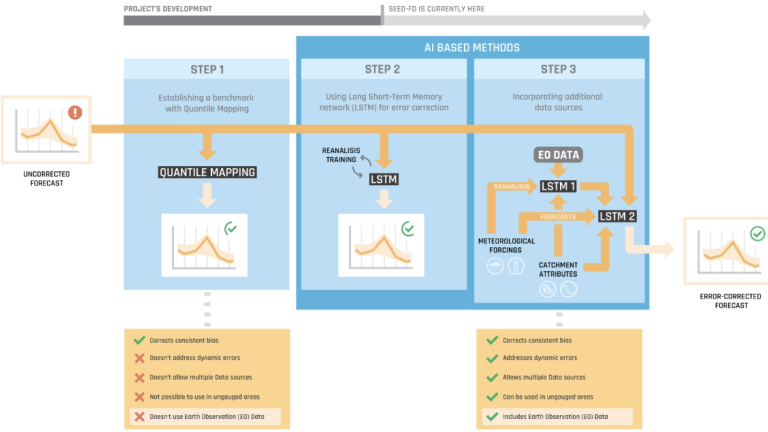
In the SEED-FD project, IIASA improves the LISFLOOD Hydrological Model by adding new process representations, enhancing evaporation processes, refining soil and discharge routing schemes, and optimizing reservoir operations. These enhancements boost the accuracy and reliability of flood and drought forecasts.
Further information and Project Outputs
 © European Union