




This project aims to develop an advanced wildfire spread prediction algorithm capable of explicitly simulating ember-driven spotting and re-ignition processes under extreme fire weather conditions. The project integrates the ignition probability framework of IIASA’s Wildfire climate impacts and adaptation model (FLAM) with the deterministic wildfire spread model of the Korea Forest Service (KFS).
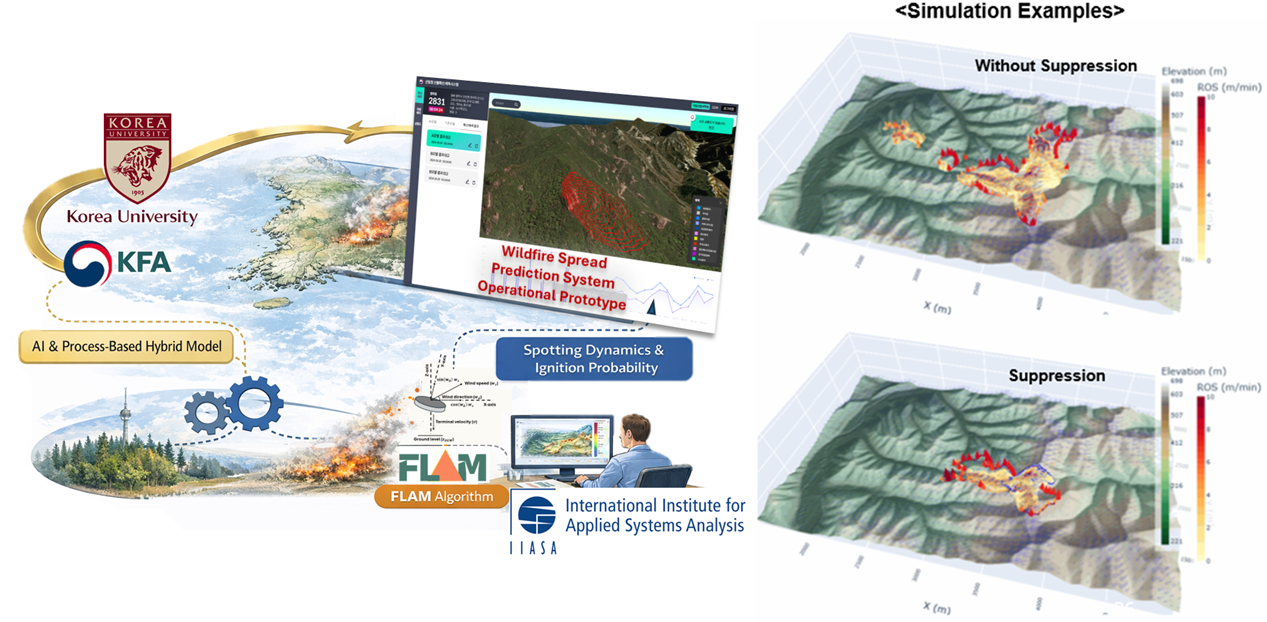 © IIASA
The primary objectives of this project are:
• To develop a high-resolution wildfire spread algorithm that explicitly models ember spotting and re-ignition processes through integration of the IIASA FLAM model and the Korea Forest Service’s wildfire spread model
• To enhance predictive accuracy under extreme wildfire scenarios by incorporating probabilistic ignition estimation based on environmental variables such as fuel moisture and fuel load
• To construct a nationwide dataset to support model implementation and ensure scalability and applicability across diverse regions of Korea
The project will follow a modular, Python-based development approach with the following technical directions:
• Development of a probabilistic algorithm to estimate ember spotting frequency and transport distance under varying environmental conditions, including wind speed, topography, and fuel characteristics
• Implementation of a re-ignition probability module at ember landing locations, utilizing ignition probability equations derived from IIASA’s FLAM model
• Resolution of key limitations in the current KFS deterministic model, which does not account for ember-induced re-ignition or cascading secondary fires
• Integration of FLAM’s validated ignition probability functions to enable realistic simulation of fire propagation beyond firebreaks and across non-burnable or fragmented landscapes
• Improvement of fire behavior prediction under dry and extreme weather conditions through repeated and probabilistic spotting simulations
The project will deliver a scientifically robust, operationally relevant wildfire spread prediction capability that:
• Enables realistic simulation of ember-driven re-ignition and cascading fire spread
• Improves predictive performance under extreme wildfire and drought conditions
• Supports national-scale wildfire risk assessment and operational decision-making in Korea
• Provides a modular, extensible Python framework suitable for future research and policy applications
This project is funded by Korea Forest Service.