




IIASA researchers have coauthored a new report published by The Nature Conservancy that maps converging climate risks to food, water, and biodiversity, and provides a practical framework to scale nature-based solutions that strengthen resilience for people and nature.
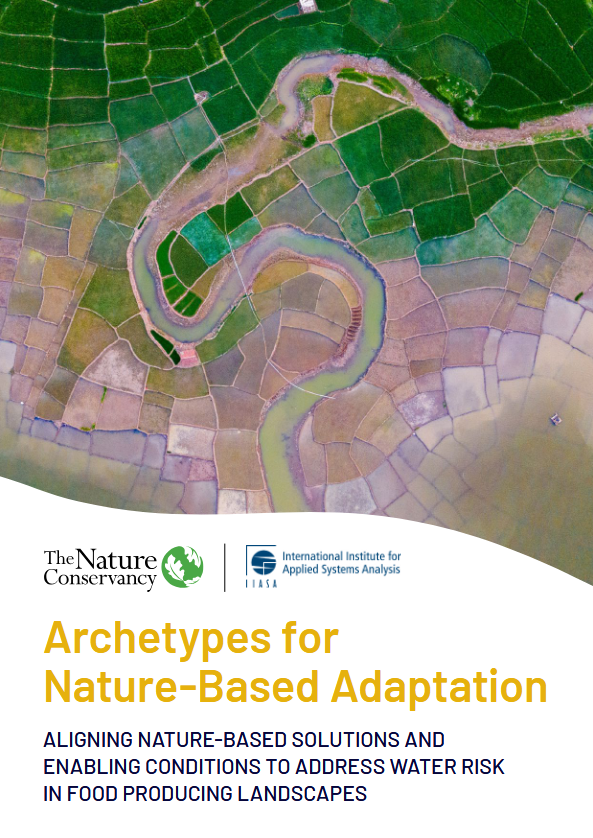 © .
© .
As climate risks intensify, solutions must work across entire landscapes. The new report titled, Archetypes for Nature-Based Adaptation: Aligning Nature-Based Solutions and Enabling Conditions to Address Water Risk in Food Producing Landscapes, identifies where water stress, flooding, groundwater decline, and water quality threats collide. It then explores how nature-based solutions (NbS), paired with enabling policy and finance, can build resilience for people and nature.
The authors highlight that as the climate crisis accelerates, risks to food, water, and biodiversity are increasingly interlinked, while the modeling visualizes future water impacts to help decision-makers act at the right scale.
Key findings include:
- By 2050, one-quarter of land could see drought frequency increase by 70%+, with some regions like North Africa experiencing spikes up to 2,500%.
- 36% of land may face surface-water stress; most of that area is projected to experience severe stress.
- Global groundwater stress is expected to rise by ~30%.
- Nutrient pollution will push ~1/3 of rivers beyond ecological thresholds; many will reach levels that threaten human health.
- 64% of freshwater biodiversity hotspots will be at risk from water stress – most of these outside protected areas.
- Up to 25% of global crop nutrient production (zinc, iron, vitamin A) is at risk.
These impacts are not isolated. They are deeply interconnected, especially in regions that serve as agricultural powerhouses ranging from the Indo-Gangetic Plains to the Great Plains of the United States. This shared vulnerability opens the door for cross-border collaboration and knowledge exchange in terms of shared water risks and solutions that can transfer across borders.
To support landscape-level adaptation, the report introduces four archetypes of water-related risk in food-producing landscapes. Each archetype is paired with a menu of nature-based solutions and the enabling conditions (policy, finance, governance, markets, partnerships) that make them durable.
The four archetypes:
- Surface-water stress in mixed production systems
As rainfall declines and droughts intensify, demand on rivers and reservoirs grows. NbS, including efficient irrigation, crop shifts, and reconnecting rivers to floodplains, can reduce withdrawals and sustain flows. Scaling requires shared basin goals and inclusive governance from farm to watershed.
- Groundwater sustainability in irrigated systems
The world’s breadbaskets show the highest groundwater stress. NbS such as low-water crops, continuous ground cover, and floodplain reconnection to enhance recharge, help curb demand and sustain groundwater-dependent ecosystems. Scaling depends on locally led management, farmer engagement, and supportive incentives.
- Water quality in intensive agriculture
Nutrient loading from intensive systems disrupts ecosystems, fisheries and drinking water. NbS like cover crops, riparian buffers, wetland restoration, and bivalve recovery, can reduce nitrogen and phosphorus. Scaling works when producers have access to finance, advisory services, and market signals (e.g., credits, reduced-input markets).
- Flooding in diverse farming systems
With ~24% of croplands in flood-prone areas, floodplain restoration and riparian buffers can reduce risk while supporting habitat and production. Scaling calls for cross-sector coordination, hazard monitoring and blended finance to manage near-term risk and long-term resilience.
IIASA researchers provided key modeling and analytical support for the report, enabling global-scale assessments of water, food, and biodiversity risk as well as the mapping of enabling conditions for NbS deployment. Specifically, Peter Burek, Dor Fridman, Albert Nkwasa, Carla Catania, Michael Obersteiner, and Taher Kahil contributed modeling expertise, scenario analysis, and spatial-risk mapping that informed the report’s archetype framework and enabling-condition design.
“Working at the intersection of food, water, and nature we found that nature-based interventions can only deliver at scale when the supporting systems, including policy, finance, and governance, are aligned,” says Kahil, who leads the Water Security Research Group at IIASA. “Our models show where the risks are multiplying and where NbS can make a difference, but also where the enabling environment must catch up.”
The authors call for action on multiple fronts: scaling up policy, finance, and governance mechanisms; integrating NbS into food-water-nature planning; expanding monitoring and data systems; and shifting from pilots to landscape-scale deployment. Through its partnership with The Nature Conservancy, IIASA is planning further work to refine regional modeling, downscale archetype frameworks, and support country-level implementation roadmaps.
Adapted from text prepared by The Nature Conservancy. Read the original article.
News

07 October 2026
MOSAIC results highlighted during Austria’s Protective Forest Week 2026
MOSAIC project results and IIASA research on climate-resilient protective forests are featured during Austria’s Protective Forest Week 2026, including work on wildfire risk, decision-support tools, and the Alpine Resilience Web Atlas.

06 October 2026
Nanjing University delegation visits IIASA to explore future collaboration
A high-level delegation from Nanjing University (NJU), led by Professor Tan Zhemin, President of NJU and Fellow of the Chinese Academy of Sciences, visited IIASA to discuss opportunities for strengthening scientific cooperation and advancing joint research on global challenges.
06 October 2026
IIASA celebrates long-term partnership with MSc European Forestry Program
Coordinators, partners and graduates of the MSc European Forestry program visited IIASA on 29 September 2026. Twenty visitors from at least eight countries came as part of the alumni event held alongside the program's graduation ceremony at BOKU University in Vienna.