
IIASA is proud to announce that 11 researchers from across various IIASA programs have been named on the 2022 Highly Cited Researchers™ list from Clarivate.
The highly anticipated annual Highly Cited Researchers™ list draws on the data and analysis performed by bibliometric experts and data scientists at the Institute for Scientific Information™ at Clarivate. The institute uses both quantitative and qualitative analysis to identify individuals from across the globe who have demonstrated significant and broad influence in their chosen field or fields of research. The preliminary list of Highly Cited Researchers is drawn from the highly cited papers that rank in the top 1% by citations for field and publication year in the Web of Science™ citation index over the past decade.
This year’s list includes 7,225 researcher awards from 69 countries and regions issued to 6,938 individuals. The number of awards exceeds the number of unique individuals as some researchers received recognition in more than one Essential Science Indicators™ (ESI) field of research.
The following IIASA researchers were selected for their exceptional influence and performance in the fields of environment and ecology research, cross-field research, geosciences, and social sciences:
- Oliver Fricko, research scholar in the Integrated Assessment and Climate Change and Sustainable Service Systems research groups of the Energy, Climate, and Environment Program.
- Petr Havlik, Integrated Biosphere Futures Research Group Leader in the Biodiversity and Natural Resources Program.
- Zbigniew Klimont, Pollution Management Research Group Leader in the Energy, Climate, and Environment Program
- Volker Krey, Integrated Assessment and Climate Change Research Group Leader in the Energy, Climate, and Environment Program.
- Michael Obersteiner, principle research scholar in the Exploratory Modeling of Human-natural Systems Research Group of the Advancing Systems Analysis Program.
- Keywan Riahi, Energy, Climate, and Environment Program Director.
- Hugo Valin, formerly a senior research scholar in the Integrated Biosphere Futures Research Group of the Biodiversity and Natural Resources Program, but currently affiliated with the Organisation for Economic Co-operation and Development (OECD).
- Yoshihide Wada, Biodiversity and Natural Resources Program Director.
Yoshihide Wada is one of only 219 researchers recognized in two fields (environment and ecology, and geosciences), while Keywan Riahi is one of only 28 researchers recognized for showing exceptionally broad performance being highly cited in three or more fields (environment and ecology, geosciences, and social sciences).
Three researchers with IIASA listed as their secondary affiliation also made the list:
- Shinichiro Fujimori, senior guest research scholar in the Energy, Climate, and Environment Program primarily associated with Kyoto University, Japan.
- Andreas Richter, a guest senior research scholar in the Advancing Systems Analysis Program primarily associated with the University of Vienna, Austria.
- Joeri Rogelj, a researcher in the Energy, Climate, and Environment Program primarily associated with Imperial College London, UK.
“Research fuels the race for knowledge and it is important that nations and institutions celebrate the individuals who drive the wheel of innovation. The Highly Cited Researchers list identifies and celebrates exceptional individual researchers who are having a significant impact on the research community as evidenced by the rate at which their work is being cited by their peers. These individuals are helping to transform human ingenuity into our world’s greatest breakthroughs and it is an honor to celebrate their achievements,” says David Pendlebury, head of Research Analysis at the Institute for Scientific Information at Clarivate.
“IIASA aims at the combination of scientific excellence with relevance to policymaking in fields that are crucial for the future of humanity. While we are proud of each highly performing scientist, it is even more impressive to see them work together on projects that have real impact,” concludes Interim IIASA Deputy Director General for Science, Wolfgang Lutz.
IIASA extends its heartfelt congratulations to all these researchers on this exceptional achievement.
The full 2022 Highly Cited Researchers list can be found online here.
News
15 October 2026
MowingQuest system-test campaign 2026 concludes, data collection continues
IIASA’s MowingQuest citizen-science campaign has wrapped up its August–September 2026 system test, with 25 pioneer users submitting almost 800 observations across eight countries. The results will help improve the app and data-quality workflows ahead of the main 2027 campaign. Two participants have also won Garmin GPS watches in the campaign raffle.
06 October 2026
Nanjing University delegation visits IIASA to explore future collaboration
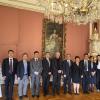
A high-level delegation from Nanjing University (NJU), led by Professor Tan Zhemin, President of NJU and Fellow of the Chinese Academy of Sciences, visited IIASA to discuss opportunities for strengthening scientific cooperation and advancing joint research on global challenges.

23 September 2026
IIASA researchers strengthen cooperation with Kyrgyzstan on AI and industrial development
IIASA Cooperation and Transformative Governance (CAT) Research Group Leader and Senior Research Scholar Nadejda Komendantova and CAT Research Scholar Dmitry Erokhin have contributed to a series of scientific and policy forums in Kyrgyzstan in 2026. Their research on artificial intelligence in the production sector builds on IIASA’s longstanding cooperation with the country on sustainable industrial development.