

IIASA congratulates Fu Bojie on receiving this year’s TWAS – Lenovo Science Award, in recognition of his seminal contribution to the understanding of interactions between human beings and the environment, and their implications for sustainability.
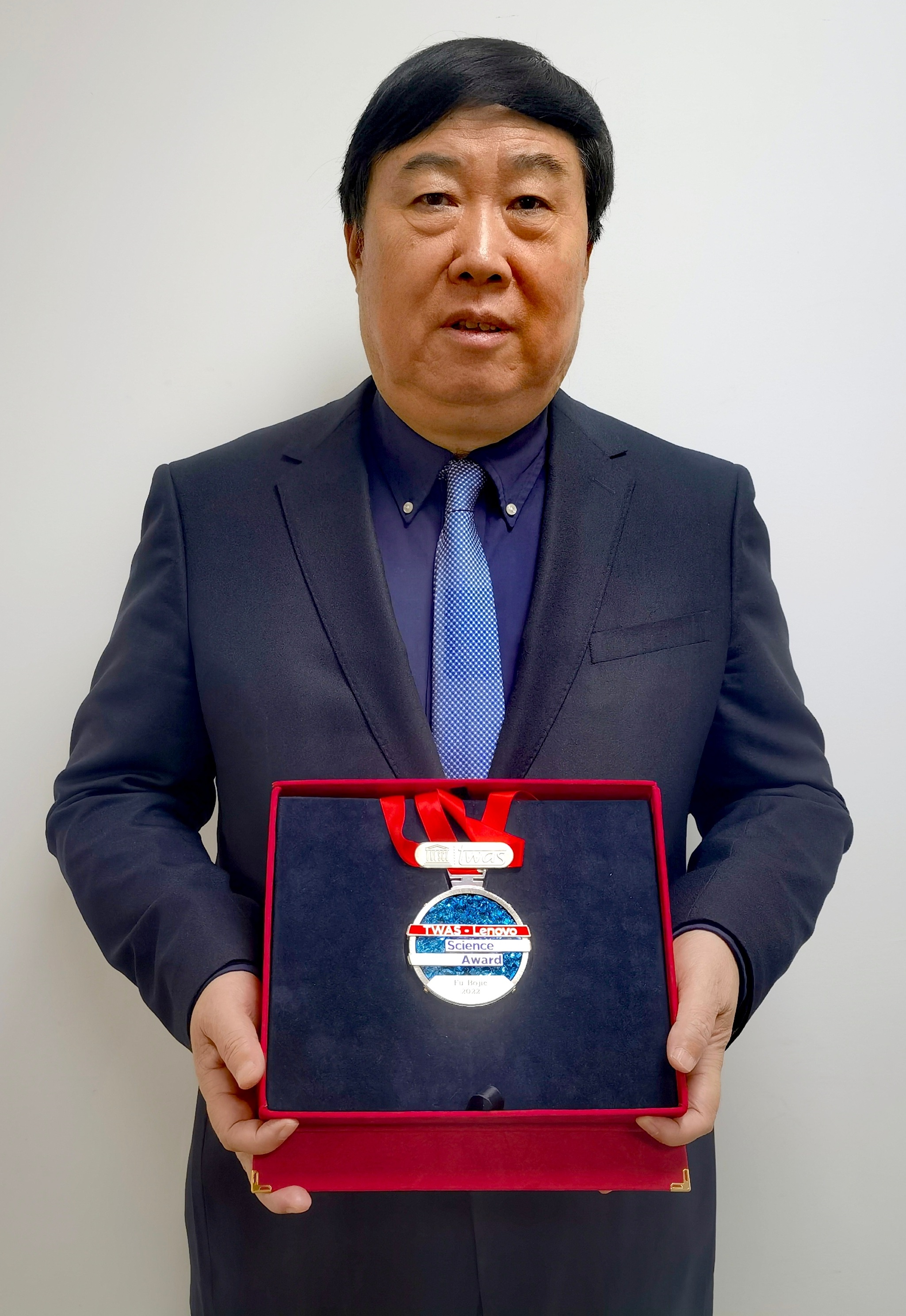 © Fu Bojie
Fu Bojie
The World Academy of Sciences (TWAS) was founded in 1983 by a distinguished group of scientists from the developing world under the leadership of Abdus Salam, the Pakistani physicist and Nobel laureate. They shared a belief that developing nations, by building strength in science and engineering, could build the knowledge and skill to address such challenges as hunger, disease, and poverty. Today, TWAS has 1,296 elected fellows representing more than 100 countries, among which are 11 Nobel laureates. Around 84% come from developing nations, and the rest are scientists from the developed world whose work has had a significant impact in the South. Once a year, the TWAS-Lenovo Science Award honors scientists in the global South who have reached the apex of scientific accomplishment.
Prof. Fu, a member of the IIASA Science Advisory Committee since 2017, is a Distinguished Professor and Chair of the Steering Committee at the Research Centre for Eco-Environmental Sciences of the Chinese Academy of Sciences. Currently, he serves as the Vice President of the International Geographical Union (IGU) and was elected an International Honorary Member of the American Academy of Arts and Sciences in 2019.
For his scientific work, which comprises more than 500 articles and 12 books, and primarily focuses on Physical Geography and Landscape Ecology, he has received numerous prizes and awards. His research has been published in leading international journals like Nature, Science, Nature Climate Change, and Nature Geoscience.
The detailed announcement and more information on TWAS can be found here.
News
06 October 2026
Nanjing University delegation visits IIASA to explore future collaboration
A high-level delegation from Nanjing University (NJU), led by Professor Tan Zhemin, President of NJU and Fellow of the Chinese Academy of Sciences, visited IIASA to discuss opportunities for strengthening scientific cooperation and advancing joint research on global challenges.
22 September 2026
IIASA at UNCCD COP17: Advancing land restoration and resilience
Building on its engagement at the 16th session of the Conference of the Parties to the United Nations Convention to Combat Desertification (UNCCD COP16) in Riyadh, IIASA contributed to a series of events and bilateral discussions at UNCCD COP17, held in Ulaanbaatar, Mongolia, towards the end of August. Under the theme, Restoring Land, Restoring Hope, COP17 advanced action on land degradation, drought resilience, and sustainable land management, with particular emphasis on rangelands and pastoral livelihoods.

21 August 2026
Overshoot Conference 2026 in Beijing: Abstract Deadline Extended
Taking place 24–25 November 2026 at Tsinghua University in Beijing, the conference is co-hosted by the International Institute for Applied Systems Analysis (IIASA) and Tsinghua University, and will bring together leading researchers, policymakers, innovators, and communicators to advance the global dialogue on overshoot pathways and responses.