

Freshwater ecosystems are under growing pressure worldwide, but conservation resources are limited. A framework developed by IIASA researchers and partners can help identify where conservation could prevent biodiversity loss and where restoration efforts are likely to have the greatest ecological impact across the United States and Europe.
Freshwater biodiversity is declining faster than biodiversity in terrestrial or marine ecosystems. Yet conservation efforts often lack practical tools to identify where action is most urgently needed.
Stream fish communities offer critical insights into the condition of freshwater habitats. As landscapes are modified for agriculture, urban development, and other human uses, stream fishes respond in predictable ways. However, these responses are not always gradual. Rather than declining steadily, fish communities often reach "tipping points" where environmental pressures exceed a critical threshold, leading to substantial shifts in species composition and abundance. Once these thresholds are crossed, ecological conditions can deteriorate rapidly and become much harder to restore.
In a study published in npj Biodiversity, researchers have developed a new framework that applies the current understanding of these ecological thresholds to guide conservation and restoration decisions across the United States and Europe. The framework enables conservation practitioners to identify where proactive measures can prevent ecosystem decline and where restoration efforts should be prioritized to achieve the greatest impact. By identifying where fish communities are most vulnerable to crossing known thresholds, the study provides resource managers and spatial planners with a practical, policy-relevant tool for optimizing land-use decisions.
"One of the biggest challenges in freshwater conservation is the lack of comparable data across large geographic regions," explains Kyle Brumm, a research scholar in the Biodiversity, Ecology, and Conservation Research Group of the IIASA Biodiversity and Natural Resources Program. "By combining ecological thresholds with information on existing protected areas, we identify where proactive conservation and restoration actions are needed to prevent future declines and support the recovery of freshwater ecosystems."
Rather than simply mapping biodiversity or human pressures, the framework identifies where ecosystems are approaching ecological tipping points.
"Stream fish communities integrate the effects of multiple environmental pressures across entire river catchments," says coauthor Dana Infante, Professor at Michigan State University in the United States. "That makes them powerful indicators of ecosystem conditions. Linking these biological responses to ecological thresholds helps identify where freshwater ecosystems are most vulnerable, before declines become more difficult and costly to manage."
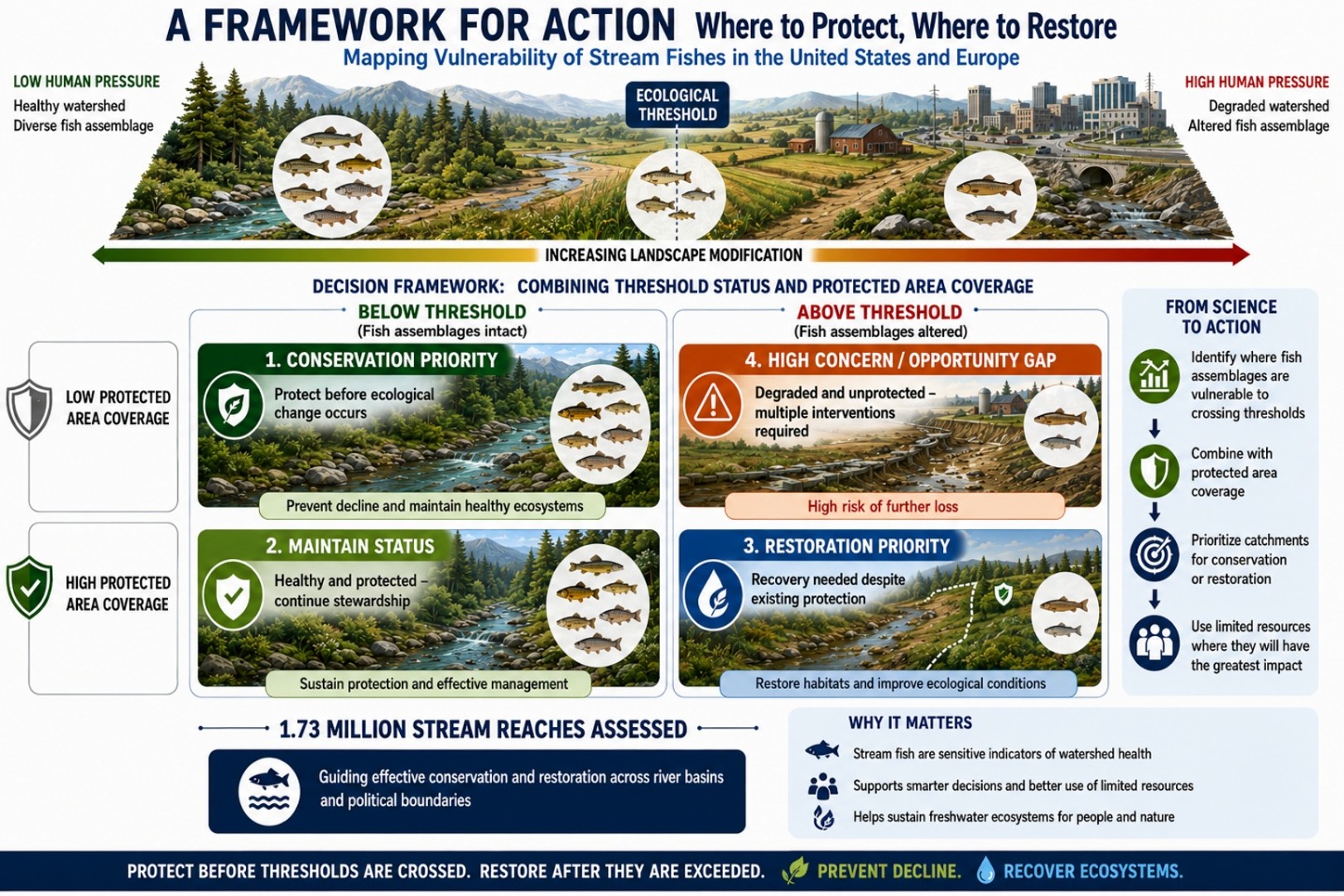 © Kyle Brumm | ChatGPT (GPT-5.5 OpenAI)
A practical tool for resource allocation
The newly developed framework integrates ecological thresholds with protected area coverage to assess how upstream pressures affect downstream fish communities. By distinguishing between areas where decline can still be prevented and those that may ultimately require restoration, the framework helps target limited resources more effectively:
- Conservation priorities: Catchments with limited formal protection that are close to crossing ecological thresholds.
- Restoration priorities: Catchments that have already crossed ecological thresholds despite having a high degree of protection.
This distinction is particularly important because preventing ecosystem degradation is often far more cost-effective and ecologically effective than restoring ecosystems after they have already been degraded.
Consistent applications across diverse regions
By applying the framework to regions with contrasting land-use histories and regulatory contexts across both continents, the study demonstrates that threshold-based approaches can be used consistently over broad geographic extents. Despite major differences in land-use history, governance, and conservation policies between Europe and the United States, the framework performed consistently across both regions.
The findings reveal a broad gradient of ecological condition across more than 1.7 million stream reaches. While some remain relatively intact, many are experiencing multiple environmental pressures that increase their risk of crossing ecological thresholds.
More broadly, the research highlights that protected area coverage alone is not always sufficient to maintain freshwater biodiversity. In some catchments, ecological thresholds have been exceeded despite substantial protection, underscoring the need to complement protected area designations with targeted restoration and management.
"Freshwater restoration is fundamentally a spatial planning challenge," says coauthor Rafaela Schinegger, Associate Professor for Nature Conservation Planning at BOKU University in Vienna, Austria. "This framework helps identify where conservation can prevent ecological tipping points and where restoration measures will have the greatest ecological benefit. Such evidence-based approaches are essential for prioritizing actions and supporting the effective implementation of the EU Nature Restoration Regulation."
The authors note that while the framework was developed and tested across the United States and Europe, the underlying approach could be applied more broadly wherever ecological threshold information is available.
As pressures on freshwater ecosystems continue to increase worldwide, conservation resources need to be invested where they can achieve the greatest impact. Threshold-based planning provides a practical way to identify these priorities before rapid ecological change occurs and could serve as a valuable model for freshwater conservation planning in other parts of the world.
Reference
Brumm, K.J., Schinegger, R., Schürz, M., Gruber, G., Borgwardt, F., Seliger, C., & Infante, D.M. (2026). Applying ecological thresholds to inform conservation and restoration efforts for stream fishes. npj Biodiversity DOI: 10.1038/s44185-026-00144-7 [pure.iiasa.ac.at/21681]
News

17 November 2026
Expanding human settlements are reshaping the global geography of agriculture
As growing towns and cities compete with agriculture for land, farming is increasingly expanding into tropical and arid regions, raising concerns for forests, biodiversity, and water resources. New research shows how these shifts are transforming the global geography of agriculture and creating new challenges for sustainable land-use planning.

16 November 2026
Exploring Real Zero: Flagship climate science research initiative to be established at IIASA
The Minderoo Foundation has committed A$9 million in seed funding to establish the Real Zero Hub and support Exploring Real Zero, a flagship climate science research initiative based at IIASA. The initiative will bring together world-leading researchers, policymakers, and institutions to develop practical, science-based pathways to eliminate fossil fuel emissions, better understand the impacts of climate change, and support governments to transition away from fossil fuels.

22 October 2026
Global agricultural productivity growth is in decline
Global agricultural productivity growth has hit its lowest level since the 1970s, threatening future food security. IIASA researchers contributed to Chapter 3 of the 2026 GAP Report published by the Global Agricultural Productivity (GAP) Initiative at Virginia Tech, exploring how regenerative agriculture could help reverse this trend while improving farm profitability and resilience.