



A new Horizon Europe project led by IIASA called Urban ReLeaf leverages citizen science for public sector innovation.
Urban ReLeaf aims to co-create citizen-powered data ecosystems to support climate change adaptation, green infrastructure, and urban design planning. The project, coordinated by Inian Moorthy and Gerid Hager from the IIASA Novel Data Ecosystems for Sustainability (NODES) Research Group, is a collaboration between academic and private sector partners as well as six cities: Athens, Greece; Cascais, Portugal; Dundee, UK; Mannheim, Germany; Riga, Latvia; and Utrecht, The Netherlands.
By 2050, it is expected that 83.7% of Europe’s population will live in cities, a marked increase from the estimated 72% in 2015. While cities provide opportunities and infrastructure, city-dwellers also face threats such as harmful levels of air pollution and the heat island effect, which is becoming increasingly severe due to climate change.
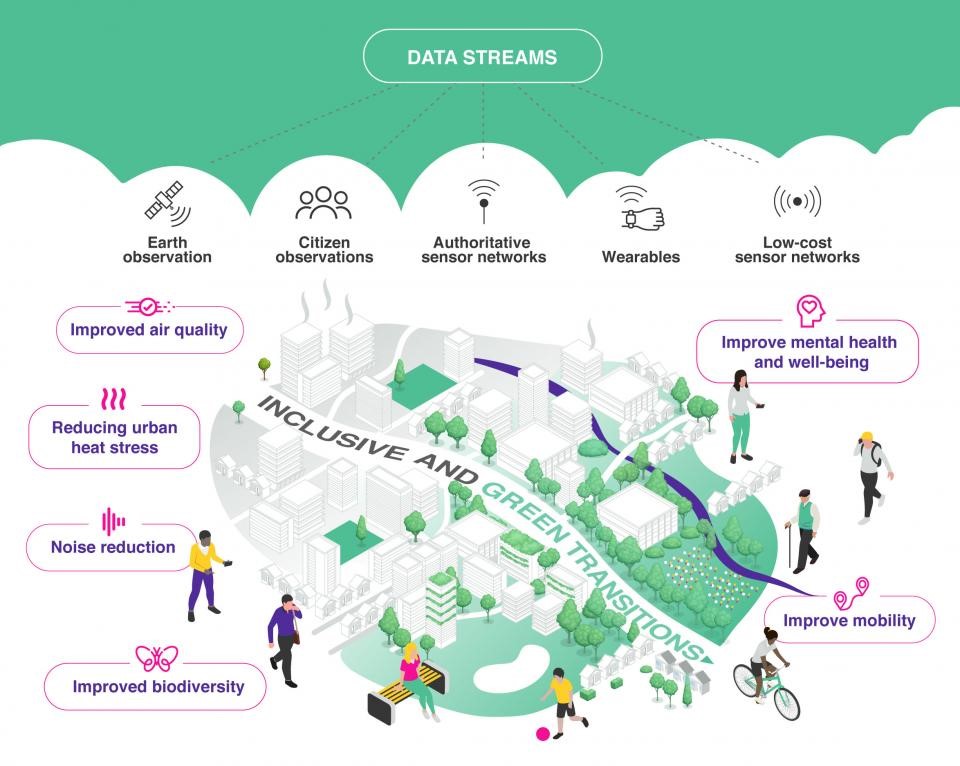
Nature-based solutions such as the expansion of urban greenspace and tree planting can provide cooling effects, decrease air pollution, and improve mental health, among other benefits. Several initiatives support this approach, for example the New EU Forest Strategy for 2030 and the European Green Deal. However, informed decision making is still a challenge for public authorities due to the lack of reliable data. Citizen science along with other novel data streams like Earth Observation, low-cost sensor networks, and wearable technologies can offer new insights to address this challenge.
 © Urban ReLeaf
Schematic representation of the methods and goals of Urban ReLeaf
“We are excited to work with urban authorities, opening a new chapter for citizen participation and the uptake of citizens’ observations,” says Gerid Hager. “With a mission-led approach, Urban ReLeaf builds new partnerships and processes where citizens collaborate alongside authorities to share knowledge and drive targeted and evidence-based decision making.”
The project kicks off on 25 January with a three-day workshop, where partners from nine European countries will begin their efforts to advance citizen-powered science as a central resource for inclusive urban green planning and policy.
“Our hope is to support just transitions for communities to address the changing climate of urban environments and greenspace planning in a more inclusive way,” concludes Inian Moorthy.
Further information:
https://iiasa.ac.at/events/jan-2023/urban-releaf-project-kick-off
News

24 September 2026
IIASA researcher joins Austrian Academy of Sciences working group on integrated carbon neutrality
On 15 September, Principal Research Scholar Thomas Schinko represented IIASA at a high-level event of the Commission on the De-Fossilization and Carbon Neutrality of the European Energy Systems (DEE) of the Austrian Academy of Sciences (OEAW). The meeting denoted the kick-off workshop of the newly established DEE Working Group "Transsectoral and Transcontinental Integration”.

30 July 2026
The trillion-dollar question behind corporate net-zero pledges
Corporate climate spending now steers trillions of dollars in transition finance worldwide. Does it drive genuine climate action? Research shows that accounting flexibility alone can make a company's reported emissions vary by roughly a factor of two – enough to appear either as a climate leader or a laggard. A new Perspective in Nature Sustainability proposes developing industry-specific net-zero blueprints to close that gap.
28 July 2026
New citizen science campaign on mowing events launching in 2026
Starting this Friday, 31st of July, the Mowing Quest citizen science campaign invites people across Europe to help improve grassland monitoring. By using the free Geo-Quest app, participants can report mowing events directly from the field and support scientific research with their own observations. The campaign will be open during August and September to test the system capabilities in preparation for a larger 2027 campaign.