
Understanding and addressing the interconnected challenges of climate change requires grappling with dynamic complexity — where climate, economy, environment and society evolve over time with feedback loops between them, delays, and unexpected outcomes. System dynamics theme within ECE addresses this complexity with an integrated perspective on nonlinear interactions shaping climate–society–economy, with a particular focus on how social dynamics influence and are influenced by environmental and economic change.
As one of the core systems modeling methodologies, system dynamics has long been used to analyze causes and consequences of global environmental change. Originally developed for industrial systems analysis, SD has become an important tool in sustainability science for exploring long-term change, policy impacts, and the consequences of alternative decisions under deep uncertainty. This research theme harnesses the agility, speed, transparency and accessibility of system dynamics modeling to explore scenarios of coupled human–Earth systems.
 © Poornima Kumar
FeliX Model and FeliXSim
FeliX is a global system dynamics model that simulates complex interactions among population, education, economy, energy, water, land, food, carbon cycle, climate, and biodiversity. FeliX was originally developed for projecting socio-environmental impacts in human-natural systems and later advanced for exploring emissions pathways, behavior changes, and sustainable development pathways and their tradeoffs. The 5-regional version of the model is available, and an online simulator (FeliXSim) that focuses on food system and behavior changes.
 © Sibel Eker | IIASA
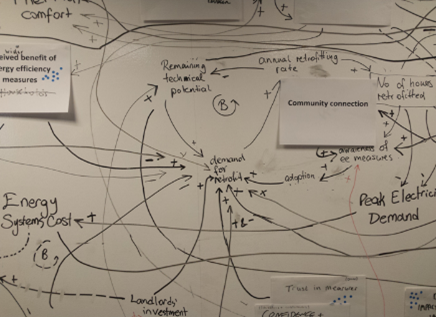
Example of a causal loop diagram
Participatory system dynamics modeling
We use participatory system dynamics modeling, also known as group model building, to engage stakeholders, experts and problem owners in the process of model development and use. Starting with co-creation of a conceptual model that captures systems elements and their links in causal loop diagrams (systems mapping), this process is shown not only to enrich the resulting model, but also to enable structured communication and systems thinking among the participants, as well as creating a shared understanding.
Capacity development and training
We provide regular trainings at regular IIASA capacity development activities or on-demand on system dynamics modeling or systems mapping, including training the trainers.
We welcome guest researchers, visitors and YSSP candidates.
Example projects
WorldTrans - addresses systemic, structural weaknesses and limitations of current integrated assessment models by using simpler models that focus on cross-sector connections, human-earth system feedbacks, uncertainties and actor heterogeneity.
CHOICE - aims to incorporate Integrated Assessment Models (IAMs) into the decision-making processes of consumers, producers, and stakeholders in the food, agriculture, and land use sectors by combining social science insights with marketing tools to drive climate action, and by increasing their outreach to citizens, communities and industrial actors.
LOW-AI - uses social media data to understand behavior change with respect to low-carbon lifestyles, developing tools that can be implemented with a higher geographical reach and are less costly than traditional approaches.
Our past projects at IIASA using system dynamics modeling include social tipping processes, the Strategic Initiative Trust in Science, Deep Demonstrations of Forging Resilience (EIT Climate KIC), IMBALANCE-P, and Mapping National Wellbeing.
Selected Publications
Yang, J., Gao, L., Guo, Z., Dong, Y., Moallemi, E.A., Eker, S. , Liu, Q., Chi, Z., Liu, F., Obersteiner, M. , & Bryan, B.A. (2025). Integrative Sustainable Development Goal policy portfolios to accelerate global progress towards a more sustainable future: a modelling study. The Lancet Planetary Health 9 (12) e101318. 10.1016/j.lanplh.2025.101318.
Eker, S. , Wilson, C. , Höhne, N., McCaffrey, M.S., Monasterolo, I., Niamir, L. , & Zimm, C. (2024). Harnessing social tipping dynamics: A systems approach for accelerating decarbonization. One Earth 7 (6) 976-988. 10.1016/j.oneear.2024.05.012.
Ye, Q., Liu, Q., Swamy, D. , Gao, L., Moallemi, E.A., Rydzak, F., & Eker, S. (2024). FeliX 2.0: An integrated model of climate, economy, environment, and society interactions. Environmental Modelling & Software 179 e106121. 10.1016/j.envsoft.2024.106121.
Liu, Q., Gao, L., Guo, Z., Dong, Y., Moallemi, E.A., Eker, S. , Yang, J., Obersteiner, M. , & Bryan, B.A. (2023). Robust strategies to end global poverty and reduce environmental pressures. One Earth 6 (4) 392-408. 10.1016/j.oneear.2023.03.007.
Moallemi, E.A., Eker, S. , Gao, L., Hadjikakou, M., Liu, Q., Kwakkel, J., Reed, P.M., Obersteiner, M., Guo, Z., & Bryan, B.A. (2022). Early systems change necessary for catalyzing long-term sustainability in a post-2030 agenda. One Earth 5 (7) 792-811. 10.1016/j.oneear.2022.06.003.
Eker, S. , Reese, G., & Obersteiner, M. (2019). Modelling the drivers of a widespread shift to sustainable diets. Nature Sustainability 10.1038/s41893-019-0331-1.
Walsh, B. , Ciais, P., Janssens, I.A., Penuelas, J., Riahi, K. , Rydzak, F., van Vuuren, D.P., & Obersteiner, M. (2017). Pathways for balancing CO2 emissions and sinks. Nature Communications 8 e14856. 10.1038/ncomms14856.