

Developed by Sergei Schebov at IIASA’s Population and Just Societies Program (POPJUS), the World Aging Data Explorer (WADE) is featured on UNESCO’s Digital Innovation Hub.
Disaster risk reduction and climate change adaptation efforts are often fragmented, making it difficult for governments, communities, and practitioners to access the right tools and solutions when they are needed most.
The UNESCO Digital Innovation Hub for Disaster Risk Reduction bridges this gap by connecting governments, scientists, innovators, communities, services, and expertise on one global, centralized platform, helping turn proven solutions into real-world action across all phases of disaster management.
The World Aging Data Explorer (WADE), now also on the UNESCO Digital Innovation Hub, offers innovative ways to explore population ageing and old age.
The WADE is a powerful tool for exploring and evaluating indicators of population aging. It provides two types of indicators:
- Conventional indicators, which use a fixed threshold for old age—typically age 65—across time and space
- New indicators, which define the threshold of old age dynamically based on life expectancy
The indicators are based on data from the UN’s World Population Prospects 2022 and 2024, covering the period from 1950 to 2100 and disaggregated by region, subregion, and country.
Related publication
Sanderson, W. & Scherbov, S. (2019). Prospective Longevity: A New Vision of Population Aging. Cambridge, MA: Harvard University Press. ISBN 978-0-06-7497561-3
News

24 September 2026
IIASA researcher joins Austrian Academy of Sciences working group on integrated carbon neutrality
On 15 September, Principal Research Scholar Thomas Schinko represented IIASA at a high-level event of the Commission on the De-Fossilization and Carbon Neutrality of the European Energy Systems (DEE) of the Austrian Academy of Sciences (OEAW). The meeting denoted the kick-off workshop of the newly established DEE Working Group "Transsectoral and Transcontinental Integration”.

23 September 2026
Eco-Welfare Network Conference
Julia Beier participated in the first in-person Eco-Welfare Network Conference, held in Brussels from 9-11 September at the Université Libre de Bruxelles as part of the Transform-Labor project.
14 September 2026
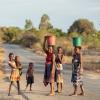
Can a warming climate put women at greater risk?
Unusually warm periods could have a link to an increased risk of intimate partner violence against women, according to a new IIASA-led study covering 31 countries in sub-Saharan Africa. The findings highlight how rising temperatures may compound existing risks of violence, with effects varying between demographic groups.