

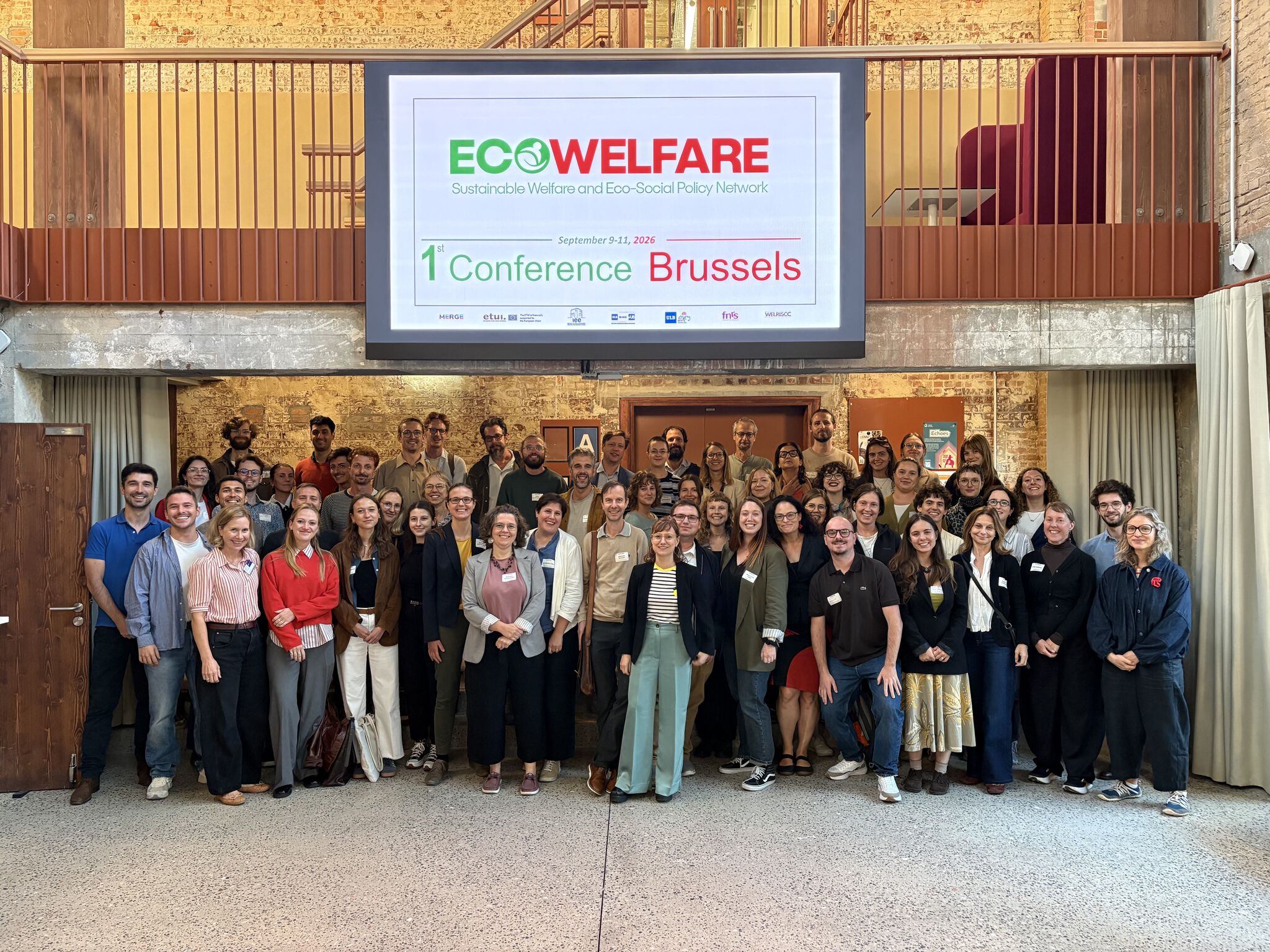
Julia Beier participated in the first in-person Eco-Welfare Network Conference, held in Brussels from 9-11 September at the Université Libre de Bruxelles as part of the Transform-Labor project.
 © IIASA
The conference brought together around 100 researchers, practitioners, and stakeholders from across disciplines to discuss sustainable welfare and eco-social policies. The program featured paper presentations, panel discussions, and a policy roundtable, “Leveraging Knowledge for Just Transition Policymaking: Challenges and Opportunities”, which brought research and EU policymaking perspectives together.
Discussions covered a broad range of topics, including (un)just transitions and questions of justice, redistribution and intersectionality; eco-social risks and vulnerabilities; postgrowth and the ecologicalisation of welfare; and the role of the state in advancing – or potentially hindering – eco-social transformation.
As part of the session on eco-social risks and vulnerabilities, Julia Beier from Equity and Justice Research Group (EQU) presented ongoing research from the Transform-Labor project on the root causes of heat vulnerability among construction and long-term care workers, using a provisioning systems perspective. The session also featured other research on working under extreme heat, including studies of occupational health and safety regulations addressing heat exposure and farmworkers’ experiences during heat events.
News

24 September 2026
IIASA researcher joins Austrian Academy of Sciences working group on integrated carbon neutrality
On 15 September, Principal Research Scholar Thomas Schinko represented IIASA at a high-level event of the Commission on the De-Fossilization and Carbon Neutrality of the European Energy Systems (DEE) of the Austrian Academy of Sciences (OEAW). The meeting denoted the kick-off workshop of the newly established DEE Working Group "Transsectoral and Transcontinental Integration”.
14 September 2026
Can a warming climate put women at greater risk?
Unusually warm periods could have a link to an increased risk of intimate partner violence against women, according to a new IIASA-led study covering 31 countries in sub-Saharan Africa. The findings highlight how rising temperatures may compound existing risks of violence, with effects varying between demographic groups.

10 September 2026
World Aging Data Explorer (WADE) on UNESCO’s Digital Innovation Hub
Developed by Sergei Schebov at IIASA’s Population and Just Societies Program (POPJUS), the World Aging Data Explorer (WADE) is featured on UNESCO’s Digital Innovation Hub.