


Consecutive heat extremes across crop growing stages sharply reduce yields across staple crops in the US and Europe under climate change. Without climate action, such events will become ten times more frequent, while most of the damage can be avoided by limiting warming to 1.5 °C, according to a study led by Vrije Universiteit Amsterdam, ETH Zurich, and IIASA.
When heat hits twice
As the climate warms, extreme weather increasingly occurs in sequence. The study led by Vrije Universiteit (VU) Amsterdam, ETH Zurich, and IIASA, together with coauthors from institutions across Europe and the United States and published in Environmental Research Letters, shows that such back-to-back heat events pose a serious threat to global food production.
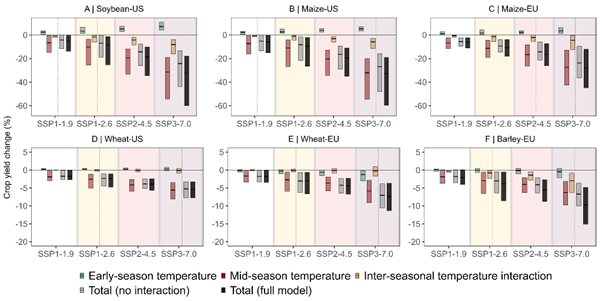
The study shows that early-season heat can raise yield potential but leaves crops more vulnerable to subsequent heatwaves during the flowering period. Across maize, soybean, wheat, and barley in the US and Europe, spring heat leads to 5–55 % larger losses from summer heat, compared to years with average spring conditions.
“Early heat can act like a double-edged sword,” says Carmen B. Steinmann, environmental scientist at ETH Zurich. “While it may boost yield potential at first, it leaves crops far more vulnerable when summer heat strikes,” adds Raed Hamed, postdoctoral researcher at the VU Amsterdam.
Rising risks, avoidable losses
“Today, warm springs generally benefit yields, but this could change”, explains Raed Hamed, lead author of the study. “Under high-emission scenarios, we project that additional yield losses from sequential heat will offset potential benefits of warmer springs.”
By the end of the century, sequential heat events could become up to ten times more frequent if emissions remain high. Accounting for this interaction increases projected yield losses by an additional 2–44%, offsetting potential benefits of warmer springs. Limiting global warming to 1.5°C reduces projected losses to just 1–6%.
“Our results underline how crucial rapid climate action is to avoid societal impacts from increasingly complex climate risks,” emphasizes IIASA senior research scholar Kai Kornhuber.
Insights for resilient food systems
The study highlights the need to consider compounding climate extremes to strengthen food system resilience. By bridging detailed physiological insights from laboratory experiments with large-scale statistical analysis, it also provides guidance for climate adaptation planning.
 © Source: Environmental Research Letters
Reference
Hamed, R., Steinmann, C.B., Ma, Q., Balanzategui, D., Broadman, E., Lesk, C., Kornhuber, K. (2025). Amplified agricultural impacts from more frequent and intense sequential heat events. Environmental Research Letters DOI: https://doi.org/10.1088/1748-9326/ae06b8
News

16 October 2026
Getting back on track to reduce methane emissions
A new study, led by IIASA researchers and coauthored by UNEP colleagues, finds that if governments fully implement their methane reduction plans, they could reduce global emissions by 11% between 2020 and 2030. This would reverse the current trend of increasing methane emissions, but would not be sufficient to achieve the goal of the Global Methane Pledge.

06 October 2026
Nanjing University delegation visits IIASA to explore future collaboration
A high-level delegation from Nanjing University (NJU), led by Professor Tan Zhemin, President of NJU and Fellow of the Chinese Academy of Sciences, visited IIASA to discuss opportunities for strengthening scientific cooperation and advancing joint research on global challenges.

21 September 2026
Fairness informs how the world cuts emissions
Who cuts emissions fastest, and who supports others do so, are central questions in global climate action. New IIASA-led research shows that building fairness into climate models from the start can inform deliberations without changing the overall climate goal.