



More than you might think. A badly chosen holiday destination can leave everyone frustrated, just as poorly designed disaster plans can leave communities devastated; although the consequences are not comparable, the decision-making processes have similar characteristics. The MEDiate project is building a novel Decision Support System (DSS) – a digital toolbox which helps policy-makers test strategies before disaster strikes. IIASA is not only helping to design models and frameworks behind this system, but also ensuring that every stakeholder participates in the discussion. Even the best technical solution won’t work if there is nobody supports it.
Why systemic risks demand new thinking
Traditional risk assessments provide useful maps of where risks exist now, but they fall short when it comes to showing how risks evolve as societies grow, infrastructure ages, and climates change. They tend to focus on single hazards, which rarely occur in isolation. MEDiate aims to close this gap by creating tools that help decision-makers by not just showing them today’s vulnerabilities but also anticipate future ones.
Why compromise fails
Most decision models reduce stakeholder preferences to averages. On the surface, this looks balanced. In reality, it often leads to outcomes that nobody prefers.
Take disaster risk planning:
- Local authorities enforce strict building codes to ensure safety.
- Developers focus on keeping costs down.
- Residents worry about housing affordability and access to services.
The averaged result may be building codes that are too weak to keep people safe but still expensive enough to upset developers and residents. Nobody is satisfied, and such solutions are unlikely to be implemented effectively.
The holiday metaphor
Think of it like planning a holiday. Half the group wants to visit a city full of museums. The other half wants to hike in the mountains. The compromise? A small village halfway in between. A little bit of nature, but no real mountains. One tiny museum exploring the village´s history, but nothing like a city. In the end, nobody enjoys the trip.
IIASA´s Cooperation and Transformative Governance (CAT) group uses methods that highlight options which balance competing priorities and remain strong under different scenarios. The DSS then allows policymakers to test these options: How would stricter building codes perform under future earthquake conditions? What happens if urban growth continues without better planning? Which strategies hold up best when several hazards strike at once?
Building resilience together
Crucially, stakeholders are not brought in at the very end but involved from the very beginning. Their preferences are mapped, debated, and tested against scientific models. The result is a shared process that builds trust and ownership.
That is why IIASA’s role goes beyond models and data. We focus on the dialogue that makes legitimate and lasting decisions. Resilience cannot be built by numbers alone—it requires people working together, agreeing on pathways they can all stand behind.
The MEDiate project shows how science and society can find common ground. In the end, resilience is not built in models alone—it emerges when communities, scientists, and policymakers move together in the same direction.
We would like to express acknowledgment to Vladimir Shchepashchenko for his great contribution during his internship period at the CAT/ASA group at IIASA.
News

15 October 2026
MowingQuest system-test campaign 2026 concludes, data collection continues
IIASA’s MowingQuest citizen-science campaign has wrapped up its August–September 2026 system test, with 25 pioneer users submitting almost 800 observations across eight countries. The results will help improve the app and data-quality workflows ahead of the main 2027 campaign. Two participants have also won Garmin GPS watches in the campaign raffle.
06 October 2026
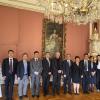
Nanjing University delegation visits IIASA to explore future collaboration
A high-level delegation from Nanjing University (NJU), led by Professor Tan Zhemin, President of NJU and Fellow of the Chinese Academy of Sciences, visited IIASA to discuss opportunities for strengthening scientific cooperation and advancing joint research on global challenges.

23 September 2026
IIASA researchers strengthen cooperation with Kyrgyzstan on AI and industrial development
IIASA Cooperation and Transformative Governance (CAT) Research Group Leader and Senior Research Scholar Nadejda Komendantova and CAT Research Scholar Dmitry Erokhin have contributed to a series of scientific and policy forums in Kyrgyzstan in 2026. Their research on artificial intelligence in the production sector builds on IIASA’s longstanding cooperation with the country on sustainable industrial development.