

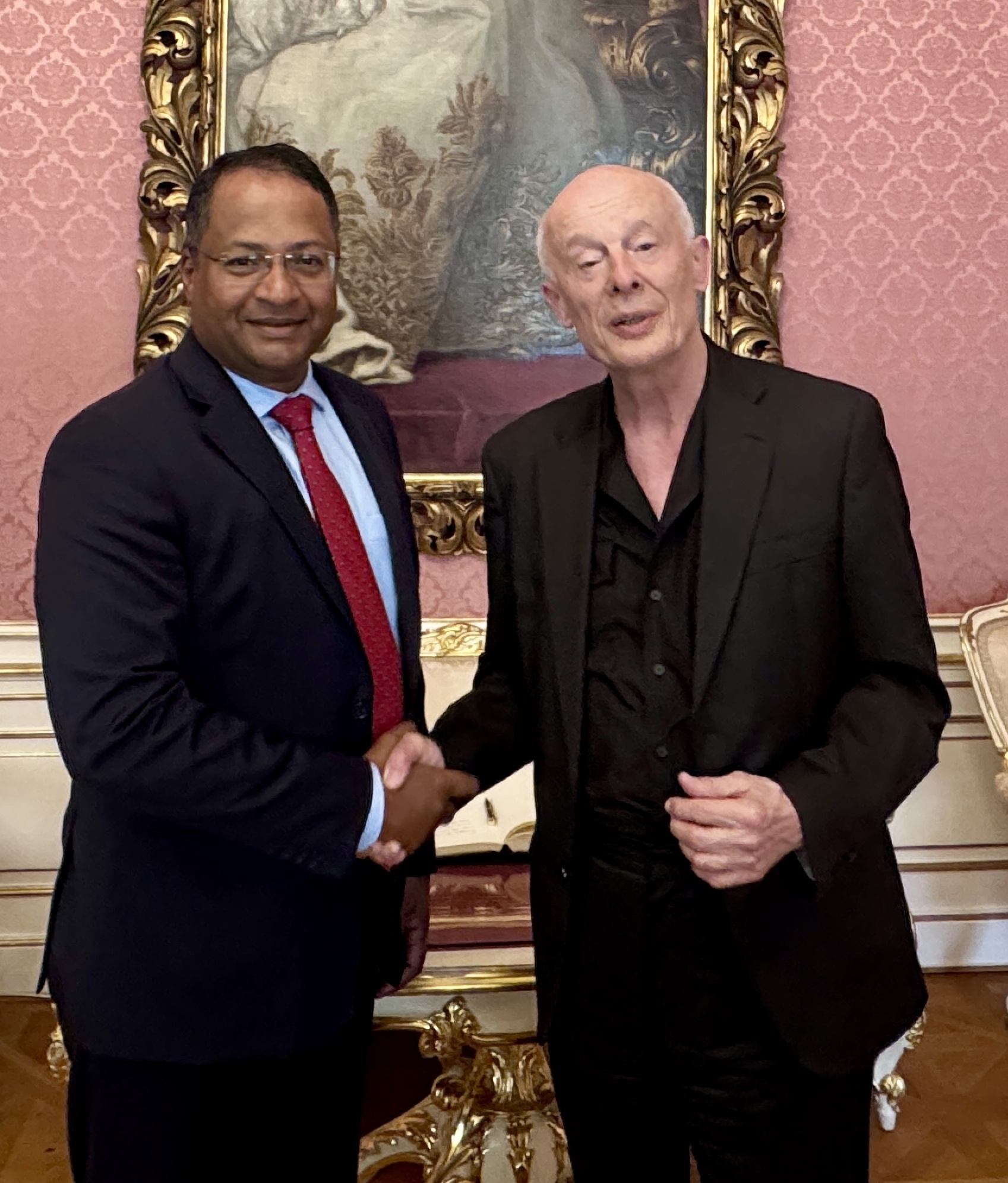
H.E. Ambassador Shambhu S. Kumaran, India's Permanent Representative to the International Organizations in Vienna, recently visited IIASA to explore deeper research cooperation and meet the Institute's Indian Young Scientists Summer Program (YSSP) cohort.
 © IIASA
H.E. Ambassador Shambhu S. Kumaran with IIASA Director General Hans Joachim (John) Schellnhuber
The Ambassador's visit provided an opportunity for an in-depth exchange on IIASA's research portfolio and on future avenues for strengthening cooperation between IIASA and Indian institutions.
The Ambassador was accompanied by Pranesh Sengupta, Scientific Counselor at the Permanent Mission of India. They were received by IIASA Director General Hans Joachim (John) Schellnhuber, together with Senior Advisor to the Director General, Pradeep Monga, and researchers spanning several of the Institute's research programs, including Keywan Riahi (Energy, Climate, and Environment), Elena Rovenskaya (Advancing Systems Analysis), Pallav Purohit (Pollution Management), and Joshi Siddharth (Integrated Assessment and Climate Change).
Opening the visit, Schellnhuber presented an overview of IIASA's history and its bridgebuilding mission – the Institute's founding conviction that systems science can foster dialogue and cooperation across political divides. Researchers then presented highlights of ongoing scientific collaboration between IIASA and India, setting the stage for an open discussion on how this partnership could be deepened further.
Schellnhuber commented: "IIASA was founded on the belief that science can build bridges where politics alone cannot. India's growing engagement with systems analysis – from energy transitions to sustainable development – is exactly the kind of evidence-based, cross-border collaboration our founders envisioned."
Discussions touched on the breadth of what closer engagement with IIASA can offer India: greater international visibility for Indian research within global academic and policy circles; access to IIASA's convening power on complex, cross-border challenges such as the future of multilateralism, or the role of nuclear energy in the energy transition; systems-analytical research that speaks directly to India's development priorities; and expanded networking and joint-fundraising opportunities for Indian scientists and decision-makers. Participants also highlighted the value of reciprocal learning – from training opportunities for early-career Indian professionals in systems analysis, to bringing Indian perspectives more fully into international research and policy conversations.
Following the discussion, the Ambassador and Dr. Sengupta signed the IIASA Guest Book before posing for an official photograph with the Institute's leadership. The visit concluded with a bilateral meeting between Ambassador Kumaran and Schellnhuber, followed by an informal meet and greet with the Indian members of IIASA's 2026 YSSP cohort, providing a chance for the Ambassador to connect directly with the next generation of Indian researchers engaging with the Institute.
The visit reaffirmed the shared interest of IIASA and India in deepening scientific cooperation on shared global challenges, from climate and energy to sustainable development, and identified concrete next steps for strengthening this partnership in the months ahead.
News

22 September 2026
IIASA at UNCCD COP17: Advancing land restoration and resilience
Building on its engagement at the 16th session of the Conference of the Parties to the United Nations Convention to Combat Desertification (UNCCD COP16) in Riyadh, IIASA contributed to a series of events and bilateral discussions at UNCCD COP17, held in Ulaanbaatar, Mongolia, towards the end of August. Under the theme, Restoring Land, Restoring Hope, COP17 advanced action on land degradation, drought resilience, and sustainable land management, with particular emphasis on rangelands and pastoral livelihoods.
13 July 2026
From innovation to impact: Professor Subra Suresh visits IIASA
IIASA recently welcomed Professor Subra Suresh – Vannevar Bush Professor Emeritus at the Massachusetts Institute of Technology (MIT), Professor at Large at Brown University, former Director of the US National Science Foundation (NSF), and former President of Carnegie Mellon University and Nanyang Technological University Singapore – for a full day of exchange culminating in a Science Parliament Lecture titled, Innovation 4.0 for Humanity 4.0.
02 February 2026
Education matters more than income to reduce premature adult mortality in India
IIASA researchers explored why mortality among adults of working age remains high in India alongside rapid economic growth, finding that education – at both individual and community levels – is more strongly associated with lower premature mortality than income or household wealth.