


A new EU-funded report reveals that while global emissions could peak before 2030, current efforts remain insufficient to meet the Paris Agreement’s 1.5°C goal. The study, produced through collaboration between IIASA, the PBL Netherlands Environmental Assessment Agency, and the NewClimate Institute, provides a detailed, evidence-based assessment of progress among the world’s largest emitters.
The 2025 edition of the Progress of Major Emitters Towards Climate Targets report highlights both encouraging momentum and critical gaps in global climate action. Despite policy rollbacks in some regions, most notably the United States, overall emission projections remain on a downward trend. However, the pace of reductions is still too slow to align with the Paris Agreement’s targets.
Fifteen major economies are likely on track to meet their 2030 unconditional Nationally Determined Contributions (NDCs), yet many others must urgently expand or strengthen policy measures. More than half of the countries analyzed have submitted or announced 2035 NDCs, but only a small number – six under current trajectories – appear capable of reaching them.
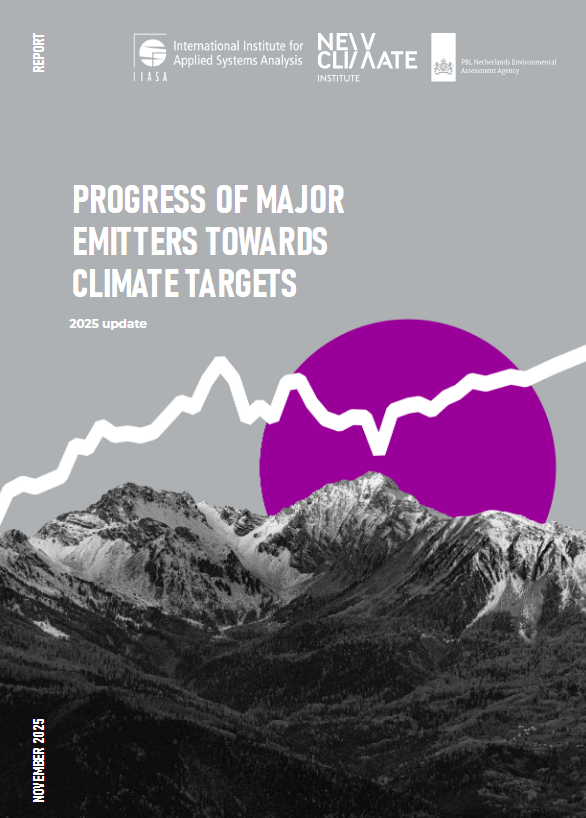 © IIASA/PBL/NewClimate Institute
Progress of major emitters towards climate targets: 2025 Update
IIASA researchers in the Integrated Biosphere Futures Research Group of the Biodiversity and Natural Resources Program Zuelclady Araujo Gutiérrez, Mykola Gusti, and Dejana Golic, as well as IIASA Biodiversity and Natural Resources Program Director Petr Havlik contributed to the analysis, combining IIASA’s modeling expertise with the policy assessments of PBL and NewClimate Institute. The collaboration underscores the importance of integrating scientific rigor with policy evaluation to guide global decision-making.
“The data show clear signs of progress, but also a stark warning,” said Araujo-Gutiérrez. “If we want to keep 1.5°C within reach, governments must not only fulfill their existing commitments but act faster and go further, especially as new 2035 targets are finalized.”
The report’s findings reinforce the urgency for stronger, coordinated international action in 2025 – a pivotal year for ramping up ambition and implementation of climate policies worldwide.
News

07 October 2026
MOSAIC results highlighted during Austria’s Protective Forest Week 2026
MOSAIC project results and IIASA research on climate-resilient protective forests are featured during Austria’s Protective Forest Week 2026, including work on wildfire risk, decision-support tools, and the Alpine Resilience Web Atlas.

06 October 2026
Nanjing University delegation visits IIASA to explore future collaboration
A high-level delegation from Nanjing University (NJU), led by Professor Tan Zhemin, President of NJU and Fellow of the Chinese Academy of Sciences, visited IIASA to discuss opportunities for strengthening scientific cooperation and advancing joint research on global challenges.
06 October 2026
IIASA celebrates long-term partnership with MSc European Forestry Program
Coordinators, partners and graduates of the MSc European Forestry program visited IIASA on 29 September 2026. Twenty visitors from at least eight countries came as part of the alumni event held alongside the program's graduation ceremony at BOKU University in Vienna.