

Want to contribute to the European Union’s climate neutrality target but not sure how? Join the latest Picture Pile campaign as part of IIASA’s LAMASUS project. Help us to identify livestock and grassland management practices from photographs, which will be used to validate a new geodatabase on land use management.
When? Now until the end of 2025
Where? Via your browser or using the Picture Pile mobile app
Background
Since 2022, IIASA has been leading the Horizon Europe funded LAMASUS project (Land Management for Sustainability). This project brings together 17 partners from 8 European countries, all working towards a shared goal: developing a new governance model to improve land use practices across Europe. One key result will be an open-access modeling toolbox, designed to help policymakers evaluate the economic and environmental benefits of different policies.
One of the main outputs of the project is a high-resolution geodatabase on land use management, which will be used to determine the environmental and socio-economic impacts of land use policies in the European Union. The development of the geodatabase has been led by the NODES research group at IIASA in collaboration with colleagues in the BNR program, which leads the LAMASUS project. More information about the geodatabase can be found here.
Why and how to contribute?
One of the key challenges with the geodatabase is that it needs validation. We have thousands of images of European landscapes that require classification by citizen scientists and volunteers. Your contributions will play a key role in helping us to validate the geodatabase and provide valuable insights into how grasslands are being utilized across Europe.
Using Picture Pile is easy. You can access it through a browser or download the app on your iPhone, iPad, or Android device.
 © NODES
Simply choose the Livestock or the Grassland Management pile and sort the photographs by livestock type or whether you see evidence of mowing or grazing. Slide the photograph in the direction of the answer or slide downwards if you are unsure. You can also check your score at any time on the Picture Pile leaderboard. The instructions provide examples to help you, in particular, how to identify signs of grazing and mowing. You can access these instructions at any time or send us any picture with your queries using the email listed in the app. Join in today and contribute to helping us improve our knowledge on land use management.
Preliminary Results from the Livestock and Grassland Management Piles
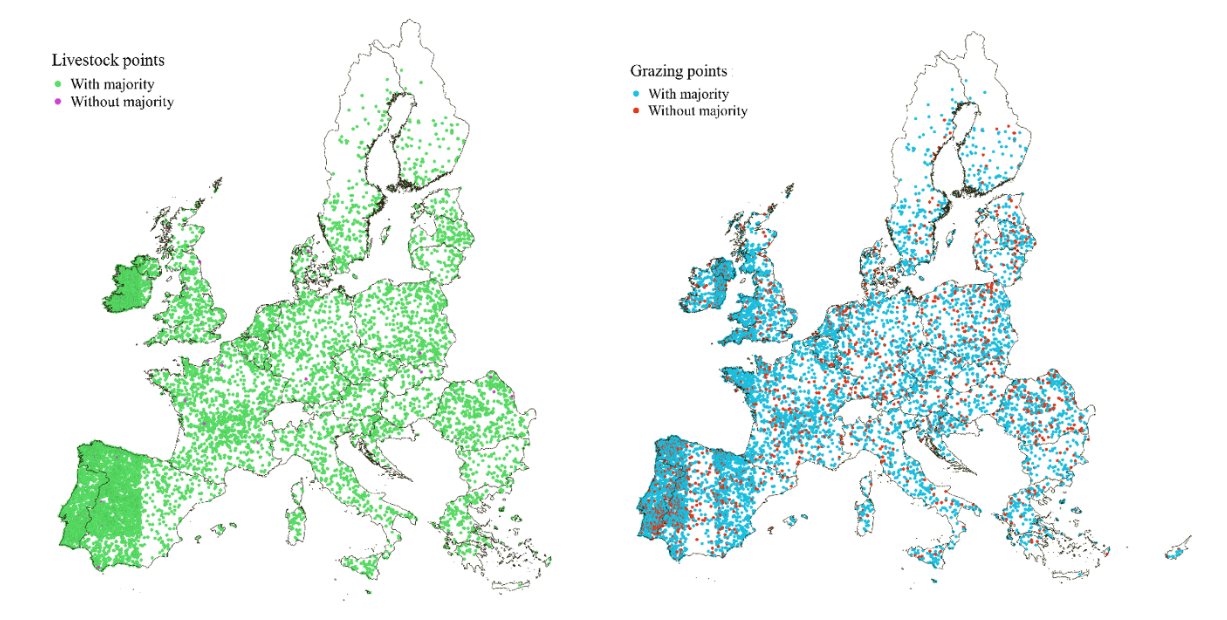
As of November 2025, the Picture Pile campaign has involved 65 participants in classifying 26,128 unique locations in the livestock pile (to detect the presence of different types of livestock) and 59 participants in classifying 10,127 unique locations in the grassland management pile (to differentiate between grassland that is grazed or mowed). The photographs were classified multiple times so that we could determine the majority or consensus between volunteers.
The figure below shows the livestock points on the left, where the majority consensus is high since livestock is much easier to classify while grazing and mowing, in contrast, is much harder to see in the photographs, explaining why the number of photos without a majority consensus is much higher (map on the right).
 © NODES
Not all the photographs are classified yet, which is why you can see certain areas that have more densely collected information.
If you are interested you can download Picture Pile on your mobile phone and help us continue to classify livestock and grassland management. In the future, we plan to compare our results with what AI models can do and present the outcomes.
Each classification you make is a step toward a more accurate, high-quality geodatabase, and, on a larger scale, it heps to support more sustainable land use policies across Europe. We hope you're enjoying the campaign. Keep swiping, stay tuned for more updates, and remember — you can join at any time!
News
07 October 2026
MOSAIC results highlighted during Austria’s Protective Forest Week 2026
MOSAIC project results and IIASA research on climate-resilient protective forests are featured during Austria’s Protective Forest Week 2026, including work on wildfire risk, decision-support tools, and the Alpine Resilience Web Atlas.
06 October 2026
IIASA celebrates long-term partnership with MSc European Forestry Program
Coordinators, partners and graduates of the MSc European Forestry program visited IIASA on 29 September 2026. Twenty visitors from at least eight countries came as part of the alumni event held alongside the program's graduation ceremony at BOKU University in Vienna.

24 September 2026
IIASA researcher joins Austrian Academy of Sciences working group on integrated carbon neutrality
On 15 September, Principal Research Scholar Thomas Schinko represented IIASA at a high-level event of the Commission on the De-Fossilization and Carbon Neutrality of the European Energy Systems (DEE) of the Austrian Academy of Sciences (OEAW). The meeting denoted the kick-off workshop of the newly established DEE Working Group "Transsectoral and Transcontinental Integration”.