

An international research team is pioneering a bold approach to European conservation, integrating biodiversity as a solution to environmental challenges. It explores three value perspectives – Nature for Nature, Nature for Society, and Nature as Culture – to shape positive future scenarios.
The first set of storylines on the future of nature conservation in Europe has been developed and published in the journal Environmental Management. The storylines explore how nature might be protected and restored considering EU Biodiversity Strategy goals and potential socio-ecological development pathways, and help to build models of positive scenarios for nature, which can be crucial in steering policy decisions aimed at restoring nature.
The study was coordinated by the Global Mammal Assessment lab at the Department of Biology and Biotechnologies “Charles Darwin”, Sapienza University of Rome, Italy, as part of the IIASA-coordinated research project NaturaConnect, which aims to support the planning and implementation of EU targets for biodiversity conservation and restoration.
The study uses a heuristic approach called the Nature Future Framework (NFF) to develop positive scenarios focused on the connection between nature and people. In this context, biodiversity is a key element in addressing environmental challenges across different spatial and temporal scales, explicitly considering a range of values for nature, that the NFF describes.
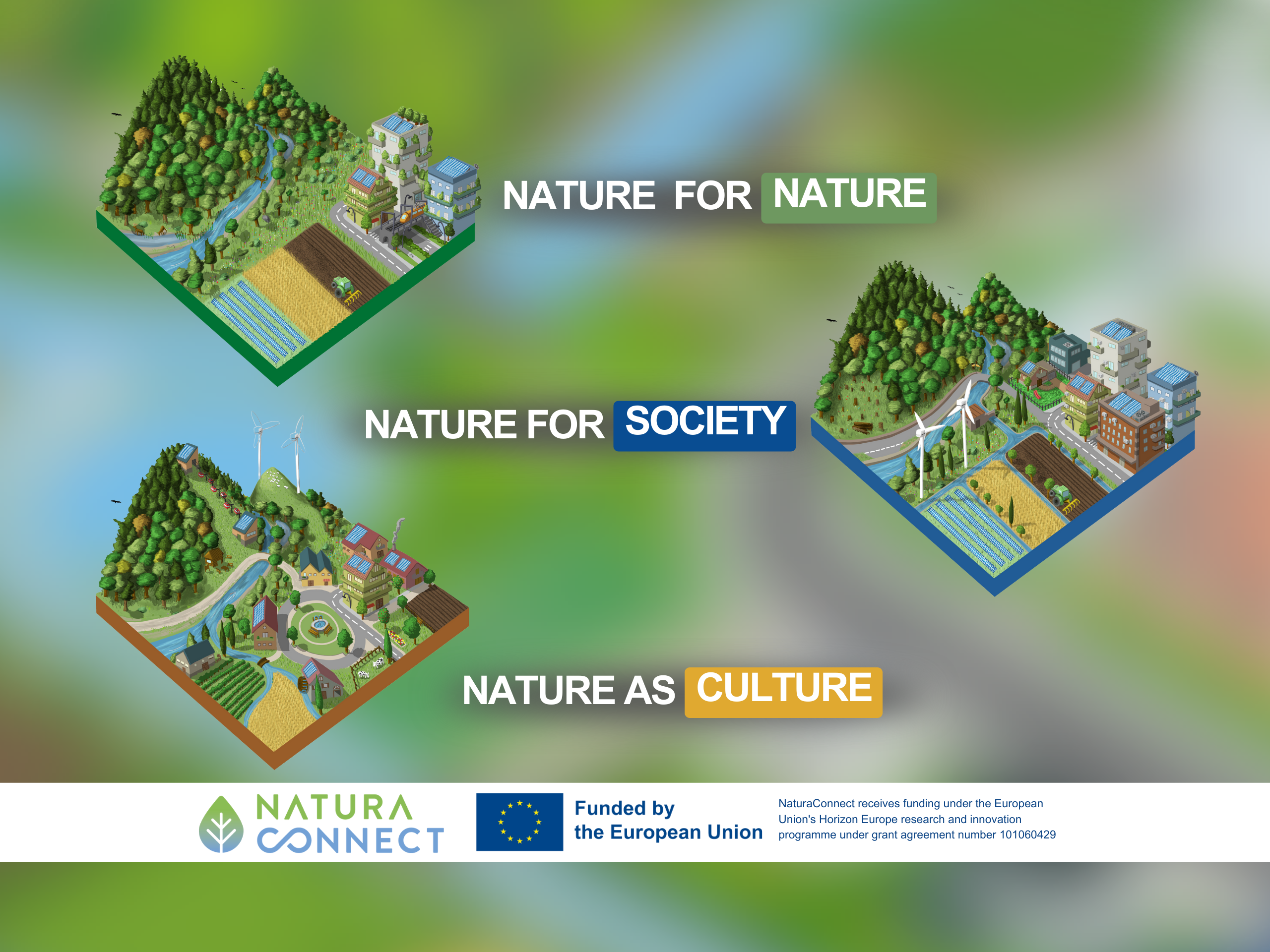 © NaturaConnect
A team of researchers developed the above first set of European positive narratives for nature conservation through consultation with experts in the field. The team analyzed differences and similarities across the three NFF perspectives, focusing on six topics: Nature Protection and Restoration; Forest Ecosystems; Freshwater Ecosystems; Urban Systems; Agriculture, and Energy.
The results consist of three narratives that emphasize the intrinsic value of nature (Nature for Nature), the maximization of instrumental values and services (Nature for Society), and the relational values between nature and people (Nature as Culture). While contrasting perspectives and priorities were highlighted, the study also presents solutions that can be beneficial for both biodiversity conservation and the instrumental and cultural benefits that nature offers to people (NCP – Nature’s Contributions to People). Across the narratives, special attention was paid to the topic of Nature Protection and Restoration. As emerged in Nature for Nature, which focuses on strict nature conservation, “how much land is set aside exclusively for nature conservation was the key aspect for differentiating the three NFF perspectives,” explains Alessandra D’Alessio from Sapienza, one of the lead authors of the manuscript.
Additionally, “depending on the desired Nature Future, the efforts to restore ecosystems may be aimed to nature protection, increased supply of utilitarian NCP, or preservation of nature cultural values,” clarifies Claudia Fornarini from Sapienza, the other lead author of the research.
The development of these narratives represents a step towards revising the widely used set of Shared Socioeconomic Pathways (SSPs) scenarios, with nature playing a central role alongside current socioeconomic considerations.
“By exploring the relationships between land use and nature conservation, our scenarios provide explicit support to decision makers in achieving the global biodiversity strategy and the EU conservation goals for 2030,” remarks Carlo Rondinini, senior author of the study and Professor of Zoology at Sapienza University.
Piero Visconti, Research Group Leader of the IIASA Biodiversity, Ecology and Conservation Group and a coauthor of the study, notes "these narratives are meant to be used by scientists and practitioners to align sector specific or location-specific land-use and biodiversity scenarios, visioning studies and sectorial strategies, to systematically designed EU-wide narrative of positive change.”
This alignment will allow for a broader exploration of transformative changes in the use, conservation, and restoration of natural resources, and will help illustrate how diverse opportunity spaces can shape sustainable futures. By presenting these narratives, the authors aim to open discussions on anticipatory governance and encourage a more inclusive and pluralistic approach to fully realize the goals of the EU Biodiversity Strategy for 2030.
Adapted from a press release by Sapienza University of Rome, Italy.
Reference:
D’Alessio, A., Fornarini, C., Fernandez, N., Namasivayam, A.S., Visconti, P., Dertien, J., Hällfors, M., Jung, M., Moreira, F., O’Connor, L., Osti, M., Quintero-Uribe, L.C., Marei Viti, M., Lauta, A., Pereira, H.M., Verburg, P.H., Rondinini, C. (2025). Narratives for Positive Nature Futures in Europe. Environmental Management. https://doi.org/10.1007/s00267-025-02123-3
News

15 October 2026
MowingQuest system-test campaign 2026 concludes, data collection continues
IIASA’s MowingQuest citizen-science campaign has wrapped up its August–September 2026 system test, with 25 pioneer users submitting almost 800 observations across eight countries. The results will help improve the app and data-quality workflows ahead of the main 2027 campaign. Two participants have also won Garmin GPS watches in the campaign raffle.

07 October 2026
MOSAIC results highlighted during Austria’s Protective Forest Week 2026
MOSAIC project results and IIASA research on climate-resilient protective forests are featured during Austria’s Protective Forest Week 2026, including work on wildfire risk, decision-support tools, and the Alpine Resilience Web Atlas.

06 October 2026
IIASA celebrates long-term partnership with MSc European Forestry Program
Coordinators, partners and graduates of the MSc European Forestry program visited IIASA on 29 September 2026. Twenty visitors from at least eight countries came as part of the alumni event held alongside the program's graduation ceremony at BOKU University in Vienna.