




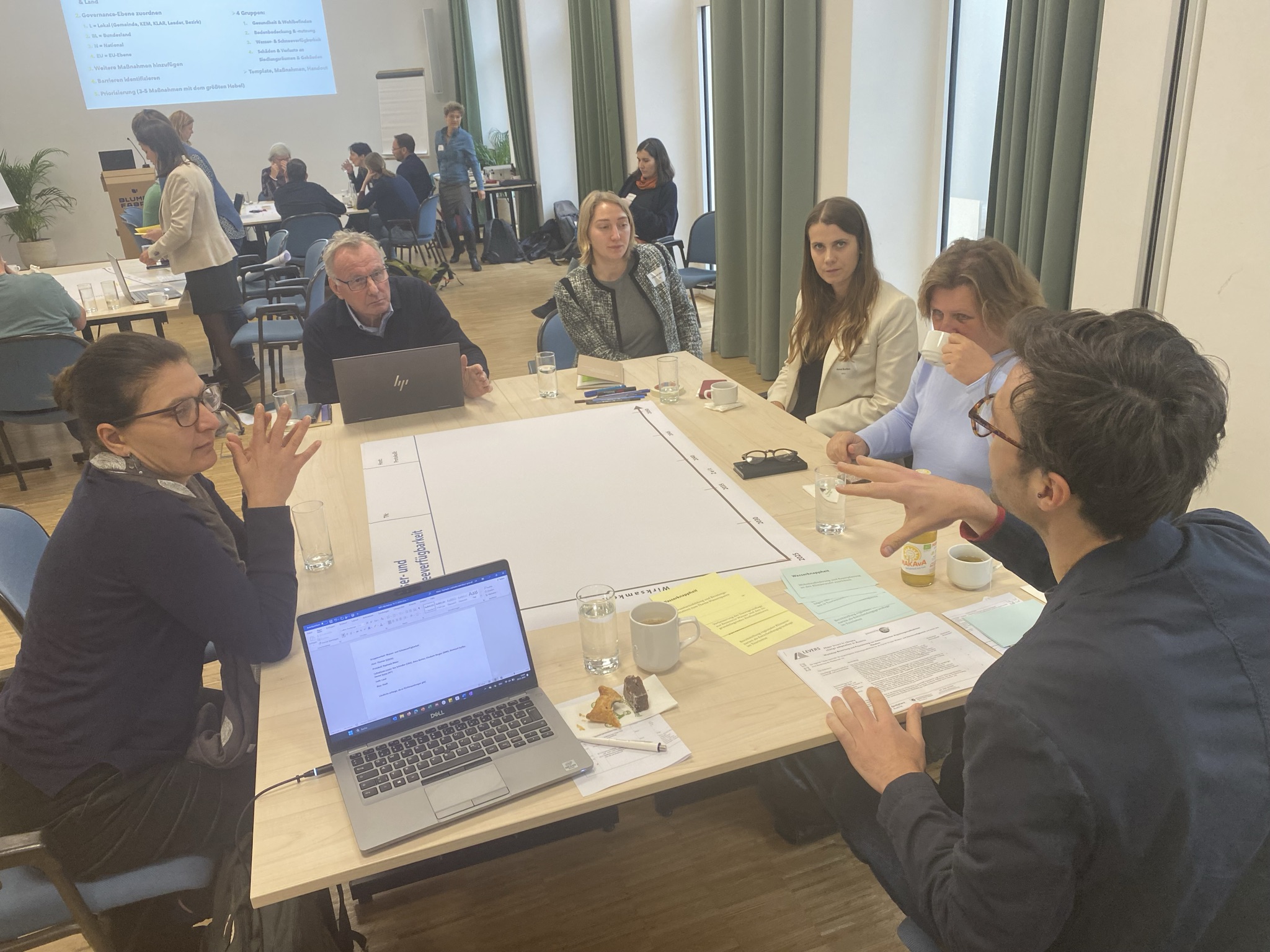
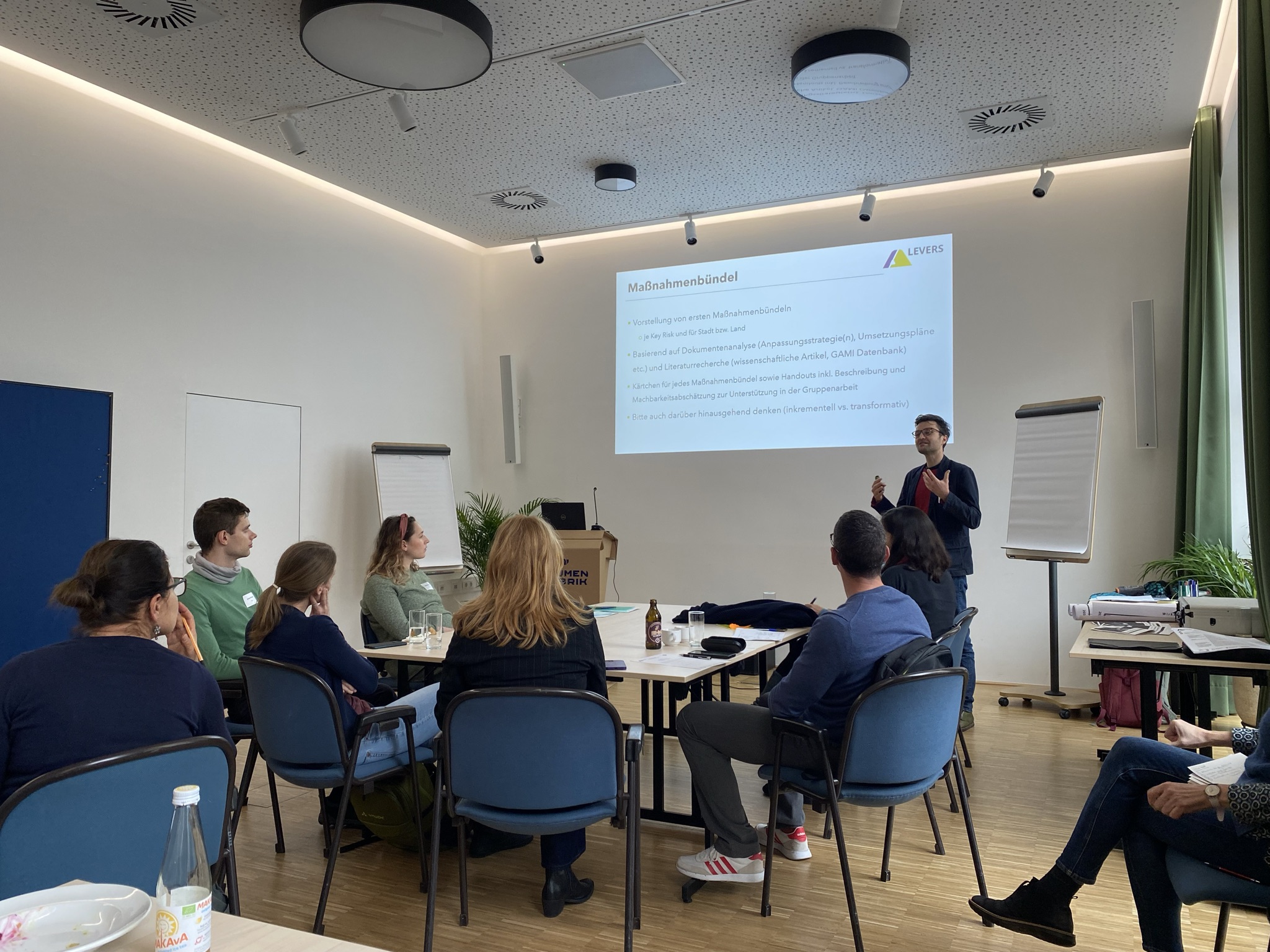
As part of the A-LEVERS project, experts on climate change met in-person in Vienna to create feasible portfolios of adaptation measures to key climatic risks in Austria
 © IIASA
The goal of the workshop, which was developed and led by EQU researchers Jonas Peisker and Thomas Schinko, was to identify adaption options for Austria that are characterized by both a high feasibility in their implementation and effectiveness to reduce the most urgent climate risks. In preparation of the meeting, the project team together with experts reviewed the literature on climate risks to produce the first burning ember diagrams for Austria that summarize the change in risks with increasing global warming and the degree of certainty associated with the projections. As key risks, the public health impacts of heat, disruption of ecosystems and land use, water and snow availability, loss and damage in settlements related to flooding were identified. The project team collected adaption measures for each of them from policy documents and databases to gain an overview of possible options.
 © IIASA
First on the workshop agenda was a presentation of the project and the adaption bundles for each of the key risks, divided into measures for prototypical urban and rural spaces. In moderated groups, the experts next discussed the timeline and effectiveness of the measures, creating possible adaptation pathways. A focus of the discussion was also on the limits of measures’ effectiveness, barriers to their implementation, and the relevant governance structures. Finally, the experts selected the most effective measures, and each group presented their results to the plenum. The findings serve as input for future work in three case study regions, which are representative for many other Austrian regions, where the project will develop context-specific adaption pathways together with local stakeholders.
 © A-LEVERS
Major levers in climate change adaptation in Austria (A-LEVERS)
The A-LEVERS project aims to develop a robust methodological framework for prioritizing adaptation options and to establish adaptation pathways to address key climate-related risks in Austria.
IIASA Role
IIASA leads a working package that assesses adaptation options and combinations. The methodology to prioritize specific measures builds on the participatory method developed within the recently completed ACRP project “pathways” for identifying measures across levels of governance and for different time scales. Based on a stocktaking of available evidence for Austria, the working package will assess the effectiveness and feasibility of different adaptation options and bundle them for the three archetype regions. For the generic adaptation bundles, boundary conditions will be identified, such as lead times, windows of opportunities, and path dependencies.
Partners and collaborating organizations
- University of Graz, Wegener Center for Climate and Global Change (lead)
- GeoSphereAustria
- IIASA
Funding
This project has received funding from the Climate and Energy Fund, represented by the Austrian Research Promotion Agency (FFG) under grant agreement FO999901435 (ACRP Call from 1/2022).
News

24 September 2026
IIASA researcher joins Austrian Academy of Sciences working group on integrated carbon neutrality
On 15 September, Principal Research Scholar Thomas Schinko represented IIASA at a high-level event of the Commission on the De-Fossilization and Carbon Neutrality of the European Energy Systems (DEE) of the Austrian Academy of Sciences (OEAW). The meeting denoted the kick-off workshop of the newly established DEE Working Group "Transsectoral and Transcontinental Integration”.
23 September 2026
Eco-Welfare Network Conference
Julia Beier participated in the first in-person Eco-Welfare Network Conference, held in Brussels from 9-11 September at the Université Libre de Bruxelles as part of the Transform-Labor project.
14 September 2026
Can a warming climate put women at greater risk?
Unusually warm periods could have a link to an increased risk of intimate partner violence against women, according to a new IIASA-led study covering 31 countries in sub-Saharan Africa. The findings highlight how rising temperatures may compound existing risks of violence, with effects varying between demographic groups.