

IIASA is pleased to announce that Susie Kitchens will join the Institute as Science Diplomacy Director and Head of Communications and External Relations in May 2026. In this senior leadership role, she will guide IIASA’s global engagement strategy, expand international partnerships, and enhance the Institute’s visibility and impact at the science-policy-society interface.
Susie Kitchens brings extensive senior-level experience in international science policy, diplomacy, and multilateral engagement, with a career spanning government, academia, and international collaboration. She is currently Director of Imperial Global at Imperial College London, where she leads the development of a science diplomacy strategy to strengthen global research partnerships and promote evidence-informed policymaking.
Prior to this, she served as Deputy Director for Global Research and Innovation at the UK Department for Science, Innovation, and Technology, shaping international research and innovation policy across priority sectors including climate, health, and emerging technologies. She also led the UK’s global Science and Innovation Network, overseeing 130 staff across 65 locations worldwide and managing major international research programs.
Her earlier roles include senior diplomatic and leadership positions in the UK Foreign & Commonwealth Office, including Deputy High Commissioner in Kenya and Consul General in Boston, USA, where she built strategic partnerships across government, academia, and industry and represented the UK in high-level international forums.
At IIASA, Susie Kitchens will be responsible for designing and implementing institutional engagement strategies with key stakeholders, strengthening relationships with member organizations, and identifying new opportunities for collaboration and membership expansion. She will also lead the development of a new international Science Diplomacy Center, supporting evidence-informed cooperation on global challenges.
“IIASA has a unique role in bringing together science, policy, and international collaboration to address the world’s most pressing challenges,” she said. “I am excited to join the Institute at a time when strengthening global partnerships and advancing science diplomacy is more important than ever, and I look forward to working with colleagues and partners to expand IIASA’s impact worldwide.”
Susie Kitchens holds an MSc in Health Promotion from the London School of Hygiene & Tropical Medicine and a BA in Human Sciences from the University of Oxford. She is also a Fellow of the Centre for Science and Policy at University of Cambridge.
News
15 October 2026
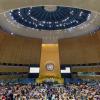
IIASA strengthens science diplomacy ties at UNGA in New York
IIASA Science Diplomacy Director and Head of Communications and External Relations Susie Kitchens represented the Institute at the United Nations General Assembly (UNGA) High-level Week and Science Summit in New York in September, contributing to discussions on how science and international cooperation can help address shared global challenges.

30 July 2026
The trillion-dollar question behind corporate net-zero pledges
Corporate climate spending now steers trillions of dollars in transition finance worldwide. Does it drive genuine climate action? Research shows that accounting flexibility alone can make a company's reported emissions vary by roughly a factor of two – enough to appear either as a climate leader or a laggard. A new Perspective in Nature Sustainability proposes developing industry-specific net-zero blueprints to close that gap.

28 May 2026
IIASA welcomes Royal Society Executive Director Dame Julie Maxton
IIASA recently welcomed Dame Julie Maxton, Executive Director of the Royal Society, to Laxenburg for a series of discussions focused on global challenges, science diplomacy, and the future of international research cooperation.