

IIASA recently welcomed Dame Julie Maxton, Executive Director of the Royal Society, to Laxenburg for a series of discussions focused on global challenges, science diplomacy, and the future of international research cooperation.
Dame Julie is an internationally respected scholar and academic administrator who has served as Executive Director of the Royal Society since 2011. During her visit, discussions focused on the long-standing relationship between IIASA and the Royal Society, as well as the vital role of science diplomacy in addressing today’s global challenges.
The Royal Society holds a special place in IIASA’s history. In 1972, the founding principles establishing IIASA were signed at the Royal Society’s offices in London, laying the groundwork for more than five decades of international scientific cooperation. Today, the United Kingdom remains an active IIASA member through UK Research and Innovation (UKRI), supporting collaboration across science, policy, and diplomacy.
The visit provided an opportunity to exchange views on how international scientific institutions can help strengthen cooperation in an increasingly fragmented geopolitical landscape. Discussions highlighted IIASA’s ambition to build on its foundational strengths in science diplomacy as a central pillar of the Institute’s vision and strategy, while also recognizing the Royal Society’s centuries-long leadership in international scientific exchange and science diplomacy. Participants discussed the need for creative and ambitious international initiatives to raise global ambition in tackling existential planetary challenges.
Dame Julie also met with renowned demographer and IIASA Distinguished Emeritus Research Scholar Wolfgang Lutz, enjoying a wide-ranging discussion on global demographic trends, sustainability, and the role of science in informing long-term policy decisions.
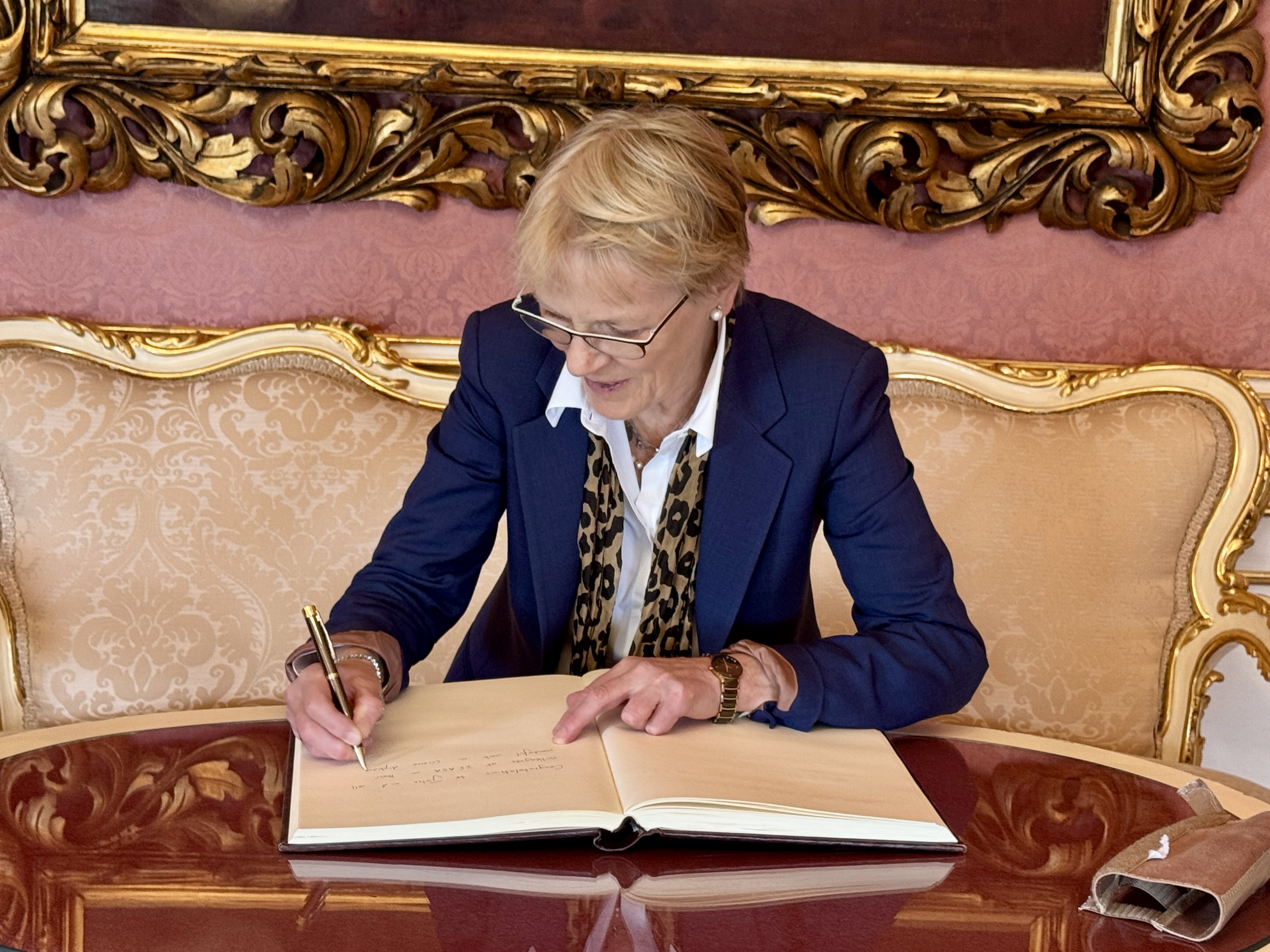
During her visit, Dame Julie was treated to a tour of the historic Schloss Laxenburg where IIASA is headquartered and graciously signed the IIASA guest book. The meeting reaffirmed the shared commitment of IIASA and the Royal Society to advancing international collaboration and science-based solutions to global challenges.
IIASA looks forward to continuing and strengthening this important partnership in the years ahead.
 © IIASA
Dame Julie Maxton signing the IIASA visitors book.
News
15 October 2026
IIASA strengthens science diplomacy ties at UNGA in New York
IIASA Science Diplomacy Director and Head of Communications and External Relations Susie Kitchens represented the Institute at the United Nations General Assembly (UNGA) High-level Week and Science Summit in New York in September, contributing to discussions on how science and international cooperation can help address shared global challenges.

30 July 2026
The trillion-dollar question behind corporate net-zero pledges
Corporate climate spending now steers trillions of dollars in transition finance worldwide. Does it drive genuine climate action? Research shows that accounting flexibility alone can make a company's reported emissions vary by roughly a factor of two – enough to appear either as a climate leader or a laggard. A new Perspective in Nature Sustainability proposes developing industry-specific net-zero blueprints to close that gap.

28 April 2026
Susie Kitchens joins IIASA as Science Diplomacy Director and Head of Communications and External Relations
IIASA is pleased to announce that Susie Kitchens will join the Institute as Science Diplomacy Director and Head of Communications and External Relations in May 2026. In this senior leadership role, she will guide IIASA’s global engagement strategy, expand international partnerships, and enhance the Institute’s visibility and impact at the science-policy-society interface.