
In the 1980s, IIASA researchers asked what cutting military budgets and redirecting these funds to agriculture could do for the world's food supply. Today, researchers at the Institute are asking the reverse question: what would happen to the world’s food if nuclear weapons were used? A folder of working papers from 40 years ago highlights some striking connections between these two questions.
Every IIASA working paper from the mid-1980s carries the same warning: NOT FOR QUOTATION WITHOUT PERMISSION OF THE AUTHOR. Under that heading, IIASA researcher Vladimir Iakimets was developing models to explore the links between military spending, agriculture, and global food security.
Four decades later, a team led by Senior IIASA Research Scholar, Christian Folberth, is studying those links from a different direction. Their project, Advanced ensemble projections for indirect impacts of nuclear conflict in global food systems – or ANFOS for short – brings together global crop modelers to project the potential impacts of different levels of nuclear winter on crop production, combining these projections with scenarios of supply-chain disruption.
An early modeling challenge
Iakimets came to Laxenburg from Moscow in 1980 as a participant in the Young Scientists Summer Program (YSSP). IIASA had been founded less than a decade earlier as a place where scientists from across political divides could work together on shared global challenges.
His first IIASA paper addressed a problem that remains familiar to modelers today: how do you select a manageable number of scenarios that still represent a much larger range of possibilities?
He worked on this question inside IIASA's former Food and Agriculture Program (FAP), which was developing the Basic Linked System – 34 national and regional models connected through a simulated world market. Much like today’s Global Gridded Crop Model Intercomparison (GGCMI), it brought multiple models together to explore global food-system questions.
On MARS
Iakimets's contribution to that system included a scenario family he called MARS – Mutual Arms Reduction Scenarios. What would happen, he asked, if countries shifted some of their military spending into their civil economies and agricultural development abroad?
By 1987, the scenarios were running on the Basic Linked System, producing some counterintuitive results. One of the more interesting findings concerned rice. Under a scenario in which some of the savings went into an international aid fund, support went to countries that were themselves major rice producers and consumers. Their production increased, pushing down the world rice price. Some then increased both imports and exports, causing their self-sufficiency ratios to fall even as their calorie supply rose.
The unexpected result emerged from the interactions between the linked national models, demonstrating the value of looking at the global food system as a whole.
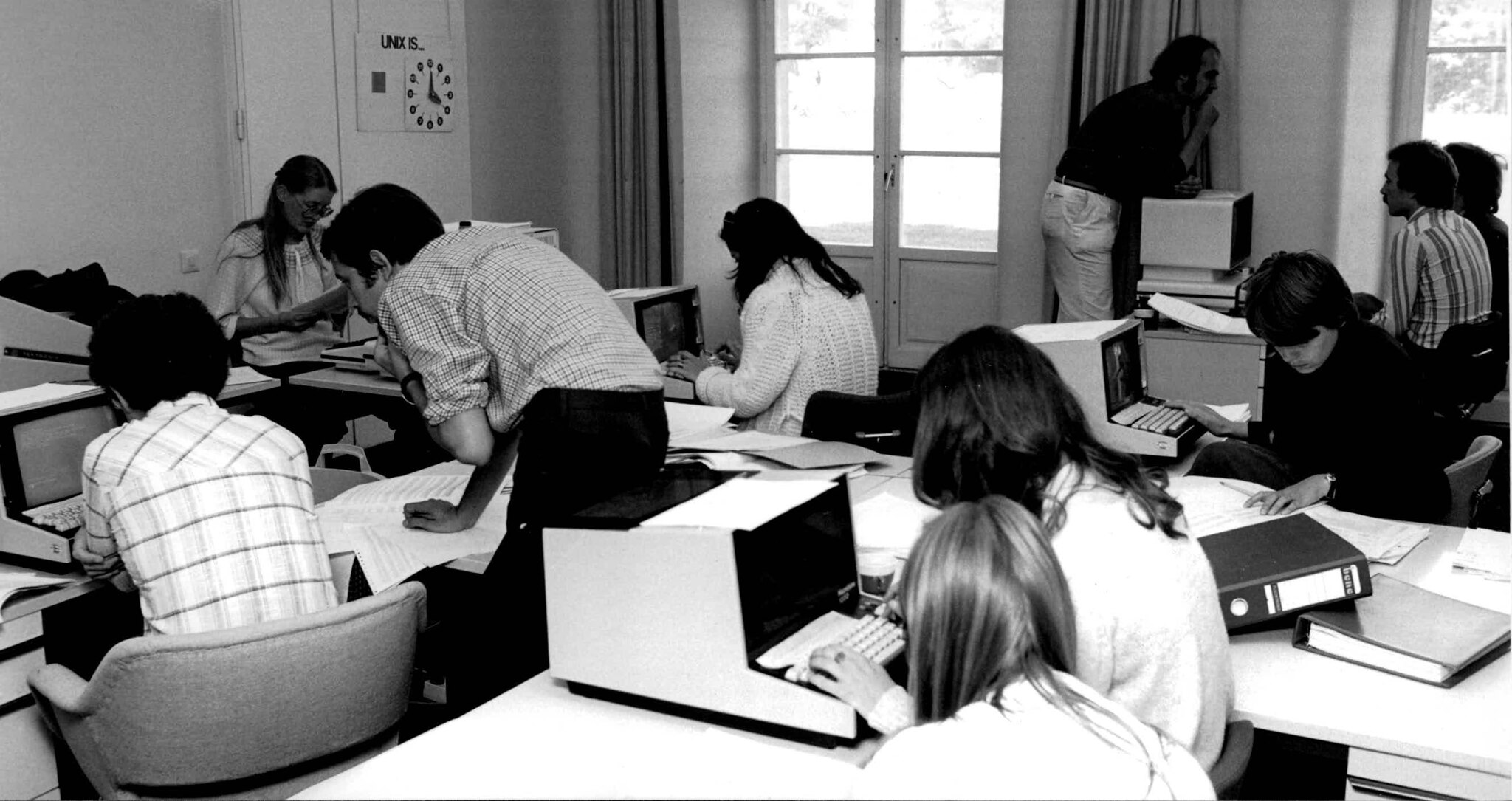 © IIASA
A throwback picture of the IIASA Information and Communication Technologies department
The nuclear winter connection
The papers also contain an interesting link to the question IIASA researchers are examining today. At the back of a 1985 MARS design paper, among references to FAO reports and UN studies of the arms race, is a paper on the long-term biological consequences of nuclear war published in Science. In the same issue of that journal, immediately before it, appeared the landmark paper that introduced the idea of “nuclear winter”.
MARS itself was not a nuclear-winter project, but these questions were already beginning to intersect decades before the ANFOS project started.
From MARS to ANFOS
Forty years later, both the question and the tools have changed.
MARS asked what could happen if countries reduced military spending and redirected the money elsewhere. The researchers involved in ANFOS are asking what happens to agriculture and food systems after nuclear weapons are used.
Advances in computing now allow the project to draw on multiple crop models, combining projections of nuclear-winter conditions from various climate models with different assumptions about adaptation and disruptions to agricultural production and supply chains. This allows researchers to explore a much wider range of possible outcomes and uncertainties than was possible in the 1980s.
Looking ahead
The questions the ANFOS project is addressing are receiving renewed international attention. In December 2024, the UN General Assembly established the United Nations Scientific Panel on the Effects of Nuclear War, which is due to report in 2027 on the physical and societal consequences of nuclear war at local, regional, and planetary scales. Against this backdrop, ANFOS is examining one important part of the bigger picture: what nuclear conflict could mean for global food production and food security.
The political landscape may have changed since the 1980s, but IIASA continues to provide a neutral space where scientists from different countries can work together on global challenges that cross national and political boundaries. Across both generations of research, one lesson remains: systems thinking matters. A shock in one part of the global food system can have consequences elsewhere that are difficult to anticipate.
The academic papers that inspired this article are now available in IIASA's open repository. As modeling tools become more powerful, they can help researchers explore not only the consequences of nuclear conflict that are expected to be tremendous even for regional confined conflicts, but they can also provide insights on choices and responses that could make global food systems more resilient to disruptions.
FURTHER INFORMATION
ANFOS is led by Christian Folberth at IIASA, funded by the Future of Life Institute, and runs from June 2024 to December 2027. It works with the Global Gridded Crop Model Intercomparison ensemble to project crop production under a range of nuclear winter intensities, together with the supply-chain disruptions - energy, fertilizer, food, and labor. Project page: https://iiasa.ac.at/projects/anfos
The archival documents discussed here are held in the IIASA PURE repository under the report numbers given below.
REFERENCES
[1] Iakimets, V. (1985). Mutual Arms Reduction Scenario (MARS) for the FAP's Study "Hunger, Growth and Equity". IIASA Working Paper WP-85-082.
[2] Iakimets, V. (1985). MARS: Describing Dynamics of Military Expenditures Reduction. IIASA Working Paper WP-85-061.
[3] Iakimets, V. (1985). MARS 1 and MARS 2 for the FAP's Study "Hunger, Growtр and Equity". IIASA Working Paper WP-85-083.
[4] Iakimets, V. (1987). Illustrative Examples of Simulation Findings of the MARS (Mutual Arms Reduction Scenarios). IIASA Working Paper WP-87-073.
[5] Ehrlich, P.R., et al. (1983). Long-term biological consequences of nuclear war. Science 222, 1293-1300.
[6] Turco, R.P., Toon, O.B., Ackerman, T.P., Pollack, J.B. & Sagan, C. (1983). Nuclear winter: Global consequences of multiple nuclear explosions. Science 222(4630), 1283-1292.
[7] Fedorov, V. & Iakimets, V. (1985). Outline of the SOVAM. IIASA Working Paper WP-85-057.
[8] Iakimets, V. & Lebedev, V. (1985). Revised Version of the SOVAM. IIASA Working Paper WP-85-066.
[9] Iakimets, V. (1986). Adjustment of regional agriculture to expected climatic changes. In: Maunder, A. & Renborg, U. (eds.), Agriculture in a Turbulent World Economy. Proceedings of the 19th International Conference of Agricultural Economists, Málaga, 26 August-4 September 1985. Gower, pp. 160-169.
[10] Fischer, G., Frohberg, K., Keyzer, M.A., Parikh, K.S. & Tims, W. (1991). Hunger: Beyond the Reach of the Invisible Hand. IIASA Research Report RR-91-015.
[11] Iakimets, V. (1981). Investigation of the Morphological Space of Systems Variants. IIASA Professional Paper PP-81-010. See also: Iakimets, V. & Reneau, D.R. (1982). Methods for Generating Preferable Technology Activities for a LP Model. IIASA Working Paper WP-82-105.
[12] Jägermeyr, J., Robock, A., Elliott, J., Müller, C., Xia, L., Khabarov, N., Folberth, C., et al. (2020). A regional nuclear conflict would compromise global food security. PNAS 117, 7071-7081.
[13] Shah, M.M., Fischer, G., Higgins, G.M., Kassam, A.H. & Naiken, L. (1985). People, Land and Food Production - Potentials in the Developing World. IIASA Collaborative Paper CP-85-011. https://pure.iiasa.ac.at/id/eprint/2737/
[14] United Nations. (n.d.). Repertory of practice of United Nations organs: Supplement No. 5 (1970–1978), Volume II, Article 23: The Security Council. https://legal.un.org/repertory/art23/english/rep_supp5_vol2_art23.pdf
[15] Müller, C., Elliott, J., Kelly, D., Arneth, A., Balkovič, J., Ciais, P., Deryng, D., Folberth, C., et al. (2019). The Global Gridded Crop Model Intercomparison phase 1 simulation dataset. Scientific Data 6, 50.
[16] United Nations. Scientific Panel on the Effects of Nuclear War. Established by General Assembly resolution A/RES/79/238 of December 24, 2024; due to report to the eighty-second session in 2027. https://disarmament.unoda.org/en/panel-effects-nuclear-war/home
[17] Iakimets, V. & Kiselev, V. (1985). First Version of the SOVAM. IIASA Working Paper WP-85-060
Note: This article gives the view of the author, and not the position of the IIASA Insights blog, nor of the International Institute for Applied Systems Analysis.