
IIASA researcher Felicity Addo reflects on how a simple holiday home to Ghana unfolded into a journey of teaching, learning, and building connections that highlight Africa's potential for science-driven transformation.
I have always believed Africa does not need charity; it needs equitable partnerships, genuine collaboration, and mutual respect in the pursuit of global solutions. Science and research can be powerful tools for diplomacy, bridge-building, and transformation.
When I first planned my trip back to Ghana, I imagined five quiet weeks of holiday. Time to rest, reconnect with family, and enjoy being home again. But as often happens, one idea grew into another, and soon my holiday unfolded into something unexpected: a journey of learning, teaching, and personal reflection.
Before traveling, I reconnected with my former university, specifically the Department of Agricultural Economics and Agribusiness at the University of Ghana, where I had completed my bachelor's degree. I shared my desire to organise a seminar and hands-on training sessions on systems analysis and modelling, and the department head, Dr. Yaw Osei-Asare, responded with genuine enthusiasm. That exchange set the tone for the rest of the trip.
From holiday to high-level conversations
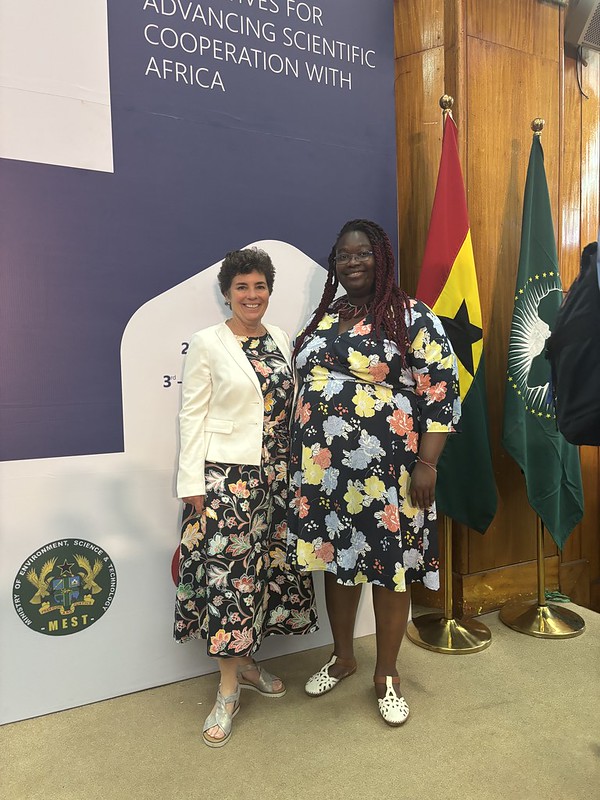
Soon after arriving, I was invited to accompany IIASA Deputy Director General Dr. Karen Lips to "Unpacking the Pact for the Future," a high-level gathering of presidents, ministers, policymakers, scholars, stakeholders and ARISE fellows of the African Academy of Sciences. Sitting in that room, I felt both humbled and inspired. Leaders emphasized the importance of research and evidence in guiding Africa's path forward, often pledging to support and increase investments in research. What struck me most throughout these high-level discussions was the power of connection: between science and policy, as well as between researchers and real-world decision-makers.
 © IIASA
IIASA Deputy Director General Karen Lips with IIASA researcher Felicity Addo.
Learning, teaching and engaging with scholars
Equally rewarding were my university engagements. At the University of Ghana, Karen and I met with the Pro-Vice Chancellor and the Director of the Research and Innovation Directorate. Together, we explored ways to collaborate, share experiences, and make research funding more accessible.
I conducted a hands-on seminar on systems analysis and food systems modeling. Faculty and postgraduate students enthusiastically explored IIASA's FABLE Calculator and scenario explorer tools, created research questions, and experimented with modelling techniques. One lesson stood out: hybrid setups are not effective for this type of training.
At the University for Development Studies, Department of Agribusiness, I led a seminar on systems analysis as a modelling approach for global challenges. I was very grateful for Dr. Edinam Setsiofia's invitation. Together with the participants, we further discussed research collaborations, challenges under limited funding, reproducibility, and ways to make student-collected field and primary data more accessible. The energy and passion in the room reminded me again that African scholars are eager not just to learn, but to shape global science.
Conversations that stayed with me
Throughout the trip, I had conversations that left a lasting impression. Meeting Dr. Frederick Ato Ammah from the African Association of Universities (AAU) was one of those moments where I saw how AAU is working to create networks and mobility opportunities for African scholars vital to reducing brain drain and strengthening Africa's collective scientific voice.
And then there were the quieter moments. Meeting Ghanaian alumni of IIASA's YSSP Program, hearing how they were progressing in their careers, reminded me that science is not just about data or models; it is also about people, their journeys, and the connections that make knowledge grow.
Key takeaways
Looking back, a few lessons stand out:
- Science must be accessible. Tools and models should be usable and understandable beyond a small circle of experts.
- Knowledge transfer matters. Open access to data and models does not guarantee their effective use. Without guidance, they remain underutilised. True impact comes when knowledge and resources are shared hand in hand.
- Networks create strength. Building connections across institutions and borders is as vital as the research itself. As we learn from each other's experiences and strengths, we empower each other to confront challenges collectively.
- Science and policy must meet. Evidence should inform decisions, and decisions must be grounded in evidence.
A continent of possibility
What I carried home most strongly is a sense of possibility. Africa is often described in terms of its challenges, but I saw something different: a young, ambitious population eager to shape the future. Whether in food systems, energy, climate, or health, the potential is enormous.
Yes, most African countries still invest less than 2% of GDP into research. Yet despite this, the determination of the scholars and students I met gaives me hope. From artificial intelligence to food security, from public health to climate systems, there is no shortage of challenges – but t there is also no shortage of innovative minds eager to tackle them.
But what strengthens my resolve is the energy, passion, and resilience of the people I met – students, faculty, policymakers, and fellow scholars. Their determination to shape Africa's future through knowledge, research, and collaboration is undeniable.
Closing reflections
My time in Ghana reminded me that while challenges remain, the opportunities far outweigh them. It reinforced a belief I hold deeply: when science is accessible, collaborative, and rooted in context, it becomes a force not just for discovery, but for lasting change.
What began as a holiday became something deeper—a journey of reconnection. I reconnected with my roots, with fellow scholars, with leaders and students, and most of all, with the idea that science is about building bridges. Ultimately, what remains with me is simple: science fosters connections, and those connections have the power to shape Africa's future.
Note: This article gives the views of the author, and not the position of the Nexus blog, nor of the International Institute for Applied Systems Analysis.