



The EU and China play a vital role in achieving global climate neutrality due to their large greenhouse gas (GHG) emissions, economic power, influence on international trade, and strong competitive position in low-carbon technology industries. Yet, both regions face tremendous challenges in how to achieve their climate targets.
The overarching objective of EU-CHINA BRIDGE is to support the transition to a climate-neutral and resilient society in Europe and China by jointly advancing knowledge on technology innovations and roadmaps for decarbonising EIIs, co-developing innovative modelling (combining cutting-edge bottom-up and IAM modelling) to derive net-zero sustainable pathways, and developing the most updated and comprehensive emissions data by the EU and Chinese experts. It will intensively engage relevant stakeholders from both regions, enhancing dialogues and fostering mutual learning among relevant stakeholders and experts.
 © IIASA
Logo from EU-CHINA BRIDGE project
Summary
The EU and China play a vital role in achieving global climate neutrality due to their large greenhouse gas (GHG) emissions, economic power, influence on international trade, and strong competitive position in low-carbon technology industries. Yet, both regions face tremendous challenges in how to achieve their climate targets. Although technological breakthrough solutions and deployment strategies are on the rise, large emitters such as energy-intensive industries (EII) like steel and chemicals, are often still considered hard to abate and simultaneously, critical economic growth engines. While various technology options exist for decarbonising EIIs, they are usually under-represented in the integrated assessment models (IAMs) used to explore decarbonisation pathways. Additionally, datasets of previous emissions often contain considerable inconsistencies and uncertainties, creating obstacles to designing effective mitigation policies.
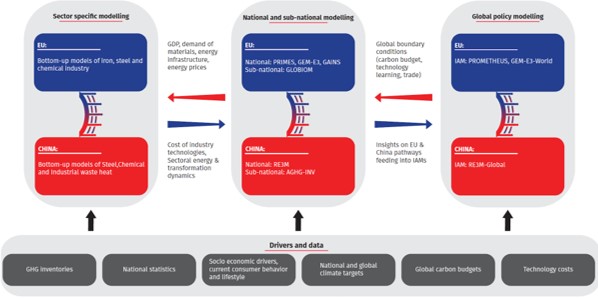
Given this complexity, relying on a single model or discipline to design emission mitigation pathways would be insufficient and potentially biased. An integrated modeling framework is a comprehensive approach that combines various models from different disciplines to simulate and analyze the interactions between environmental, economic, and social systems. These models often incorporate aspects of climate science, economics, energy systems, land use, and policy analysis, enabling a multi-dimensional view of potential emission mitigation strategies. By integrating these diverse perspectives, the framework can provide a more accurate and nuanced understanding of the potential impacts of different policy measures, technological innovations, and behavioral changes. Moreover, integrated modeling frameworks can help to bridge the gap between scientific research and policy development. By translating complex scientific data into practical actions, these frameworks can contribute to designing policies that are both grounded in evidence and aligned with climate change mitigation goals.
 © IIASA
Project Consortium
The EU-CHINA BRIDGE project consists of 16 leading universities, research institutes, companies and networks in energy, climate change and policy modelling, circularity research, and overall sustainable development:
- WI - Wuppertal Institut Fuer Klima, Umwelt, Energie gGmbH (Coordinator)
- WSP - Global engineering and professional services consulting firm
- IIASA - International Institute for Applied Systems Analysis
- UoB - University of Birmingham
- ICCS - Institute of Communication and Computer Systems
- HOLISTIC
- ITE - University of Kassel
- THU-SA - Tsinghua University
- THU-CE - Department of Chemical Engineering, Tsinghua University
- THU-DESS - Department of Earth System Science, Tsinghua University
- RUC - Renmin University of China
- SDU - Shandong University
- CHINACOAL - China National Coal Group Corporation
- BITARIM - Advanced Research Institute of Multidisciplinary Sciences, Beijing Institute of Technology
- FULONG - Inner Mongolia Fulong Heating Engineering Technology
- BIT-ME - School of Mechanical Engineering, Beijing Institute of Technology
 © Marc Bruxelle | Dreamstime
Funded by the European Union.
Views and opinions expressed are however those of the author(s) only and do not necessarily reflect those of the European Union. Neither the European Union nor the granting authority can be held responsible for them.