



The European Green Deal aims, among others, to increase the contribution of EU agriculture to climate change action, improve the management of natural resources, ensure a fair economic return for farmers, and reinforce the protection of biodiversity. EU agriculture and food practices are currently not on the right track to meet the Green Deal ambitions and objectives. These objectives are interdependent, and while often aligned, they may also compete. Synergies and trade-offs between socio-economic and environmental outcomes are brought together in the concept of a Safe and Just Operating Space (SJOS), where the Safe component reflects the bio-physical boundaries of the ecosystem and the Just component the requirements for the well-being of the people involved. Policy makers and opinion leaders often lack sufficient information to gauge the likely effects of a SJOS crises in their country. The ambition and overarching objective of BrightSpace is to address this challenge by designing effective and sustainable strategies to navigate within a SJOS.
BrightSpace provides an analytical toolbox to experiment, analyse, and coordinate the effects of innovative technologies, governance structures, as well as short- and long-term policies related to agriculture, thereby allowing for the execution of consistent, coherent, and lasting strategies with the desired consequences.
The project emphasises the diversity of challenges regarding the SJOS across countries and regions and delivers new empirical evidence on cause-effect relations between drivers and outcomes relevant for the SJOS.
A harmonised data framework and modelling toolbox are developed for medium-term and forward-looking projections of possible SJOS futures by 2050 and beyond.
The support for effective and sustainable actions will include the identification of critical pathways for technological, institutional and consumer-oriented options for EU policies in the areas of agriculture, climate change, trade, and energy.
Planned outcomes
- Boost EU and Associated Countries analytical and modelling capacity in agriculture in both biophysical and socio-economic domains.
- Develop an analytical and policy framework and timeframe for the European farming sector to operate within the safe and just operating space and planetary boundaries and achieving EU climate change policy objectives.
- Analyse policies and develop policy recommendations for agricultural policies in Europe in 2030.
 © IIASA
IIASA’s contribution
IIASA brings its expertise with agricultural and environmental research and data collection, building agricultural models at different scales, and its knowledge on operationalization of the SJOS indicators and its determinants in EU agriculture into this project.
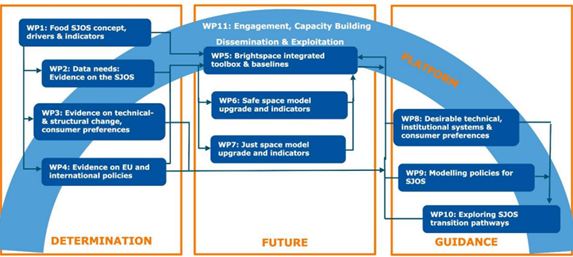
IIASA leads WP9, exploring the impact of planned EU policies on safe and just outcomes, and the potential of innovative policies to narrow the gap to the SJOS. To this end models will be continuously update and EU policies covering a broad number of food systems domains (CAP, climate, biodiversity and bioenergy policies, food and health policies, trade policies) will be assessed. Novel policy options to bridge the gap between targeted and achieved safe and just outcomes, with a focus on trade-offs and synergies will be co-designed and tested.
Besides leading this work package, IIASA contributes to many more tasks and deliverables in the project.
 © BrightSpace
Consortium
The consortium includes partners from the private and public sector representing: (a) academia and higher education (CZU, UBO, UCSC, UOXF, WU); (b) SME dealing with research consultancy, data collection, development (EuroCARE). Another SME has also a strong track record in the field of communication, stakeholder engagement and exploitation (PLAB); (c) public government bodies dealing with agricultural and environmental research and data collection, and building agricultural models at different scales (WR, CITA, IIASA, Thünen, INRAE, PBL, TC CAS).
- Stichting Wageningen Research (WR)
- Thünen Institute
- Institut National de Recherche Pour L’agriculture, L’alimentation et L’environnement (INRAE)
- Rheinische Friedrich-Wilhelms-Universität Bonn (UBO)
- Università Cattolica Del Sacro Cuore (UCSC)
- European Centre for Agricultural, Regional and Environmental Policy Research (EuroCARE)
- Planbureau voor de Leefomgeving (PBL)
- Centro de Investigación y Tecnología Agroalimentaria (CITA)
- Technology Centre Prague (TC Praha)
- Czech University of Life Sciences Prague (ČZU)
- Planslab KFT (PLAB)
- Wageningen University (WU)
- Joint Research Centr (JRC)
- University of Oxford (UOXF)
 © European Union
Funded by the European Union. Horizon Europe Grant Agreement No 101060075.
Views and opinions expressed are however those of the authors only and do not necessarily reflect those of the European Union or the European Commission. Neither the European Union nor the granting authority can be held responsible for them.
News

Annual Report 2025
Annual Report 2025: Advancing Global Partnerships Highlights
Throughout 2025, IIASA expanded its international cooperation through new agreements, research initiatives, and high-level exchanges focused on sustainability, climate action, and systems science.