



The BioFlex project explores how photovoltaics, wind, bioenergy, and the natural fluctuations they bring, shape the resilience and flexibility needs of future energy systems. As climate change increases the frequency of extreme events, BioFlex targets modelers interested in a comprehensive and coherent analysis of the future resilience and flexibility needs in the energy system. Led by a consortium including IIASA's AFE Group, TU Wien, and BOKU, the project provides new frameworks and tools to bridge gaps between energy system flexibility and infrastructure resilience.
Research goals
- Define a set of requirements for modelling resilience and flexibilisation concepts
- Test proprietary tools to identify their capabilities and limitations
- Formulate a guide for advancements in research, development, and innovation
Traditional power system models often overlook extreme events, focusing only on predictable fluctuations. Resilience research, on the other hand, deals mainly with disaster prevention and emergency response. BioFlex brings these worlds together, creating a common foundation for infrastructure planning that accounts for both routine variability and rare, high-impact events.
Methodology
BioFlex defines flexibility as the ability to move resources through time, space, and between sectors.
The project expands the traditional scope of flexibility by integrating resilience measures, like redundancy and system hardening. It also considers risks such as detrimental cascading effects, which may occur if flexibility is poorly managed.
BioFlex uses:
- MEDEA (BOKU): Electricity market modeling
- BeWhere (IIASA): Bioenergy supply chain optimization
This combination allows the team to assess cross-sector flexibility at the interface between electricity and bioenergy.
System Integration & Sector Coupling inducing flexibility
The BioFlex project provides key impulses for energy policy steering toward robust climate neutrality. A particularly relevant insight for decision-makers is that existing planning tools systematically overestimate the resilience of the energy system—especially in the face of climate-related extreme events, disasters, and geopolitical crises. The proposed field of System Integration Impact Assessment (SIIA) opens up new possibilities: it enables forward-looking, cross-sectoral planning that not only realizes efficiency gains but also makes risks visible at an early stage. BioFlex demonstrates that a robust energy future requires not only technological innovation but also a politically coordinated, realistic planning culture that places synergies and integration risks at the center of its considerations. Reliability and the robustness of sustainable development progress must become a political planning premise—not a corrective afterthought.
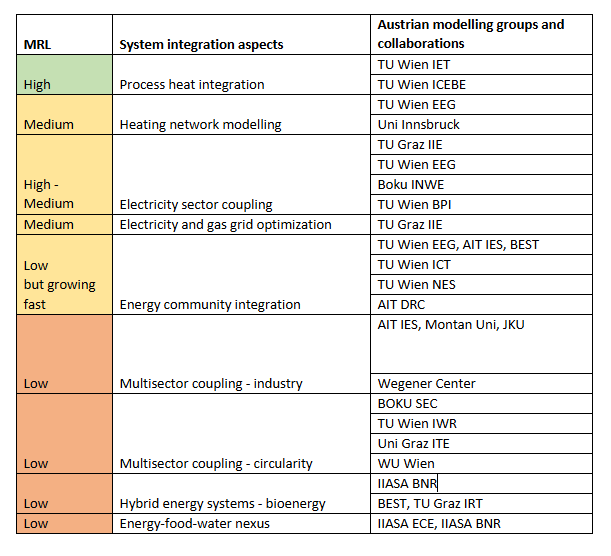
The Austrian research landscape offers plenty of expertise on different aspects of System Integration. However, respective modelling practices exhibit different Modelling Readiness Levels (MRLs) for addressing the synergies, trade-offs, and threats emerging from integration itself.
Table 1 Modelling Readiness Levels (MRLs) of different system integration aspects based on the case study of the Austrian energy system modelling community. Source: own evaluation – major revision publication pending
 © Schipfer | IIASA
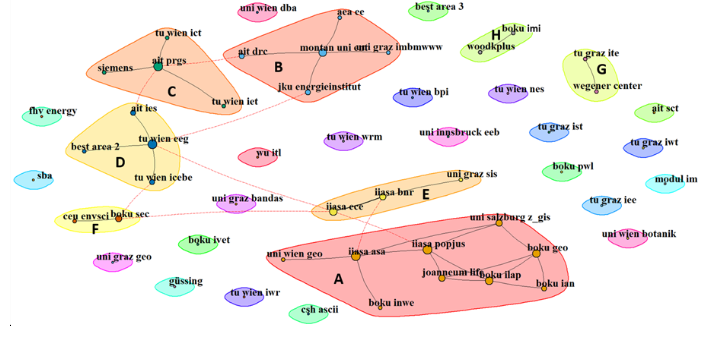
A collaboration database to close respective research gaps in Austria based on over 1,000 scientific publications and including 125 analyzed authors from 56 research groups, is available for free download along with a preprint of the scientific publication → https://doi.org/10.5281/zenodo.15276174
Figure 2: Co-authorship network of Austrian research groups relevant to integrated energy system modelling.
Source: own illustration using the R Bibliometrix package – major revision publication pending
 © Schipfer | IIASA