




Improving Monitoring for Better Integrated Climate and Biodiversity Approaches, Using Environmental and Earth Observations
The BioClima EU-China Horizon Europe project, aims to improve biodiversity and climate monitoring by integrating AI with ground-based and remote sensing data systems. AI-driven tools will analyze vast environmental datasets, enhancing the tracking of Essential Biodiversity (EBVs) and Climate Variables (ECVs). By integrating AI with traditional data methods, BioClima aims to refine models and analytical pipelines, and to promote innovative solutions for biodiversity conservation and climate action. The innovative approaches and models developed by the project for ecosystem restoration will serve as valuable inputs for regional and national climate adaptation strategies.
The key objectives of BioClima EU-China are:
Develop Integrated Observational Systems - to establish advanced integrated monitoring systems for climate and biodiversity monitoring that combine in situ observations (including citizen science and professional networks), remote sensing data (satellite, UAVs), and environmental datasets to provide comprehensive, geographically explicit insights into terrestrial ecosystems in the EU and China.
Advance Data Fusion and Analytical Modelling - to develop sophisticated data models and analytical pipelines that enable seamless fusion of diverse data streams, including climate, land use, and biodiversity datasets, to support predictive modelling, ecological risk assessment, and decision-making. Use of traditional methods as well as innovative AI/ML methods are foreseen.
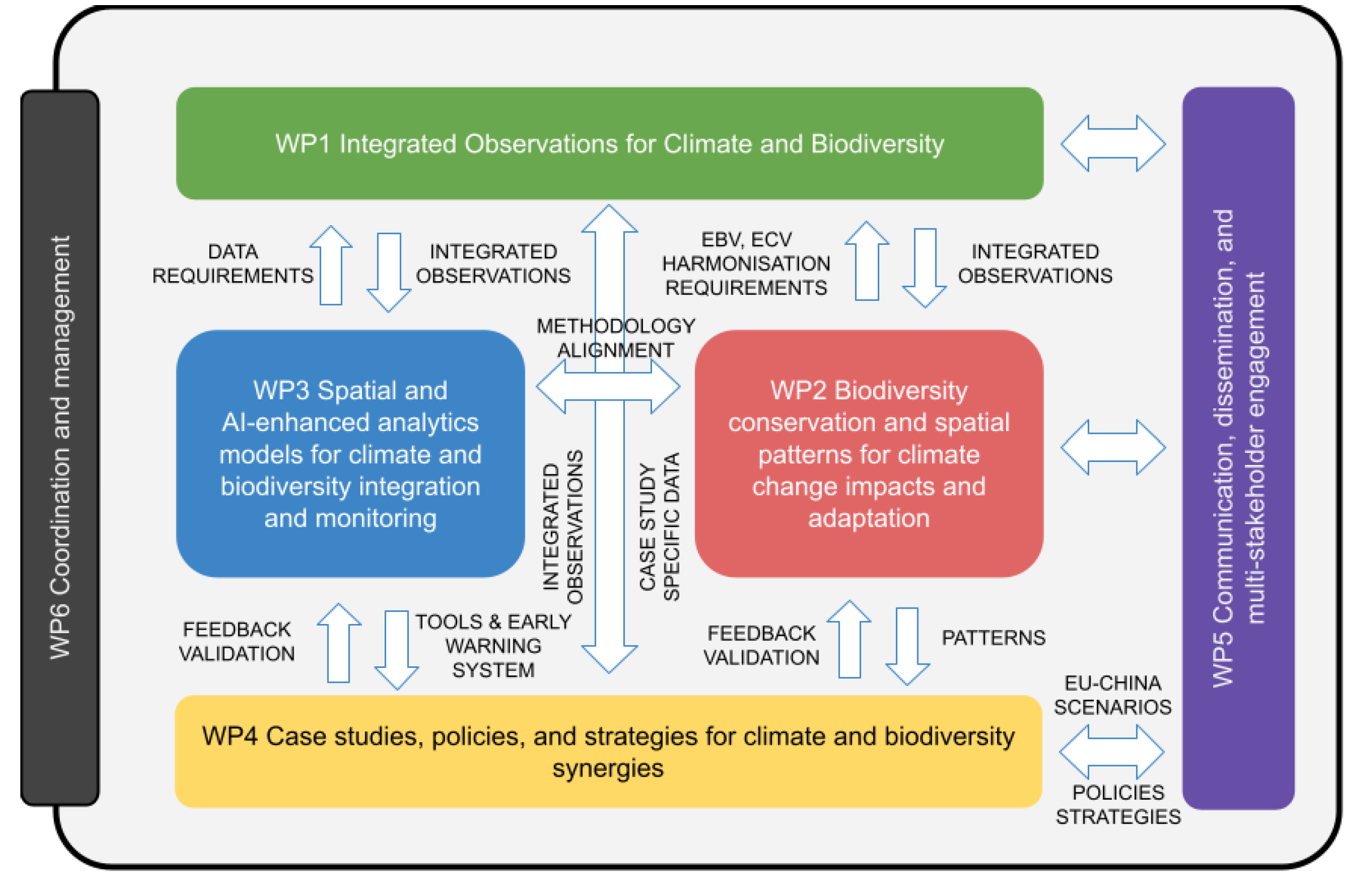 © BioClima EU-China
The project is separated into five working packages. The figure shows the linkages among these work packages.
Enhance Biodiversity and Climate Change Monitoring via Spatial Patterns - to improve the monitoring of biodiversity and climate change impacts through the development and application of Essential Biodiversity Variables (EBVs) and Essential Climate Variables (ECVs), focusing on vulnerable ecosystems such as forests and grasslands. Assess the impact of climate change on biodiversity and explore the synergies and trade-offs between biodiversity conservation and climate mitigation through detailed comparative case studies in both the EU and China.
Support Policy and Decision-Making and Upscale from Local to Global – execute and evaluate use cases to demonstrate synergies between climate and biodiversity monitoring, and upscale them to European scale. To provide scientific insights and evidence-based recommendations to support policy-making and the implementation of integrated climate and biodiversity strategies at national and international levels.
Strengthen International Cooperation, Sustainability, and Capacity Building - strengthen EU-China collaboration in environmental research through joint knowledge exchange and innovation. Utilize the China-EU Research and Innovation Flagship Program to create a digital cooperation platform within BioClima, advancing biodiversity and climate research in line with global initiatives (GEO, UNFCCC, CBD). Develop a strategy for international communication, dissemination, and sustainable use of project results, including education and capacity-building for stakeholders, policymakers, and scientists.
Four IIASA research groups are involved in the BioClima EU-China project, each leading or being involved in different tasks:
The role of Novel Data Ecosystems for Sustainability (NODES):
WP1 focuses on data integration, ensuring seamless fusion of in situ observations, citizen science data, and remote sensing data to monitor forest biomass changes. A key component will be the development of a Geo-Wiki-based crowdsourcing tool, enabling citizen scientists and local experts to attribute biomass changes to specific drivers, such as harvesting, insects and diseases, drought, wind, but also reforestation, afforestation, forest growth etc. This collaborative effort aims to generate maps depicting the drivers of changes, which will contribute to WP3 for impact analysis and WP4 for experimentation, strengthening cross-regional insights between Europe and China.
The role of Agriculture, Forestry, and Ecosystem Services (AFE):
AFE is taking a critical role in the project by leading WP4 focusing on integrating climate mitigation and biodiversity conservation strategies at the EU scale. AFE’s researchers will work on advancing IIASA’s sectoral models (EPIC, G4M, FLAM) and projecting the impacts of various scenarios on ecosystem services, which will be key in understanding the trade-offs and synergies between these two important goals. AFE will also coordinate activities in an Austrian case study.
The role of Biodiversity, Ecology, and Conservation (BEC):
BEC will develop a pollination model that will estimate the amount of pollination service and their impact on yields of crops fully or partially dependent on insect pollination. BEC will also provide a synthesis of key actionable evidence from this project that could be of relevance for the implementation of specific targets of the EU FF5 package, EU Biodiversity Strategy and several other EU policies and strategies.
The role of Integrated Biosphere Futures (IBF):
IBF focuses on the integrated modeling of climate mitigation and biodiversity conservation actions. In particular, various scenarios will be simulated in the GLOBIOM/G4M modelling suite to assess how climate and biodiversity strategies can be prioritized and implemented under various future environmental conditions. IBF will also quantify the contribution of the AFOLU sector to climate mitigation and biodiversity conservation targets.
The BioClima EU-China Consortium brings together 16 partner institutions:
Funding statement:
Call: HORIZON-CL6-2024-CLIMATE-01-7 - EU-China international cooperation on improving monitoring for better integrated climate and biodiversity approaches, using environmental and Earth observation.