


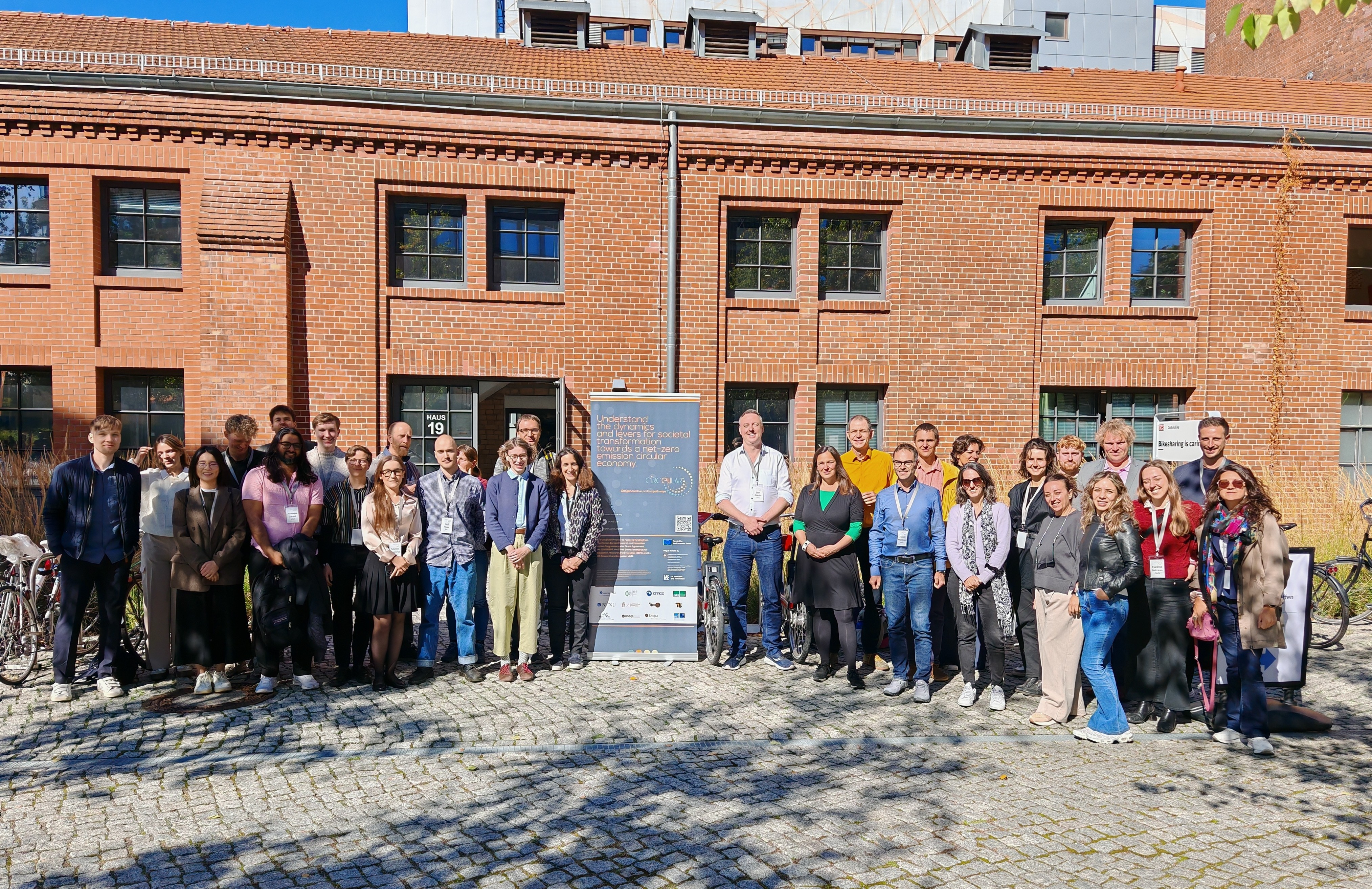
The CircEUlar consortium convened in Berlin – at the Potsdam Institute for Climate Impact Research (PIK) – from 22 to 24 September for a three-day project meeting. The event was not only an opportunity to review progress and share research, but also to hold stakeholder workshops connecting the project team with external experts and policy actors.
 © Source: circeular.org
Day 1: Pathways and Scenario Planning
The meeting opened on Monday, 22 September with a welcome lunch and introductions led by Felix Creutzig (PIK) and Volker Krey (IIASA). The initial sessions explored the integration of pathways and sensitivity analyses, with lively discussions among all modeling teams. An introduction to the Scenario Explorer infrastructure, which provides a roadmap for collaborative data reporting and outreach, was also done (more to follow on this soon).
Breakout groups then examined key research areas, from model comparison of material stocks and flows to the Circular ReBoundary online tool, as well as thematic sessions on Buildings, Mobility, and Digitalization. These discussions laid the groundwork for harmonizing data, improving model integration and defining future research priorities.
Day 2: Technical Insights and Stakeholder Engagement
The morning of Tuesday, 23 September saw several parallel working sessions covering the technical focal underpinnings of the CircEUlar modelling work, including rolling stock integration, exploration of emissions and energy intensity, and strategies for narrowing resource use in buildings. Later, the project partners also discussed further model integration and how to translate case study results into scenario modelling.
The afternoon was dedicated to two Stakeholder Events. One entitled “Towards Net-Zero through a Circular Economy. Pathways to circularity for the built environment: how do we get there?”, bringing external planning policy experts into the conversation. Participants were introduced to the emerging findings on circular consumption practices, with a particular focus on the German case study, and engaged in participatory backcasting across key circular housing and mobility visions for the future. The other Expert Workshop was on “Towards Net-Zero through a Circular Economy: Artificial Intelligence for low-carbon Urban Planning (AI4UP)”. An intimate gathering of mainly German and Swiss actors who discussed challenges and opportunities for data usage, geospatial analysis and AI applications in urban planning. Informal networking with drinks and nibbles rounded off the day.
Day 3: Integrating Insights and Shaping Policy
The final day focused on integrating survey results and stakeholder input into the modelling work. Discussions also addressed our plans for policy dialogue and recommendations, setting the stage for upcoming deliverables and the next phase of collaboration. The meeting concluded with report-backs from all groups and a wrap-up session, confirming a shared roadmap for future work. By structuring the agenda around breakout groups and collaborative working sessions, we were able to delve deeper into integrating different work streams and activities in smaller working groups ensuring richer, more cohesive and consolidated future deliverables.
Alongside the formal project meeting, partners also enjoyed opportunities to network informally, including a group dinner and a cultural outing to the Busan Philharmonic Orchestra at the Berliner Philharmoniker.
Adapted from a news item shared on the CircEUlar website.
News

16 October 2026
Getting back on track to reduce methane emissions
A new study, led by IIASA researchers and coauthored by UNEP colleagues, finds that if governments fully implement their methane reduction plans, they could reduce global emissions by 11% between 2020 and 2030. This would reverse the current trend of increasing methane emissions, but would not be sufficient to achieve the goal of the Global Methane Pledge.
06 October 2026
Nanjing University delegation visits IIASA to explore future collaboration
A high-level delegation from Nanjing University (NJU), led by Professor Tan Zhemin, President of NJU and Fellow of the Chinese Academy of Sciences, visited IIASA to discuss opportunities for strengthening scientific cooperation and advancing joint research on global challenges.

21 September 2026
Fairness informs how the world cuts emissions
Who cuts emissions fastest, and who supports others do so, are central questions in global climate action. New IIASA-led research shows that building fairness into climate models from the start can inform deliberations without changing the overall climate goal.