



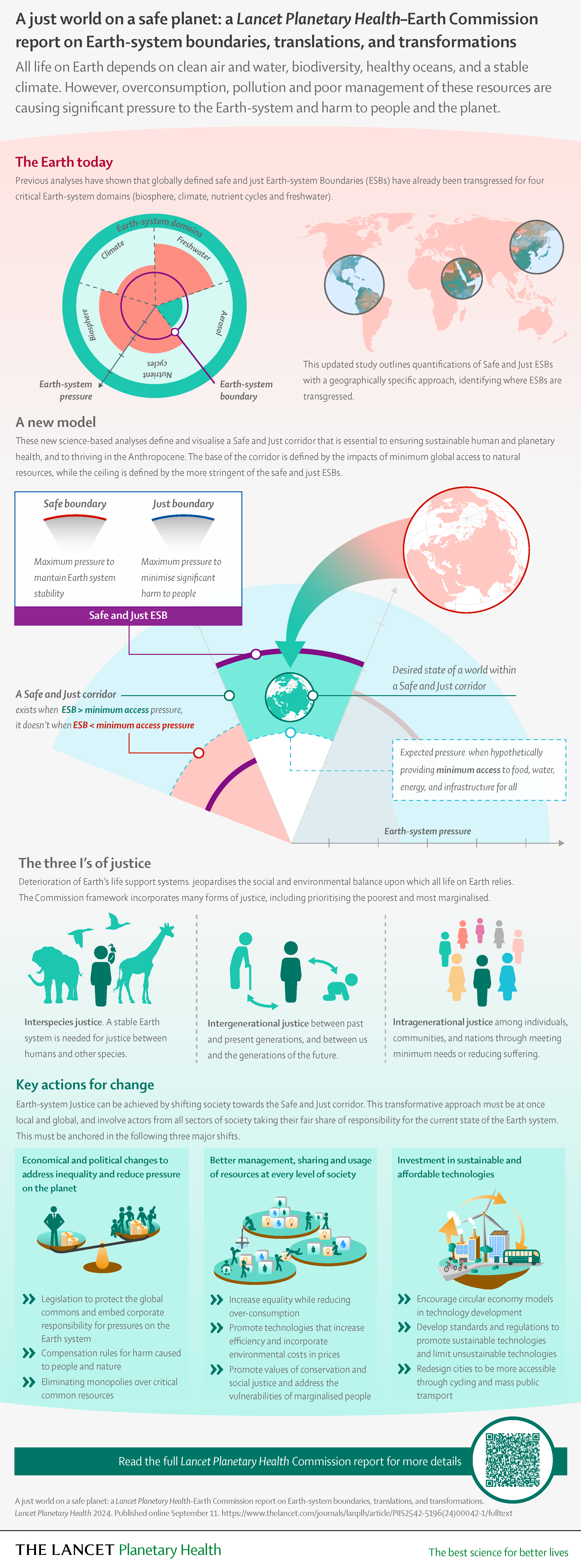
IIASA researchers contributed to a new study showing that to sustain even a basic standard of living for everyone, we need to dramatically change our economic systems and technologies. The research highlights the need to fairly manage, use, and share critical resources to ensure both people and the planet can thrive.
More than 60 scientists from the Earth Commission, an international science group hosted by Future Earth and of which IIASA is a member, contributed to the study. The work builds on previous research, which showed that many of the Earth’s essential limits necessary for the planet to remain stable and for people to live safely – the so-called Earth System Boundaries – have already been exceeded.
In this latest study, the researchers focused on the concept of the Safe and Just Space, which refers to the balance where human needs can be met without harming the environment or over-extracting resources. The new work includes the addition of a “foundation” showing us what the global population needs from the Earth system to live a life free from poverty. This is the first time scientists have quantified safety (a stable planet) and justice (people being protected from harm) in the same units - demonstrating that justice is a prerequisite for the safety of the planet and people.
The authors warn that this Safe and Just Space is shrinking and that without urgent changes, there might not be enough space left within Earth’s limits by 2050 for everyone to have even basic resources like food, water, and energy.
“Earth's systems are in danger of crossing tipping points, causing further harm unless significant transformations are made to our energy, food, and urban systems,” explains IIASA researcher Caroline Zimm, one of the study authors.
The study highlights that inequality and the overconsumption of resources by a small portion of the global population are major drivers of this shrinking space and that poorer communities that already face the greatest harm from climate change, biodiversity loss, and pollution, are most at risk. No one is, however, safe from the consequences of continued damage to the Earth's systems. Even the wealthy, who might initially feel less impact, are vulnerable in the long run as environmental systems that support life and economies begin to collapse.
“We’re beginning to realize the damage that inequality is doing to the Earth. Increasing pollution and poor management of natural resources is causing significant harm to people and nature. The longer we continue to widen the gap between those who have too much and those who don’t have enough, the more extreme the consequences for all, as the support systems that underpin our way of life, our markets, and our economies begin to collapse,” notes study lead author Joyeeta Gupta, former co-chair of the Earth Commission, and Professor of Environment and Development in the Global South at the University of Amsterdam.
To prevent further harm and ensure a stable future, the authors call for urgent action in three key areas:
- Economy and society: governments, businesses, and communities need to work together to create policies that reduce inequality while lowering the pressure on the planet.
- Resource management: resources need to be shared more fairly and efficiently.
- Sustainable technologies: we need more investment in sustainable technologies that use fewer resources and reopen the shrinking Safe and Just Space.
These changes will require major shifts in how societies, businesses, and economies operate, but the authors emphasize that the knowledge and tools to make these transformations already exist.
“Cities and businesses are especially well-positioned to lead these efforts as they have the flexibility to lead the transformation toward positive tipping in human systems to avoid negative tipping of the Earth system. By setting science-based targets and focusing on improving efficiency and sufficiency in the use of planetary resources and Earth-systems services, they can play a key role in achieving a safe and just future for all,” says study coauthor and IIASA Distinguished Emeritus Research Scholar, Nebojsa Nakicenovic.
The authors conclude that the only path to a sustainable and fair future lies in reducing inequality and transforming how we use the Earth's resources and that if we act now, it is still possible to ensure that everyone on the planet escapes poverty and is protected from harm caused by environmental changes. The window for action is however closing fast.
Reference
Gupta, J., Bai, X., Liverman, D.M., Rockström, J., Qin, D., Stewart-Koster, B., Rocha, J.C., Jacobson, L., et al. (2024). A just world on a safe planet: a Lancet Planetary Health–Earth Commission report on Earth-system boundaries, translations, and transformations. The Lancet Planetary Health DOI: 10.1016/S2542-5196(24)00042-1
 © Earth Commission
News
18 November 2026
New report: Climate overshoot could cause lasting, irreversible harm to northern forests
Wildland fires in the circumboreal forest are becoming more frequent and severe, and in many areas may soon exceed what these ecosystems can recover from. A new report launched at COP this week warns that some of the resulting damage could persist for decades or centuries, even if global temperatures later decline. As global warming is set to exceed 1.5°C global warming, the report calls for urgent action to strengthen the resilience of this vast ecosystem.
17 November 2026
Spotlight on Simon Kay
Former Deputy Head of Unit at the European Commission's Directorate-General for Climate Action (DG CLIMA), Simon Kay, has joined IIASA as a Guest Senior Research Scholar in the Integrated Biosphere Futures (IBF) Research Group of the Biodiversity and Natural Resources Program from October 2026 to September 2027. We want to take this opportunity to share his journey to IIASA, as well as to highlight the unique expertise he brings to the Institute.
16 November 2026
Exploring Real Zero: Flagship climate science research initiative to be established at IIASA
The Minderoo Foundation has committed A$9 million in seed funding to establish the Real Zero Hub and support Exploring Real Zero, a flagship climate science research initiative based at IIASA. The initiative will bring together world-leading researchers, policymakers, and institutions to develop practical, science-based pathways to eliminate fossil fuel emissions, better understand the impacts of climate change, and support governments to transition away from fossil fuels.