
IIASA Director General, Hans Joachim (John) Schellnhuber joined leading scientists, Nobel laureates, and international science leaders at the Pontifical Academy of Sciences in Vatican City towards the end of September to explore how science can help address humanity's most pressing challenges.
Held under the theme, The Future of Science in a Changing World, the plenary session brought together distinguished experts to discuss the future of scientific discovery and its role in shaping a sustainable and equitable world. Discussions spanned artificial intelligence, physics, medicine, biodiversity, and climate change, with particular emphasis on interdisciplinary cooperation, scientific integrity, and ethical responsibility.
Schellnhuber, who is also a lifetime member of the Pontifical Academy of Sciences, delivered a presentation titled, The future of climate change and tipping points, during a session on Earth Sciences and the Future of the Planet. His contribution highlighted the risks of potentially irreversible changes in the Earth system and the urgent need for science-informed action.
Among the prominent participants were Demis Hassabis, co-founder and CEO of Google DeepMind; Emmanuelle Charpentier, of the Max Planck Unit for the Science of Pathogens; Steven Chu, Nobel laureate and professor at Stanford University; Fabiola Gianotti, former Director-General of CERN; and Svante Pääbo, Nobel laureate and scientist at the Max Planck Institute for Evolutionary Anthropology. Other distinguished participants included Jeremy Farrar, Assistant Director-General at the World Health Organization, and Tshilidzi Marwala, Rector of the United Nations University.
The program also included an audience with Pope Leo XIV, highlighting the importance of dialogue between scientific progress, ethical responsibility, and global leadership.
The discussions resonated strongly with IIASA's mission to advance interdisciplinary systems analysis and foster international scientific cooperation. As interconnected challenges increasingly transcend national and disciplinary boundaries, science diplomacy plays a key role in building trust, bridging divides, and translating scientific evidence into collective action.
"Humanity's future will be shaped not only by what science discovers, but by what we choose to do with that knowledge. We need a new era of global cooperation in which science transcends borders, bridges divides, and helps chart a course towards a thriving planet. This is the ambition that drives IIASA and makes science diplomacy more essential than ever," said Schellnhuber.
The Vatican gathering reaffirmed the importance of science as a unifying force and the need for institutions like IIASA to connect knowledge, policy, and international cooperation in pursuit of a sustainable future.
Visit the website of the Pontifical Academy of Sciences for further information on the event.
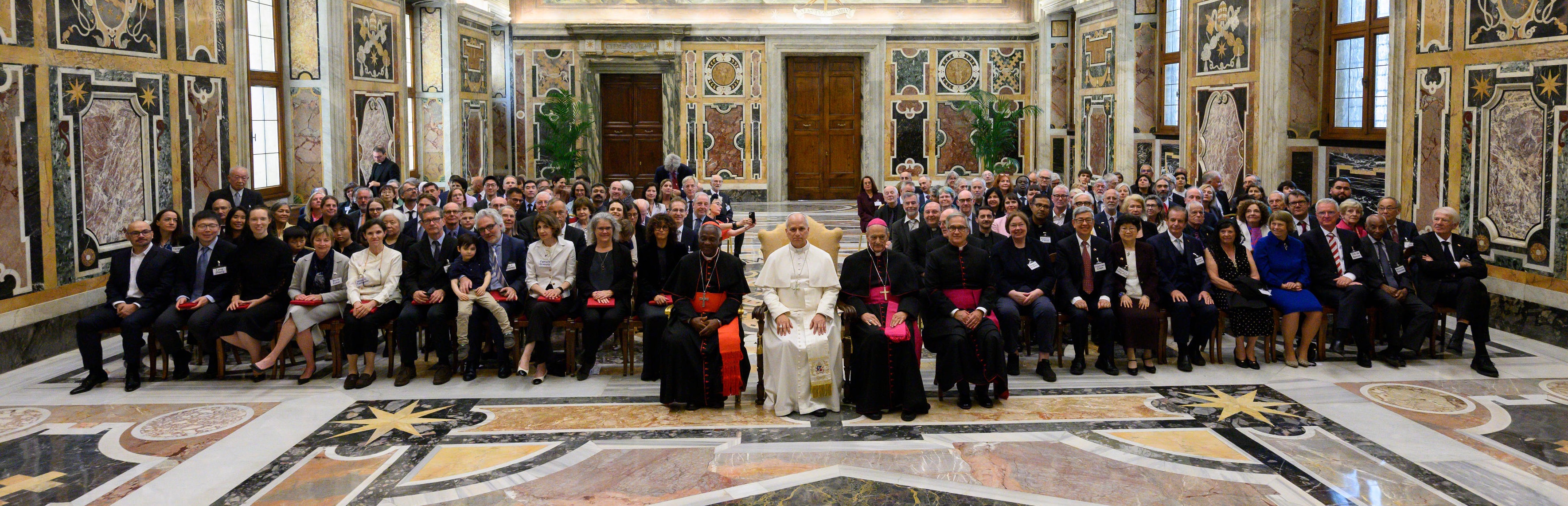 © Vatican media
Group photo of participants at the plenary, The Future of Science in a Changing World
News
09 December 2025
Expanding horizons for scientific engagement in Italy
On 3 December 2025, H.E. Ambassador Giovanni Pugliese and Scientific Counselor Amedeo Staiano of the Italian Embassy in Austria visited IIASA for discussions on strengthening scientific engagement between Italy and the Institute.

14 February 2025
Strengthening citizen science and sustainability monitoring in Europe
Researchers from the IIASA Novel Data Ecosystems for Sustainability (NODES) Research Group are part of the newly launched RIECS-Concept (Towards A Pan-European Research Infrastructure for Excellent Citizen Science), a project designed to develop a conceptual framework for a pan-European citizen science research infrastructure. The initiative aims to enhance the role of citizen science in data collection, validation, and policy engagement, ensuring long-term sustainability and broader participation in scientific research across Europe.

13 February 2023
French and Italian ambassadors visit IIASA
H.E. Gilles Pécout, Ambassador of the French Republic to the Republic of Austria, and H.E. Stefano Beltrame, Ambassador of the Italian Republic to the Republic of Austria, recently paid a joint visit to IIASA to meet with the institute’s leadership and discuss possible research collaboration between their countries and IIASA.